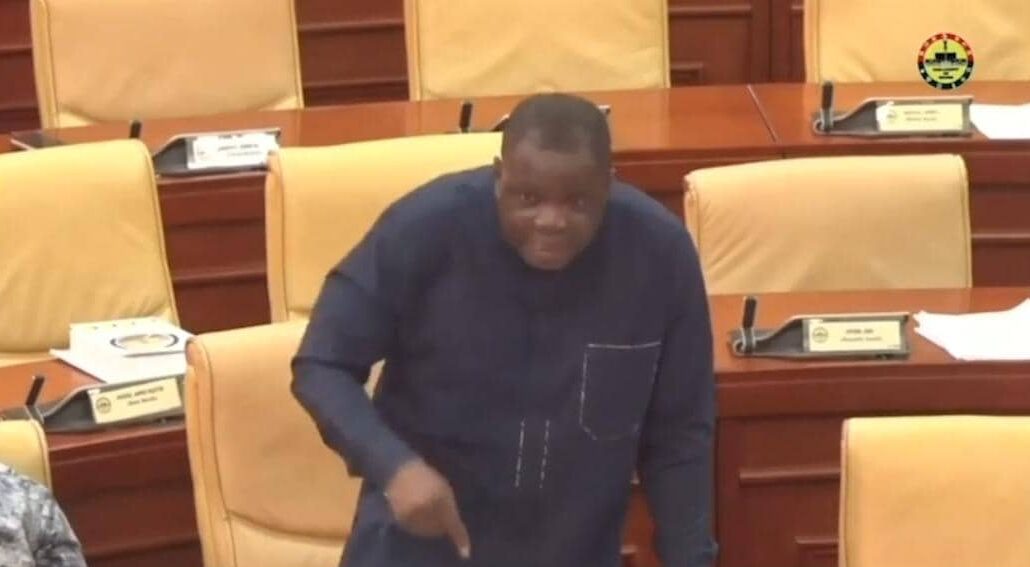

The Minister for Roads and Highways, Governs Kwame Agbodza has briefed Parliament on government’s Big Push infrastructure programme.
This follows media reports that the project is being implemented through sole sourcing and without the required transparency for a public funded intitaive.
Read full speech by Mr Agbodza to Parliament.
UPDATE ON THE BIG PUSH INFRASTRUCTURE PROGRAMME BY HON. KWAME GOVERNS AGBODZA, MINISTER FOR ROADS AND HIGHWAYS – 24TH MARCH, 2026.
1. Rt. Hon. Speaker, Honourable Members of this august House, I present you an update on President Mahama’s flagship Infrastructure Development Programme, “The Big Push”.
2. Mr. Speaker may recall that President Mahama dedicated the first two years of the Big Push Programme to address the unprecedented deplorable state of our road network.
3. Through the Big Push Infrastructure Programme, launched in 2025, the Government is investing heavily in repairing critical roads, upgrading key economic corridors, creating jobs, and reducing the cost of doing business across all 16 regions.
4. The programme places strong emphasis on Ghanaian contractors and workers, helping to strengthen local technical expertise in the construction sector.
5. Mr. Speaker, the Big Push programme has received strong support from Parliament so far. This House has approved nearly GHS 50 billion for these multi-year road and bridge projects. We appreciate the support from leadership and members of this
house.
6. As I speak, over 2000km of roads in all 16 regions of our country are undergoing extensive transformation.
7. Mr. Speaker, in times past, we have all been concerned by the state of our roads, mindful of the amount of monies invested.
8. In the spirit of probity, accountability and transparency, we encouraged the public to remain engaged in monitoring the projects in their localities and we always appreciate their
constructive feedback.
9. Mr. Speaker, recently an online platform requested for details about on-going Road Projects and same was willingly and promptly provided to them.
10. I am grateful for the opportunity to update Parliament on the status of implementation of the Big Push Infrastructure Programme.
11. Mr. Speaker, no Ministry is subjected to as much consistent scrutiny as the Ministry of Roads and Highways.
12. On average, about ten questions are filed weekly covering a wide range of issues—from contract awards to project costs and timelines. The Ministry also regularly gets invitations from Committees of Parliament to respond to developments within the sector.
13. Mr. Speaker, I welcome the scrutiny. It strengthens accountability and ensures that we remain aligned with the expectations of the Ghanaian people.
14. I wish to assure this House that I take the responsibility entrusted to me with the utmost seriousness, and I remain fully committed to delivering on our mandate with integrity, transparency, and efficiency.
15. Mr. Speaker, prior to the 2024 elections, it was clear that majority of Ghanaian were not happy with the deplorable and dangerous nature of the country’s road network.
16. They made it a condition that when given the mandate, the government of President Mahama should take urgent and immediate steps to improve the country’s road network.
17. This has been justifiably followed by consistent questions of timeliness by members of this house as to when the roads in their constituencies will be improved.
18. Mr. Speaker, this is a house of records! Let me state unequivocally that all contracts awarded under the programme were done in strict adherence to the Public Procurement Act and its accompanying regulations.
19. Mr. Speaker, all contractual information is publicly available and on the Ministry’s website.
20. The Big Push Roads were identified as 12 major economic corridors across the country which were christened the “12 disciples”. These projects were broken into 54 lots to foster
competition and speed up implementation.
21. Mr. Speaker, additionally, 23 road projects valued at GHS14.88 billon which were awarded by the previous administration and abandoned by contractors due to lack of dedicated funding were absorbed as part Big Push. These projects were novated with a new funding source.
• Design and Construction of Suame Interchange and Ancillary Works Component – Phase 1
• Design and Construction of Suame Interchange- Local Roads Component – Phase 2
• Takoradi – Agona Rehabilitation and Dualization of Takoradi – Agona Junction Road (23km) Including 2No. Dual Carriageway Bridges
• Rehabilitation of Tepa (Mabang) – Goaso Road (39.0km)
• Reconstruction of Jinijini – Sampa Road Project (80km)
• Rehabilitation and Upgrading of Kasoa Winneba Road (30km)
Lot 1: Rehabilitation and Upgrading of Kasoa – Akoti Road
(Km 0+000 – Km 12+000
• Rehabilitation and Upgrading of Kasoa – Winneba Road (30.Km) – Lot 2A: Construction of Interchanges at Km 15+900 (Onion Market); Km 18+900 (Potsin); Twin River Bridge at
Km 22+900 (Okyereko); and 3No. Footbridges.
• Rehabilitation and Upgrading of Kasoa – Winneba Road (30.Km) – Lot 2: Rehabilitation and Upgrading of Akoti Junction – Winneba Roundabout (Km 12.00 – 30.00)
• Rehabilitation and Upgrading of Kasoa – Winneba Road (30.0km) – Lot 1A: Construction of Interchanges at Sapato (Km 1+800), Buduburam (Km 3+200) Awutu Breku (Km
7+200), Akoti (Km 9+800) and 2No.
Footbridges
• Rehabilitation of Ofankor – Nsawam Road (Dual Carriageway) 33.0km
• Design Build for the Dualization of Adenta Dodowa Road (R40) – 22km
• Upgrading of Nkwanta – Oti Damanko (50.3km – 62km)
• Upgrading of Nkwanta – Oti Damanko (0-50.3km)
• Upgrading of Tumu – Sissili – Navrongo Road (Km 0 – 15)
• Upgrading of Tumu – Chuchuliga – Navrongo (km 15-47) including construction of 36m span reinforced concrete bridge over Kanyibie River and 24m span reinforced concrete bridge over bechelihu river. – 32.6km
• Partial Reconstruction of Navrongo Chuchuliga – Tumu Road;
(34.23km) Including Partial Reconstruction of Navrongo
Chuchuliga – Sandema Road (16km)
• Upgrading of Tumu – Han – Lawra Road (Km 45 – 70)
• Upgrading of Tumu – Han – Lawra Road (Km 30 – 45)
• Upgrading of Tumu – Han – Lawra Road (Km 10 – 30)
•
• Upgrading of Tumu – Han – Lawra Road (Km 0 – 10)
• Construction of National Route N18 – Wa – Han Road (Km 54 -76)
• Rehabilitation of Hohoe – Jasikan 30km
• Reconstruction of Have – Hohoe Road (53km)
22. Mr. Speaker, it is globally acceptable to use sole sourcing even in situations where there is the need to extend the implementation of works which were previously competitively
procured to speed up completion. Even the above 23 projects were not previously procured competitively.
23. Mr. Speaker, given the scale, urgency, and national importance of these projects, a mix of procurement methods were employed in accordance with law.
24. Mr. Speaker, it is important to note that, only 44 percent of all the major contracts, including Big Push contracts, awarded by this Ministry under President Mahama, were procured through sole sourcing.
25. We have also awarded over 400 contracts through open competitive tendering.
26. It will therefore be mischievous for any right-thinking member of society to conclude that the Ministry of Roads and Highways only procure works through sole sourcing.
27. Mr. Speaker, I have already mentioned the deplorable state of the road network across the country we inherited from the previous administration. This had brought untold hardship to the motoring public and contributed massively to food inflation. This led to public agitation threatening the survival of the state.
28. Mr. Speaker, something needed to be done and done urgently.
29. Mr. Speaker, with dedicated funding already secured under the Big Push Programme, was both prudent and necessary to proceed swiftly to ensure value for money and avoid cost overruns associated with prolonged procurement and implementation timelines.
30. Mr. Speaker, most of the projects would not have started till date if we had not adopted the faster, more efficient route.
31. Mr. Speaker, the following projects, for example, would have remained stalled or not commenced:
a. Kasoa – Winneba Road
b. Winneba Interchange
c. Dualization of Winneba – Cape Coast
d. Suame Interchange and Local Roads
e. Kumasi Outer Ring
f. Ofankor – Nsawam Road
32. Mr. Speaker, we put in place the following mechanisms to ensure value for money in terms of cost, quality and longevity:
a. Contrary to the practice under the previous regime, under the Big Push, our agencies did their own survey, design and costing, saving billions of Ghana Cedis.
b. Contractors were then invited to submit proposals. Their proposals were then subjected to independent Value for Money assessments.
c. We have instituted stricter monitoring and cost control mechanisms to ensure we only pay for work done.
33. Mr. Speaker, we have now established a system where no contractor will walk away with a cedi without working for it.
34. We have also reached an understanding with the Ghana Institution of Surveyors to develop local capacity of their members to be licensed as independent VFM consultants.
35. Mr. Speaker, it is important to point out the deliberate falsehood that rely on simplified metrics such as “cost per kilometre” without considering the scope of the project.
36. Mr. Speaker, for the avoidance of doubt, under the reset leadership of President Mahama, road projects have not been unjustifiably suspended or terminated.
37. The huge unpaid debt of over GHS 40billion has received attention with over GHS 11 billion paid to retire arrears inherited from the previous administration. This is by far the single largest arrears clearance in a relatively short period in our history.
38. Mr. Speaker, Government has not abandoned the on-going Accra-Kumasi Bypass Project. Indeed, we complete one lot and took possession last year and the rest are being prepared for financing in the 2027 budget, if approved by Parliament. The unpaid arrears and cost to complete this project is estimated at GHS 6.0billion.
39. Mr. Speaker, let me state emphatically that when it comes to the Big Push Programme:
• Parliament exercises continuous oversight.
• Questions are answered regularly on the floor of this House.
• Independent professional bodies validated project costs.
• Procurement processes comply with established legal frameworks.
• There is no abuse of sole sourcing.
40. Unlike previously, it is the exception and not the norm. Indeed, no procurement law or any other law has been breached and definitely, there is no scandal here.
41. Mr. Speaker, the implementation of the Big Push is a departure from the previous situation where no commitment authorization was secured for projects procured in 2024 and the award of contracts did not go through any competitive bidding processes.
42. I call on this august house and the entire country to rally behind the transformative Big Push Programme and refuse to be used to bastardize it. Big Push is delivering the infrastructure we all want in all 16 regions.
43. Thank you, Mr. Speaker.