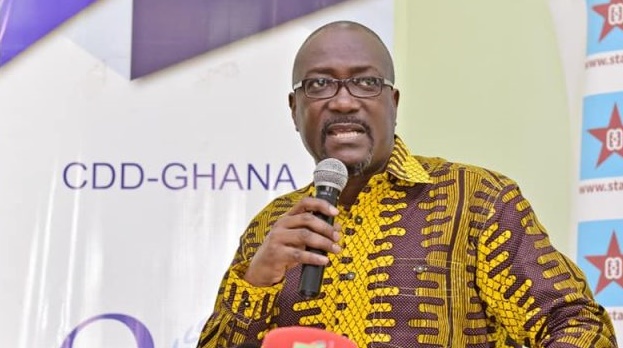

The Chairman of the Constitutional Review Committee, Professor H Kwasi Prempeh, has made a case for the Office of the Special Prosecutor (OSP) to be allowed to defend the suit that is challenging its powers to prosecute without the Attorney General’s authorisation.
He made the point that refusing to allow the OSP to defend this suit and, instead, allowing the Attorney-General to go to Court in the person of Deputy Attorney-General, Justice Srem Sai, in the position of nominal defendant, to advance a position in agreement with the Plaintiff’s, makes a mockery of Ghana’s adversarial system of justice.
In a Facebook post, he said “So the Supreme Court of Ghana will not allow the “real party in interest,” the OSP in this case, to defend against a lawsuit challenging the constitutionalitly of its statutory establishment and existence, but will allow the “nominal defendant”, the AG, whose position and interest in the suit is not adverse to that of the plaintiff, to file a purported defense that agrees with the position of the plaintiff.
“The Court is essentially privileging ‘form over substance’ and encouraging collusive suits or ‘sham cases,’ where, as in this case, the AG and the private plaintiff are, in both law and fact, on the same side of the matter. This is not how litigation or adjudication in the common law tradition is supposed to work: the two sides to the suit must have truly adverse interests and positions and, thus, the incentive to plead and advance their rival legal positions with genuine zealousness, enabling the Court, as impartial referee, to have the best possible legal arguments from both sides to inform and determine its final decision in the case.
“Refusing to allow the OSP to defend this suit by Plaintiff Noah E. Tetteh and, instead, allowing the AG to come to Court in the person of Deputy AG, Justice Sai, in the position of nominal defendant, to advance a position in agreement with the Plaintiff’s makes a mockery of our adversarial system of justice. Let the OSP defend this suit. The law is not an ass. Or maybe it is in.”
Background
The Office of the Attorney General (AG) has responded to a constitutional writ at the Supreme Court with arguments that seek to strike out portions of the Office of the Special Prosecutor (OSP) Act, 2017 (Act 959) that grant the OSP independent prosecutorial authority.
In an affidavit filed on Wednesday, 8th April 2026, in the case of Adamtey v. Attorney General, the state’s chief legal advisor argued that the current legal framework allowing the Special Prosecutor to initiate criminal proceedings without express authorisation of the Attorney General is a direct violation of the 1992 Constitution.
Article 88 of the Constitution, which vests all prosecutorial powers of the Republic in the Attorney General, is at the heart of the suit.
The AG contends that while the OSP was established to fight corruption, it cannot function as a “parallel state” with powers that bypass the constitutional oversight of the Attorney General.
The substantive case involves private citizen Noah Ephraem Tetteh Adamtey, who is challenging the constitutionality of Act 959, which governs the OSP’s independent operations.
The AG is specifically challenging sections of the Act that allow the OSP to prosecute cases of corruption without seeking a “fiat” or specific permission from his office.
“The power to prosecute is a constitutional monopoly held by the Attorney General,” the state’s filing suggests. “Any legislation that seeks to grant a separate entity the power to prosecute without being under the direct supervision and authorisation of the AG is, to that extent, unconstitutional and void.”
It would be recalled that on January 27, 2026, the Supreme Court of Ghana dismissed an application by the Office of the Special Prosecutor (OSP) to join the same constitutional lawsuit challenging the legality of its own powers.
The OSP sought to join the suit to defend its foundational mandate, but the Attorney General (AG) successfully opposed this request, arguing that the OSP was not a necessary party.
Every high-profile corruption case, from the unified petroleum embezzlement probe to the recent raids on fuel depots, would effectively be put on hold until the Special Prosecutor receives written authorisation from the AG’s office for each specific trial.
This would defang the OSP, turning it back into a subordinate department of the Ministry of Justice and potentially subjecting independent investigations to political interference.
Proponents of the OSP, including several civil society organisations, have long argued that the office’s primary value is its independence.
They maintain that the Special Prosecutor was designed specifically to handle cases involving “politically exposed persons” where the Attorney General, an appointee of the President, might face a conflict of interest.