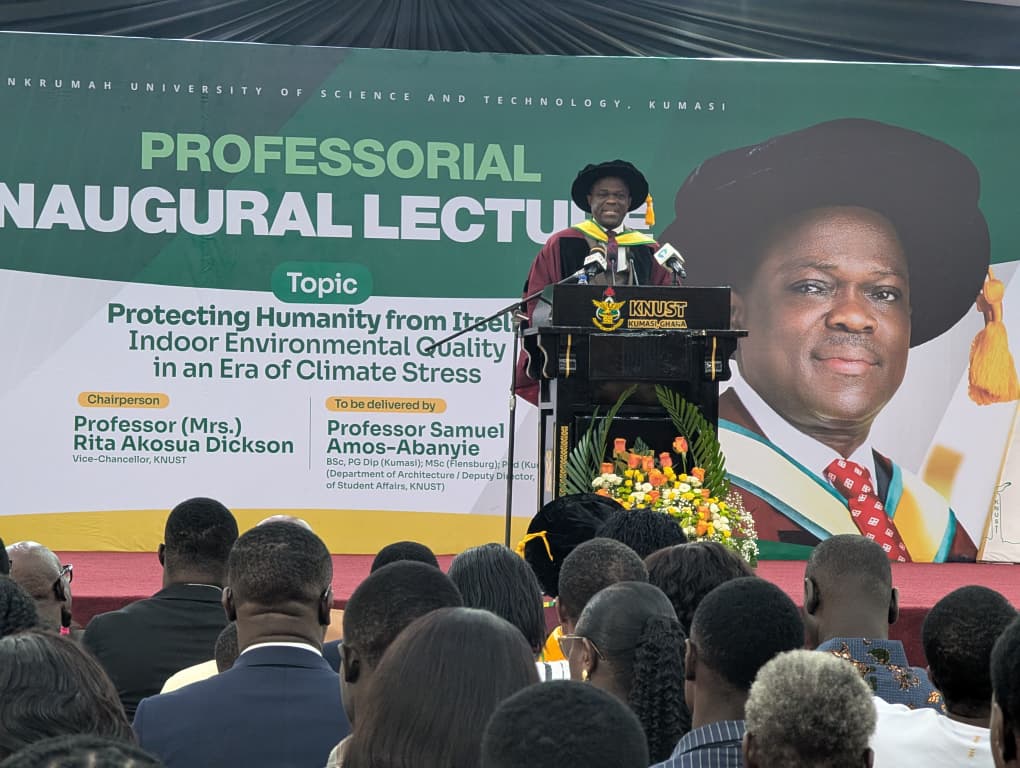

At a time when the world is battling climate change, a leading Ghanaian academic is warning that the real danger may be much closer than we think – inside our homes, offices, and classrooms.
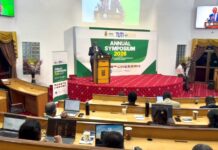
Delivering his professorial inaugural lecture at the Kwame Nkrumah University of Science and Technology, Professor Samuel Amos-Abanyie challenged conventional thinking with a bold assertion: “Humanity’s greatest risk may not come from nature but from the environments we create for ourselves.”
His lecture, titled “Protecting Humanity from Itself: Indoor Environmental Quality in an Era of Climate Stress,” painted a picture of how many Ghanaians are unknowingly living in unhealthy indoor environments.
“Buildings are not passive. They interact continuously with the human body and mind,” he stressed.
The Professor of Architecture at the Department of Architecture, College of Art and Built Environment at KNUST explained that poor Indoor Environmental Quality (IEQ) including inadequate ventilation, excessive heat, poor lighting, and noise pollution can contribute to illnesses, fatigue, and reduced productivity.
Even more concerning, he noted, is that people have adapted to these poor conditions.
“The most unsettling insight is not that conditions are poor, but that people accept them as normal.”
Citing global data from the World Meteorological Organization, Prof. Amos-Abanyie highlighted that 2024 was the hottest year on record, with temperatures continuing to rise.
For Ghana, the situation is even more alarming.
Research presented during the lecture shows the country is warming faster than the global average; driving increasing reliance on air conditioning which already consumes up to 80% of electricity in some buildings.
This, he warned, creates a dangerous cycle: “The more we cool our spaces artificially, the more energy we consume and the more we worsen the very problem we are trying to escape.”
The lecture also exposed everyday design contradictions in the built environment including windows meant for ventilation instead trap heat, concrete compounds replace greenery, increasing temperatures, building extensions block natural light and airflow, and noise pollution disrupts learning and productivity
In a striking analogy, the Professor who also serves as the KNUST Deputy Director at the Directorate of Students’ Affairs referenced a 1930 experiment where organisms given unlimited resources ultimately destroyed their own environment and died.
“Humanity risks approaching its own ‘petri dish’ moment,” he warned.
Despite the grim outlook, Prof. Amos-Abanyie offered practical, solution-driven recommendations. These include making energy efficiency a requirement for building permits, designing homes with future expansions in mind, integrating noise control into urban planning, establishing indoor environmental monitoring systems, and intensifying public education on healthy building practices.
He also urged individuals to take simple but impactful steps.
“Improve ventilation, allow natural light, and be mindful of the materials you bring into your spaces.”
Vice-Chancellor of KNUST, Professor Rita Akosua Dickson described the lecture as both “timely” and “necessary,” challenging society to rethink its relationship with the built environment.
“To what extent are we willing to sacrifice short-term comfort for long-term sustainability?” she asked.
As urbanization accelerates and climate pressures intensify, the spaces we inhabit are becoming critical to our survival.
Prof. Amos-Abanyie’s message was simple but urgent: “Healthy buildings are not a luxury. They are a necessity. And if humanity fails to act, the very environments designed to protect us may become the ones that harm us most.”
In a rapidly warming and urbanizing world, he concluded, the future of human health may depend not just on medicine but on how we design, build, and live within our spaces.
By Ibrahim Abubakar