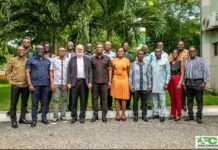

The Chief Executive Officer (CEO) of the Forestry Commission, Dr Hugh Brown, has reaffirmed the need for his outfit to be given paramilitary status.
He said this will help protect the country’s forest resources and guarantee the security of its field staff.
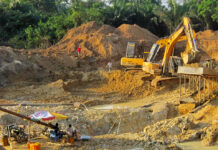
Mr Brown stressed that when the Commission is made a paramilitary entity and allowed to use advanced weapons, forest and resource guards would be more secure and empowered to clamp down on the activities of criminal elements such as illegal miners, poachers, illegal loggers, and illegal chainsaw operators, who are killing and maiming their field officers.
He made the appeal on Saturday, April 25,2026, at the burial service of one of the field officers at the Wildlife Division of the Forestry Commission, Raphael Ganyo, who was shot and killed by a poacher at the Kalakpa Resource Reserve in Ho in the Volta Region on January 6, 2026.
The 28-year-old Ganyo, who was employed by the Wildlife Division of the Forestry Commission on November 1, 2021, as a resource guard, was shot in the chest by a poacher while on patrol duty near the Zitoe Camp of the Reserve.
Until his death, Ganyo had served as a member of the Law Enforcement Unit and worked to rid the resource of criminal elements.
More killings
Ganyo’s death adds to the many field officers of the commission who have either been killed or brutally attacked by environmental criminals in the line of duty.
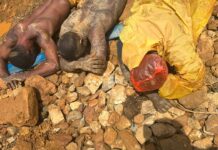
More than a dozen field officers of the Forestry Commission have been killed by illegal miners and other environmental criminals over the past eight years, with 57 others battling varying degrees of injury from brutal attacks.
While they navigate difficult operational challenges and logistical constraints to safeguard forest reserves, national parks and resource reserves, the forest guards have become easy targets for illegal miners, illegal chainsaw operators, and poachers who destroy the environment with wanton abandon.
Records from the Forestry Services Division (FSD) show that at least 10 of its officers have lost their lives in confrontations with illegal miners over the past eight years, while 34 others sustained life-threatening injuries from dastardly attacks by illegal miners.
Our checks at the Forestry Commission revealed that between 2017 and now, 23 staff from the Wildlife Division have either been killed or brutally maimed by poachers and illegal chainsaw operators.
Specifically, the statistics revealed that four resource guards were killed by poachers between 2017 and 2026, while 19 others were severely maimed, with some still battling for their lives.
For instance, on January 27, 2017, Stephen Osei Yaw of the Kogyae Strict Nature Reserve at Ejura in the Ashanti Region was shot and killed by a poacher.
Similarly, Thomas Kwaku Majam lost his life on March 21, 2018, when a poacher shot at him at the Mole National Park at Damongo in the Savannah Region.
Barely a year later, Matthew Nkuah died after he was shot while on a night operation at the Bia National Park at Sefwi Wiawso on April 3, 2019.
Further examination of the data provided by the Wildlife Division indicates that while resource guards sustained most of the life-threatening injuries through brutal attacks by poachers, others were attacked by elephants, with some also sustaining injuries through the explosion of chemicals used by illegal miners.
Nee for Urgency
Against this backdrop, Dr Brown reiterated the urgent need for the Commission to be granted paramilitary status to strengthen its operational capacity and safeguard its personnel.
He stressed that the current structure has left field officers exposed to increasingly violent encounters with heavily armed environmental criminals, particularly illegal miners and poachers, who operated with far more sophisticated weapons.
“The kind of arms and ammunition we are permitted to use do not match what we are confronted with in the field,” he said.
Dr Brown explained that the Commission remained constrained by existing regulations that required it to seek authorisation from the Ministry of Defence before accessing certain categories of weapons, a situation he described as limiting their effectiveness in high-risk operations.
Regulatory review, challenges
“We are taking steps to review the Forestry Commission Act, and that will pave the way for us to have the legal mandate to carry arms within the forest reserves and the wildlife parks, and be able to enforce law and order,” he stated.
Dr Brown further indicated that beyond weaponry, the Commission faces significant logistical and operational challenges, including inadequate patrol vehicles and motorbikes, and insufficient protective gear for personnel deployed in hostile environments.
He further disclosed that the Commission is grappling with a personnel deficit of about 2,400, a gap he said had stretched existing staff thin and increased their vulnerability during operations.
The CEO of the Forestry Commission maintained that granting them paramilitary status would not only allow access to advanced training but also ensure that officers are properly equipped to deal with the evolving nature of environmental crime.
“We believe that once we get this done and get the legal framework in place through the review, we should be in a better position to protect the nation’s precious natural resources,” he said.
Honours
In recognition of his service and sacrifice, the Forestry Commission posthumously promoted Raphael Ganyo to the rank of Chief Resource Guard, the highest level within that structure.
It also announced that the Zitoe Camp, where he was stationed before his death, would be renamed the Raphael Ganyo Camp, with the necessary formalities to be carried out to reflect the change.
As part of efforts to support the bereaved family, the Commission had committed to employing two members of the family within the Wildlife Division to replace the fallen guard.
In addition, a donation of GH¢50,000 had been made to the family, complementing other forms of support the Commission has extended since the incident occurred.
These interventions, Dr Brown indicated, underscored the Commission’s resolve to stand by the family while honouring the memory of fallen officers whose deaths highlight the risks associated with protecting the nation’s natural resources.
By Benjamin Aidoo