
President John Mahama has commiserated with victims of the flood that occurred in Accra on June 29.
He said the capital city is receiving increasingly higher volumes of rainfall every year.
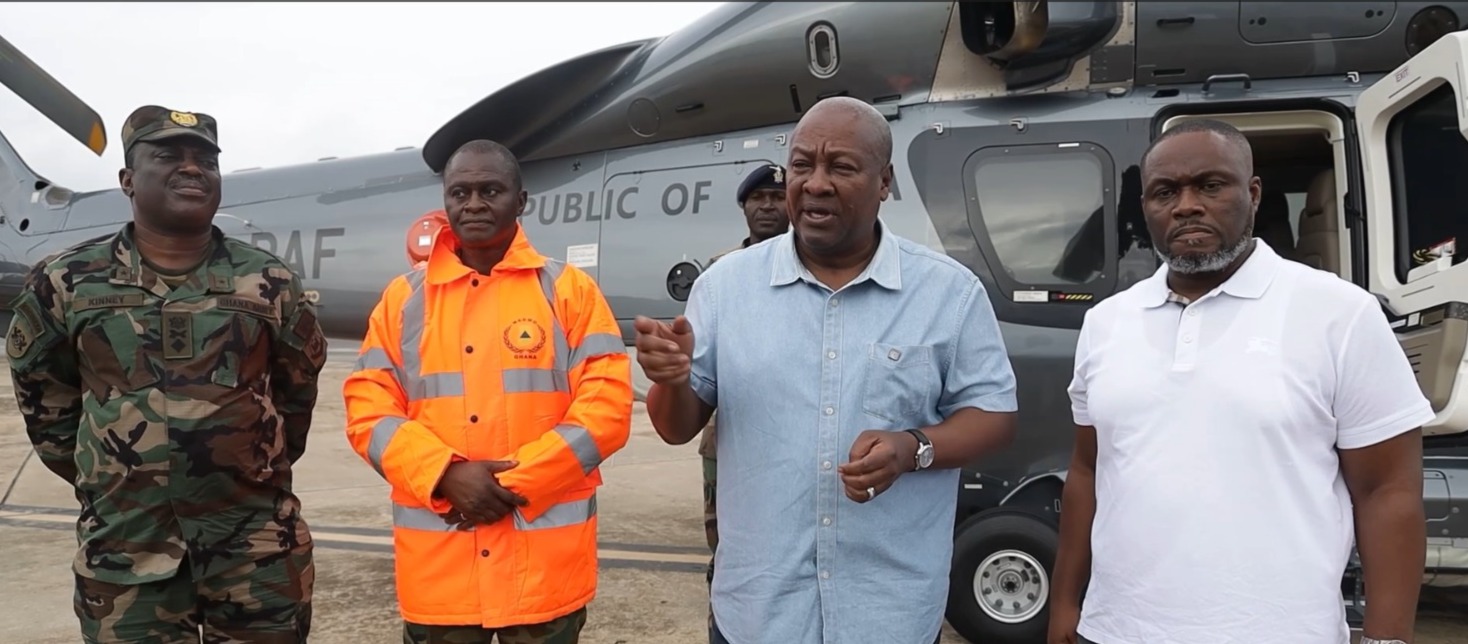
“I wish to express my deepest sympathy to all those who have lost property as a result of today’s floods. The damage has been extensive, and many families have been severely affected,” the President said at an aerial tour of the city.
According to him, “The amount of rainfall recorded today is among the highest experienced in several years. Preliminary data indicates that approximately 140 millimetres of rainfall fell on Accra. By comparison, the highest single-day rainfall recorded last year was about 56 millimetres. The volume of rain that fell today was therefore significantly higher.”
He noted that this calls for reengineering as well as change in attitude of residents.
“During today’s aerial inspection, we observed several illegal dumping sites located within wetlands. Some individuals have turned these wetlands into refuse disposal sites, charging operators of tricycles to dump waste there.
Once these wetlands become filled with refuse, the same individuals sell the reclaimed land to unsuspecting people for housing development, further worsening the flooding situation.
We must therefore tackle this challenge from both an engineering and an enforcement perspective by opening blocked channels and identifying structures obstructing the natural flow of water,” President Mahama stated.
Please read full text below:
1. We have just concluded an aerial inspection of the flood-affected areas in Accra. Unfortunately, the flooding has been very extensive today for several reasons.
2. The amount of rainfall recorded today is among the highest experienced in several years. Preliminary data indicates that approximately 140 millimetres of rainfall fell on Accra. By comparison, the highest single-day rainfall recorded last year was about 56 millimetres. The volume of rain that fell today was therefore significantly higher.
3. There are several factors contributing to flooding in Accra. The first is climate change. If we examine rainfall patterns from 2024, 2025 and 2026, we can clearly see that Accra is receiving increasingly higher volumes of rainfall every year.
4. According to the Ghana Meteorological Agency (GMet), within a 30-day period in June 2024, Accra recorded about 85 millimetres of rainfall. In the same period in 2025, that figure increased to 172 millimetres, while in June 2026 it rose sharply to approximately 333 millimetres.
5. This means that our waterways no longer have sufficient time to recover before more rain falls. Out of the 30 days in June, rainfall occurred on about 22 days, leaving only seven or eight dry days. That aspect of the problem is beyond our control because it is driven by changing climatic conditions.
6. However, there are also engineering and human factors contributing to the flooding.
7. As I have explained before, Accra lies between the Akwapim Mountain Range and the Atlantic Ocean. Before the city expanded, streams naturally flowed across this plain into the sea.
8. When the British established Accra as the capital, this was not a major problem because the city was relatively small. However, as the population has grown and development has intensified, buildings have increasingly obstructed the natural paths of these streams.
9. We therefore need engineering solutions that will reopen these waterways and allow floodwaters to flow freely into the Atlantic Ocean.
10. There is also the issue of human behaviour. People continue to dump refuse into drains, dispose of waste improperly and block waterways with all kinds of debris.
11. During today’s aerial inspection, we observed several illegal dumping sites located within wetlands. Some individuals have turned these wetlands into refuse disposal sites, charging operators of tricycles to dump waste there.
12. Once these wetlands become filled with refuse, the same individuals sell the reclaimed land to unsuspecting people for housing development, further worsening the flooding situation.
13. We must therefore tackle this challenge from both an engineering and an enforcement perspective by opening blocked channels and identifying structures obstructing the natural flow of water.
14. We have spoken about this issue repeatedly over the years. However, whenever government begins removing structures built in waterways, some people accuse us of being inhumane.
15. Yet when disasters such as today’s flooding occur, the consequences affect everyone. The irresponsible actions of a few individuals end up putting entire communities at risk.
16. We will therefore convene a meeting of the National Security Council to address this matter urgently.
17. Every Metropolitan, Municipal and District Assembly will be directed, in collaboration with the Ministry of Works, Housing and Water Resources, to identify all obstructions along major drainage channels within their jurisdictions.
18. These structures will be earmarked for removal.
19. We will not only demolish the obstructing buildings but also clear away the rubble. There is no point demolishing a structure if the debris is left behind to continue obstructing the waterways.
20. Resolving Accra’s flooding problem will require a major national effort, but it is one we must undertake.
21. In the long term, we must also reduce the pressure on Accra by decongesting the city.
22. That is why government is planning to relocate some major government institutions outside Accra while developing a new growth centre where people can live, work and build instead of concentrating development within the capital.
23. This is a long-term project expected to span about 20 years.
24. We are currently working on the designs. Once they are completed, the land will be demarcated, and interested Ghanaians will be able to acquire plots and begin development.
25. Government will provide the necessary infrastructure, including roads, water and electricity, to support the growth of the new city and reduce pressure on Accra.
26. I wish to express my deepest sympathy to all those who have lost property as a result of today’s floods. The damage has been extensive, and many families have been severely affected.
27. I also commend the Ghana Armed Forces, the National Disaster Management Organisation (NADMO), the Ghana Police Service, the Ministry of Works, Housing and Water Resources, the emergency response teams and the 48 Engineers Regiment for their swift rescue operations.
28. I have watched several videos showing rescue personnel carrying stranded residents to safety and deploying boats to save lives. Their dedication has undoubtedly prevented an even greater tragedy.
29. I have directed NADMO to identify affected victims and provide immediate support wherever possible over the coming days.
30. I have also instructed the Minister for Finance to release funds from the Contingency Fund to support post-flood relief efforts for those affected.
31. Once again, I extend my heartfelt sympathies to every family that has suffered losses.
32. At the same time, I urge all Ghanaians to change our attitudes towards sanitation, waste disposal and development in flood-prone areas.
33. We must find a permanent solution to the flooding challenge in Accra.
34. We should not behave like the proverbial vulture that says it will repair its roof after the rains, only to forget about it once the weather clears.
35. This time, we must act differently. Together, we must ensure that lasting solutions are implemented so that this cycle of devastating floods does not continue year after year.