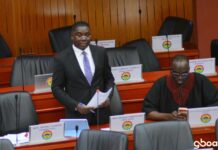

On Thursday, 23rd July 2026, the Finance Minister presented the 2026 Mid-Year Budget to Parliament.
While the government benches are loudly celebrating abstract statistics, an honest look at the actual text reveals massive structural loopholes that explain why ordinary Ghanaians are still feeling a severe economic squeeze.
Let’s look directly at the headline claim, a real GDP growth rate of 6.0% for the first half of the year. On paper, this looks like an economic boom. But as an analyst, I know there is a massive loophole in this number.
This growth is heavily skewed by a raw gold export surge worth over $12 billion. This is a mineral-driven extraction boost, not a broad-based domestic recovery. Our local manufacturing plants are quiet, consumer demand is heavily suppressed, and our agricultural supply chains are struggling.
Celebrating growth that is completely confined to raw mineral extraction while the local productive sectors are suffocating is a massive statistical distraction.
The most glaring lie in this Mid-Year Budget review is the severe compression of domestic public expenditure. The government reports that it has spent GH¢143.7 billion so far.
While the administration frames this under the fancy label of “strict fiscal discipline,” any local contractor or supplier will tell you the truth, it represents a complete freeze on capital expenditure.
Local development projects have ground to a halt, statutory funds are facing massive delays, and liquidity has completely dried up in our local markets.
The cash is being heavily prioritized to service Eurobond debts and to artificially prop up the Cedi to look good for the cameras, rather than flowing into the physical projects that put money directly into the pockets of the Ghanaian worker.
We must address the persistent revenue shortfalls that the state is trying to manage behind closed doors as Ghanaians. Because domestic tax revenue is consistently falling below target, the state is heavily squeezing the local banking sector to sustain its own operations.
This creates a massive crowding-out effect. When the government forces local banks to fund state expenditure, it starves our expanding FinTech startups, small businesses, and local entrepreneurs of affordable capital.
True economic success cannot be measured by meeting bare-minimum indicators under an emergency IMF framework; it must be measured by the cost of doing business, the reduction of operational inputs, and the actual purchasing power of the average citizen.
Macro-stability is a good statistical shield, but being slightly better than a previous crisis period should never be mistaken for excellence or real success.
The data from this mid-year review shows a heavily managed, constrained economy where growth is locked in banking vaults and raw mineral exports rather than flowing through our local markets.
Until fiscal management moves past abstract data and translates into tangible capital, affordable electricity, and real relief for the private sector, the headline numbers remain completely detached from the everyday Ghanaian reality.
As a business owner or Ghanaian, are these headline statistics matching the reality of your operations and the cost of living? Ghana can do better than this!
By Agyemang Emmanuel- Finance, FinTech & Business Analyst