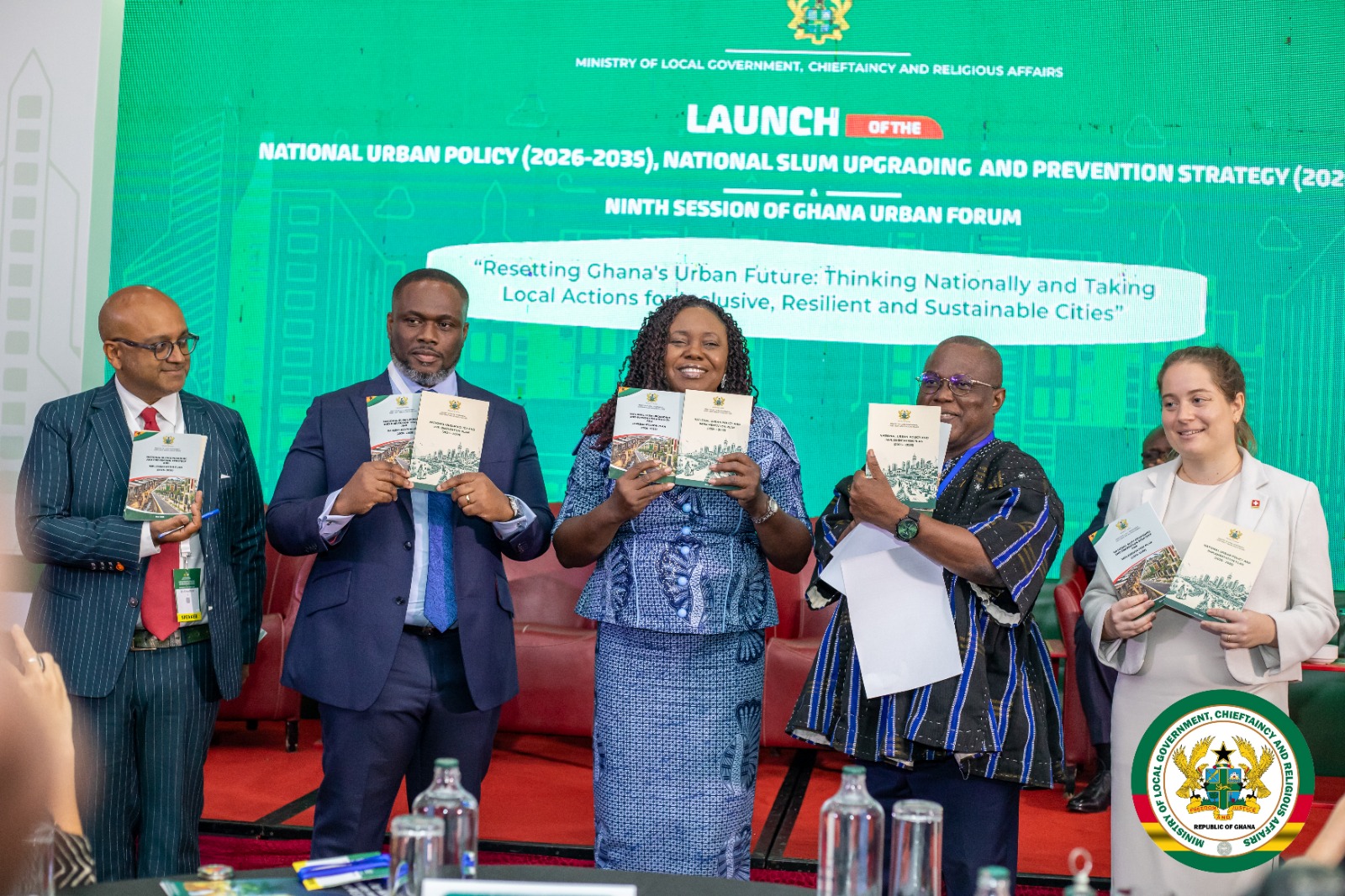

President John Dramani Mahama has launched Ghana’s National Urban Policy and Implementation Plan (2026–2035) and the National Slum Upgrading and Prevention Strategy (2026–2035), setting out a 10-year roadmap to promote sustainable, inclusive and climate-resilient urban development across the country.
The policies were launched at the 9th Ghana Urban Forum in Accra, bringing together government officials, Metropolitan, Municipal and District Chief Executives (MMDCEs), development partners, traditional leaders, urban planners and civil society organisations.
A speech delivered on behalf of President Mahama by the Chairman of the National Development Planning Commission (NDPC), Dr. Nii Moi Thompson, described effective urbanisation as critical to Ghana’s economic growth, environmental sustainability and social inclusion.
The President noted that Ghana’s urban population has grown significantly over the past four decades, placing increasing pressure on housing, transport, sanitation, drainage systems and other essential infrastructure.
He said the new policy adopts a comprehensive approach to urban development by integrating affordable housing, land use planning, climate resilience, environmental sustainability, digital innovation and sustainable financing.
President Mahama also announced that government is prioritising smart city development through digital land administration, geographic information systems, digital permitting and data-driven governance to improve efficiency, transparency and service delivery.
He further highlighted ongoing investments under the Big Push Programme and the 24-Hour Economy initiative, aimed at expanding road networks, drainage infrastructure, markets and enterprise development to support economic growth and job creation.
Delivering a statement on behalf of the Minister for Local Government, Chieftaincy and Religious Affairs, Alhaji Amin Abdul-Rahaman, Chief Director of the Ministry, described the launch as a renewed national commitment to coordinated and inclusive urban development.
He said the National Urban Policy seeks to promote sustainable urban growth, climate resilience, effective land use planning, affordable housing, improved infrastructure financing and equitable access to basic services.
According to him, the National Slum Upgrading and Prevention Strategy provides a framework for improving living conditions in informal settlements through better housing, enhanced service delivery, strengthened land management and active community participation.
He called on Metropolitan, Municipal and District Assemblies to integrate both policies into their medium-term development plans and annual budgets to ensure effective implementation.
The Minister for Works, Housing and Water Resources, Kenneth Gilbert Adjei, also reaffirmed his Ministry’s commitment to supporting implementation of the policy through investments in affordable housing, resilient infrastructure, water resource management and climate-responsive development.
He disclosed that the Ministry has commenced a review of the National Housing Policy to align it with the objectives of the National Urban Policy and better address Ghana’s growing housing needs.
President Mahama urged government institutions, local authorities, development partners, the private sector and citizens to work together to ensure the successful implementation of the policies.
He stressed that the success of the National Urban Policy would not depend solely on the quality of the documents but on the commitment of all stakeholders to translate the policy into practical actions that improve the lives of Ghanaians.
The National Urban Policy and Implementation Plan and the National Slum Upgrading and Prevention Strategy will guide Ghana’s urban development agenda from 2026 to 2035, with implementation expected to strengthen urban governance, improve infrastructure and build resilient cities capable of meeting future development challenges.