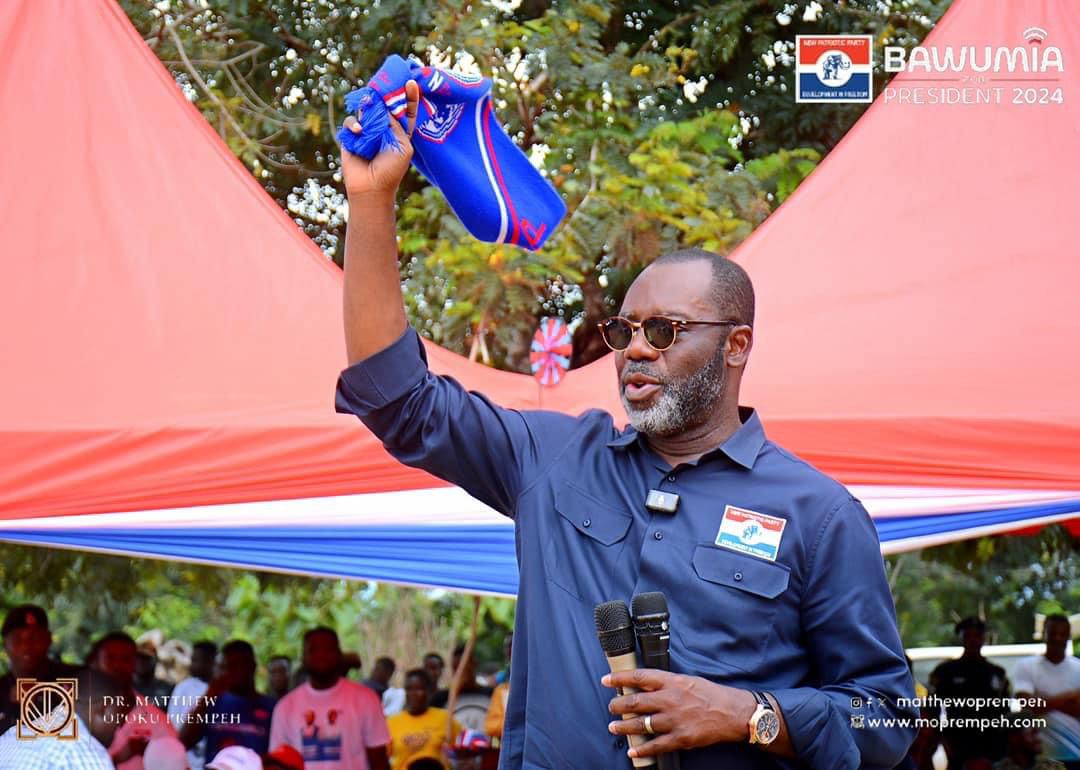

The 2024 New Patriotic Party (NPP) running mate, Dr Matthew Opoku Prempeh, has appealed to the leadership of the party to reconnect with grassroots to rebuild its future.
He believes that the party’s survival and future electoral fortunes depend on rebuilding its grassroots structures, nurturing new organisers and making room for younger voices.
In a Facebook post on Tuesday, August 18, 2026, NAPO stated that the party must not rely on the strength built by previous generations but deliberately work to renew the tradition.
“Every generation receives both an inheritance and an assignment,” he stated.
He emphasized that the current generation of NPP members have a responsibility to build on the foundations laid by their predecessors.
He said the Ashanti Region, which has long been regarded as the NPP’s electoral stronghold, must look beyond its historical support for the party and consider what more it could do to strengthen the NPP nationally.
“Today, as Dr Mahamudu Bawumia leads our party into its next chapter, Ashanti Region must ask not only what it has contributed to the NPP, but what it is prepared to contribute to its future,” Dr Prempeh stressed
Dr Prempeh appealed for stronger constituency structures, renewed engagement with the grassroots, greater involvement of young people and the development of a new generation of party organisers.
He warned against reducing the Ashanti Region’s relationship with the NPP to its reputation as the party’s “World Bank”.
He argued that the region’s contribution goes beyond votes.
“That is why I sometimes hesitate when Kumasi and Ashanti Region are described simply as the NPP’s World Bank,” he said. “Our relationship with this tradition is older and deeper than votes.”
He said Kumasi and the Ashanti Region have historically supplied the NPP tradition with organisers, thinkers, activists, parliamentarians and leaders, particularly during difficult periods.
He traced the roots of the tradition to the National Liberation Movement (NLM), recalling the role of Baffour Osei Akoto and other activists who organised around political and economic grievances in the 1950s.
He said the tradition subsequently evolved through the United Party and Progress Party before finding renewed expression in the NPP in 1992.
According to him, history demonstrated that the tradition had survived because successive generations have been prepared to organise, sacrifice and rebuild.
“Those who gathered around the Subin organised. Those who built the United Party organised. Those who kept the tradition alive through difficult years organised. Those who founded the NPP built again,” he said.
He observed that the NPP’s eventual return to power under former President John Agyekum Kufuor was the result of years of persistence and organisation.
Dr Prempeh called on the party’s current generation to view its political inheritance as a responsibility rather than an entitlement.
By Benjamin Aidoo