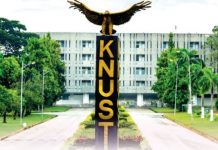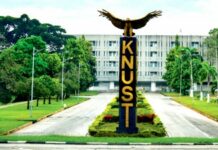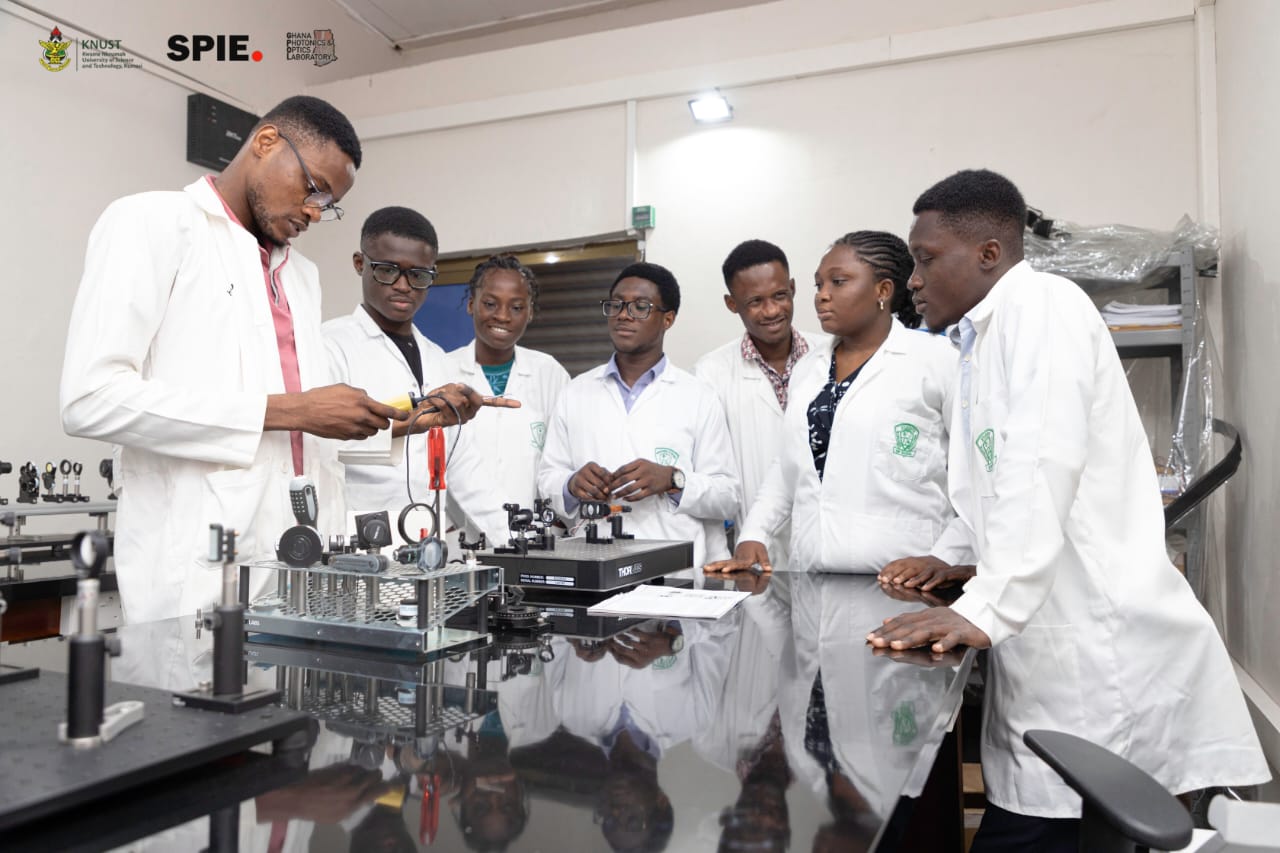

Ghana is set to strengthen its capacity in light-based science with the launch of the Ghana Photonics and Optics Laboratory (GPOL) at the Kwame Nkrumah University of Science and Technology (KNUST) on Tuesday 22 September 2026.
GPOL will be hosted at the Department of Physics. It is the work of KNUST researchers led by Dr Akyana Britwum, Principal Investigator and Scientific Lead, and Dr Michael Kweku Edem Donkor, Technical Lead and Co-Principal Investigator, with the support of international partners.
Its purpose is to build, teach and maintain light-based instruments for health and safety, from devices that authenticate medicines without opening the package, to affordable diagnostic imaging, to sensors that read heavy metals in soil and water in seconds.
The laboratory will not merely use such instruments. Through its partners it is building the capacity to do the science of photonic instrumentation itself: to build the instruments, to improve what they can do locally, and to point them at questions that matter to Ghanaians and Africans, while training the people who will carry the work forward.
Substandard and falsified medicines circulate in West African markets. Glaucoma and newborn jaundice are caught late where screening and laboratories are far away. Heavy metals from mining move through soil and water and are found only after the harm is done.
Photonics, the science of using light to measure, image and sense, addresses each of these, but the instruments have long been imported, expensive, and, when broken, left broken. GPOL exists to change that.
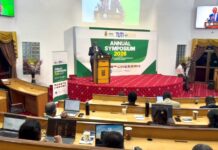
The new laboratory will be commissioned during the inaugural NYANSAPƆ Photonics School for Health and Safety, which brings together 38 emerging scientists from six African countries and leading photonics researchers from Africa, Europe and North America. Unlike a conventional scientific conference, the six-day school places students inside working laboratories.
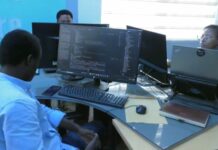
Participants learn the science behind the instruments, and then operate them: technologies used in medical imaging, tissue and blood-flow measurement, chemical analysis and other health and safety applications. The equipment and expertise established through the programme remain at KNUST, creating a lasting platform for research, training and regional collaboration.
The school takes its name from NYANSAPƆ, the Adinkra “wisdom knot,” a symbol of learning, ingenuity and adaptability, drawn from the proverb that is also the motto of KNUST.
The teaching faculty measures how seriously the world takes this effort. The launch keynote comes from Dr Peter de Groot, 2025 President of SPIE, the world’s largest professional society for optics and photonics. Distinguished lectures follow from Dr Daewook Kim of the University of Arizona, who builds optics for some of the world’s largest telescopes, and Dr Samuel Achilefu of UT Southwestern Medical Center, inventor of goggles that show surgeons tumour cells during an operation and one of very few scientists elected to three United States National Academies.
Laboratory modules are taught by researchers from ICFO in Barcelona, Vanderbilt University and Aix-Marseille Université, with further lectures from Imperial College London; and, from within West Africa, by faculty from INP-HB and the Université Alassane Ouattara in Côte d’Ivoire, the University of Kara in Togo, and KNUST’s own researchers.
“Photonics is one of the defining technologies of this century, and there is no reason Ghana should be on the sidelines,” Dr Britwum said. “With GPOL and the NYANSAPƆ school, we are establishing the laboratory, the training and the international partnerships that let us as researchers and our students do world-class optics here at home, on problems that matter to Ghana.”
“What sets this School apart is that students do not simply hear about these techniques. They learn the science behind each instrument, operate it themselves, and take the data it produces through to analysis,” added Dr Donkor. “Commissioning the GPOL at KNUST means the equipment, the understanding and the skill all remain in Ghana long after the school ends.”
The inaugural cohort brings together students from more than 10 institutions across Ghana, Côte d’Ivoire, Togo, Kenya, Rwanda and Zimbabwe. The week closes with a community outreach day at Hwiremoase, where the whole school teaches photonics to hundreds of pupils, the beginning of the pipeline GPOL exists to build.
The NYANSAPƆ Photonics School and the launch of GPOL are supported by SPIE as title sponsor, with additional support from Optica, Menlo Systems and Thorlabs, and from the Institute for Quantum Computing (IQC) through KNUST’s partnership with the Pan-African Initiative for Research (PAIR) at the University of Waterloo, and in partnership with ICFO.
“Photonics is a growing strength for our Department and hosting the NYANSAPƆ School places our students shoulder to shoulder with leading researchers from around the world,” said Prof. Francis Kofi Ampong, Head of the Department of Physics at KNUST.
“The laboratory being commissioned during the week will serve our students and our research and have a lasting impact on Ghana’s scientific community.”
By Christian Yalley