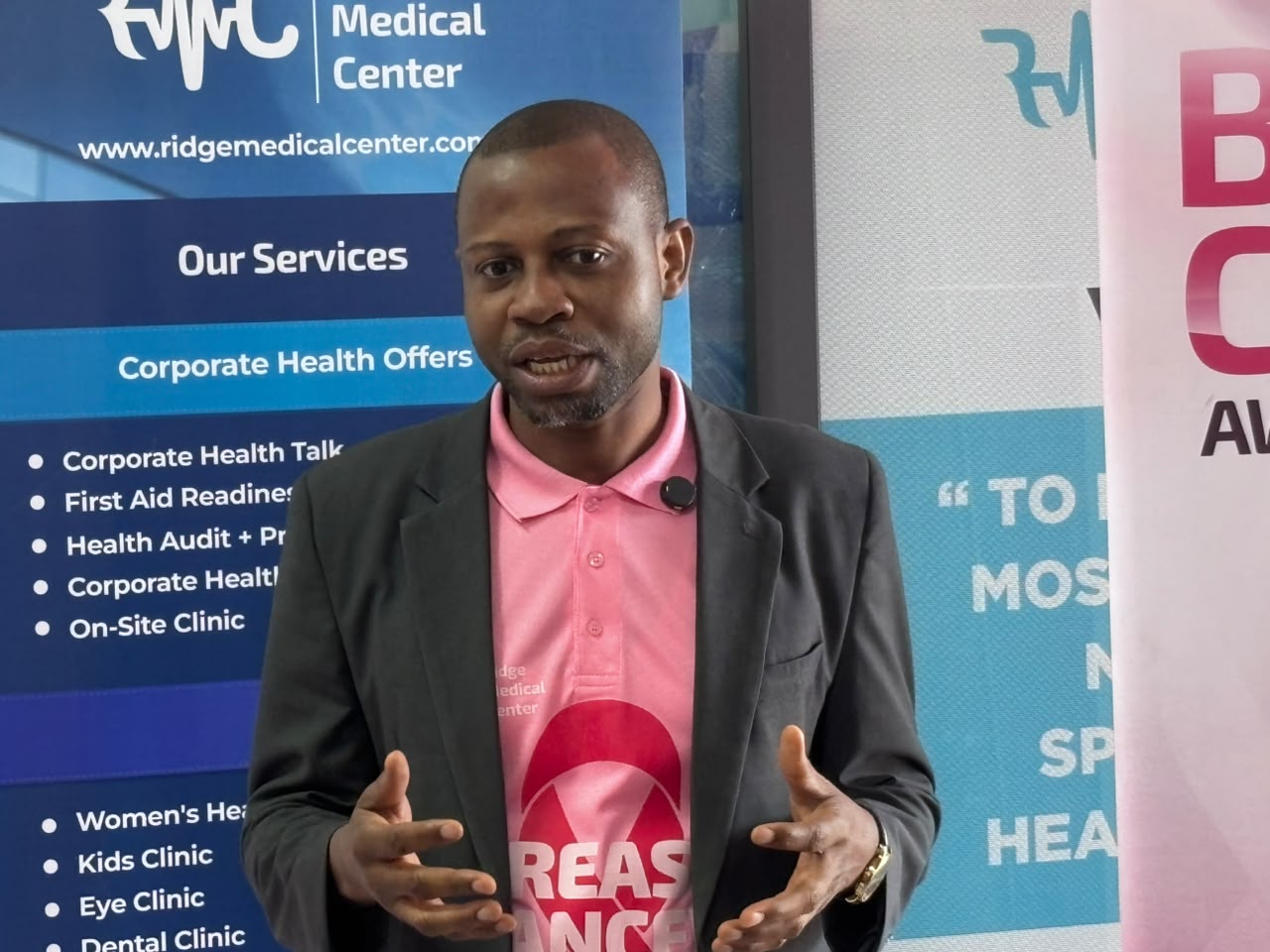

CEO of the Ridge Medical Centre (RMC), Dr David Sunu, dismissed claims that when men suck breasts, it reduces the chances of breast cancer. He says there is no robust data to back the claim.
“What is known is that breastfeeding is known to reduce the likelihood of breast cancer; as to whether when men suck breasts as well, we don’t have robust data to back that,” he said when the Ridge Medical Centre launched its Pink October to create awareness of breast cancer, in Accra on Monday, October 5.
Breast Cancer Awareness Month has been celebrated in October since the eighties. It is called “Pink October” as people around the world adopt the pink colour and display a pink ribbon to raise awareness about the importance of prevention and routine screening for the early diagnosis of breast cancer.
Dr Sunu also attributed the increasing rate of breast cancer in Ghanaian women to lack of education and the resort to unapproved medical options.
“There is a lack of education, preference to use herbal medication, there is the preference for religion, which causes delays, but what we are saying is that if you screen and then we pick up any anomalies, it allows us to do more, which would then protect more women from dying from breast cancer,” he said.
Regarding the use of herbal medicines for breast cancer treatment, he said, “There aren’t enough studies to justify the effectiveness of herbal medicine for cancers; indeed, what we have observed is that relying on herbal treatment leads to delays; there is a lot of. There is a lot of scientific data behind what treatment modalities are effective for different kinds of cancers; we do not have the same for herbal treatment for cancers, and so, as medical practitioners, our recommendation is that we should go with that which is tried and tested, that which is based on statistics.
“Relying on unknown methods of treatment without enough statistics is a recipe for disaster because it will delay the patient from coming to the hospital early; when you present late, the cancer would have spread to many organs and that will limit what medical science can do for you.”
He further called on the Ministry of Health and the Ghana Health Service to ensure that there are robust programmes for screening.
“In our part, we don’t have a robust programme for screening and early detection; that is, elsewhere there is a robust programme for screening and early detection. If you diagnose the condition early, you can take out that lump; you can take out the cancerous tissue before it begins to spread. When it spreads to other parts of the body, it becomes difficult, so the main difference is about having a system in place or a programme that allows for early detection so that you can treat, you can cure, and you can prolong life. But in our part of the world, the programmes are not that robust or effective to allow for early detection.
“To the Ministry of Health and the Ghana Health Service, for that matter, there is a need for increased awareness regarding breast cancer in particular. We are increasingly seeing a lot of corporate bodies, even GHS and MoH in October, driving awareness, which is good, but we need to do more, and we need to integrate such awareness into the day-to-day activities of health facilities. We also need to have structures and training programmes beyond October, which will then ensure that more people are getting screened. If we look at those who are above 40 years, for example, we must have a programme in place that makes it very easy for them to have their mammograms, which is the X-Ray that assesses to see whether there is suspicion of cancerous tissue in the breasts or not, especially in the rural areas. When that is done, I believe that it will increase the chance for us to catch the condition early.
“For the general public, there are a lot of health facilities where, if you walk in and say you want to get a clinical breast examination, it will be done. At least once a year, every woman should get her breasts examined. Men can be affected, but we know that 99% of the cases occur in women also; that is why we focus on women, so they should have their breasts examined at least once a year, and that will make a huge difference.”
He also dismissed claims that when men suck breasts, it reduces the chances of breast cancer.
“What is known is that breastfeeding is known to reduce the likelihood of breast cancer; as to whether when men suck breasts as well, we don’t have robust data to back that,” he said.
Pinktober: Breast Cancer survival exceeds 90% when detected early – Breast Society of Ghana