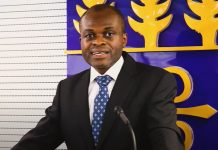
Minister of Government Communications Felix Kwakye Ofosu has said that he does not understand the need for the third-term presidential suits at the Supreme Court.
He makes the point that President John Dramani Mahama has said on many occasions that he is not interested in any third term in office.
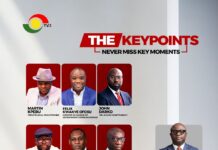
“The President on many occasions has said that he is not interested in a third term. So what is the farce about these whole scare-mongering tactics of the NPP?” he said on the Key Points on TV3 on Saturday, October 31.
Also speaking on the same show, a Policy Analyst, Senyo Hosi, predicted that the Supreme Court will dismiss all the third-term presidential limit suits.
He made the point that there was nothing to be gained by pursuing this matter in court.
“The Supreme Court will dismiss the whole thing. Write it on the wall. There are too many cases at the Supreme Court. This is not where we should be wasting our time,” he said.
Legal practitioner and policy analyst Austin Kwabena Brako-Powers has called for the dismissal of the New Patriotic Party’s (NPP) writ seeking the Supreme Court’s interpretation of presidential term limits, describing the action as premature and unnecessary.
Reacting to the writ on Thursday, October 29, 2026, Mr Brako-Powers argued that there is no live constitutional dispute requiring the court’s intervention. He said the action seeks a judicial pronouncement on a hypothetical future situation rather than an existing legal controversy.
He cited Bilson v Attorney-General, in which the Supreme Court emphasised that constitutional interpretation must arise within a justiciable dispute and New Patriotic Party v National Democratic Congress and Others in support of the principle that a mere intention or future possibility may not constitute an actionable constitutional wrong.
Mr Brako-Powers further argued that Article 66(1) and (2) of the 1992 Constitution is clear on presidential tenure and the two-term limit, leaving no ambiguity that requires the court’s interpretation. He relied on Republic v Special Tribunal; Ex parte Akosah and Agyei-Twum v Attorney-General; Ex parte Dr Zenator in support of his argument on when constitutional interpretation is necessary.
He maintained that a political party cannot manufacture an interpretative controversy around clear constitutional provisions simply because it wants certainty about a possible future electoral situation. In his view, the Supreme Court should not be asked to clarify what the constitutional text already states plainly.
The writ concerns Article 66(2) of the 1992 Constitution, which prohibits a person from being elected President for more than two terms. The NPP is seeking declarations on how the term limit should apply, including where presidential terms are interrupted.
Another aspect of the writ concerns a Vice-President who assumes the presidency and later seeks election. The NPP reportedly seeks a declaration on whether serving more than half of a predecessor’s unexpired term should count as a full term for presidential eligibility purposes.
Mr Brako-Powers questioned the basis for importing the United States’ approach to presidential succession into Ghanaian constitutional law. The Twenty-Second Amendment to the US Constitution expressly addresses the counting of certain periods served after succession, but Ghana’s Constitution does not contain the same formula.
He argued that the interpretation of Ghana’s presidential term limits must be grounded in the country’s own constitutional text and structure, rather than a rule adopted under a different constitutional framework.
Mr Brako-Powers warned that entertaining premature claims about prospective candidacies could encourage political parties to seek judicial pronouncements on hypothetical electoral disputes before any relevant act or decision has occurred.
He maintained that, given the principles on justiciability and constitutional interpretation established in the cited authorities, the Supreme Court should dismiss the NPP’s writ as premature and unnecessary, rather than entertain what he considers an attempt to obtain an advisory opinion on clear constitutional provisions.