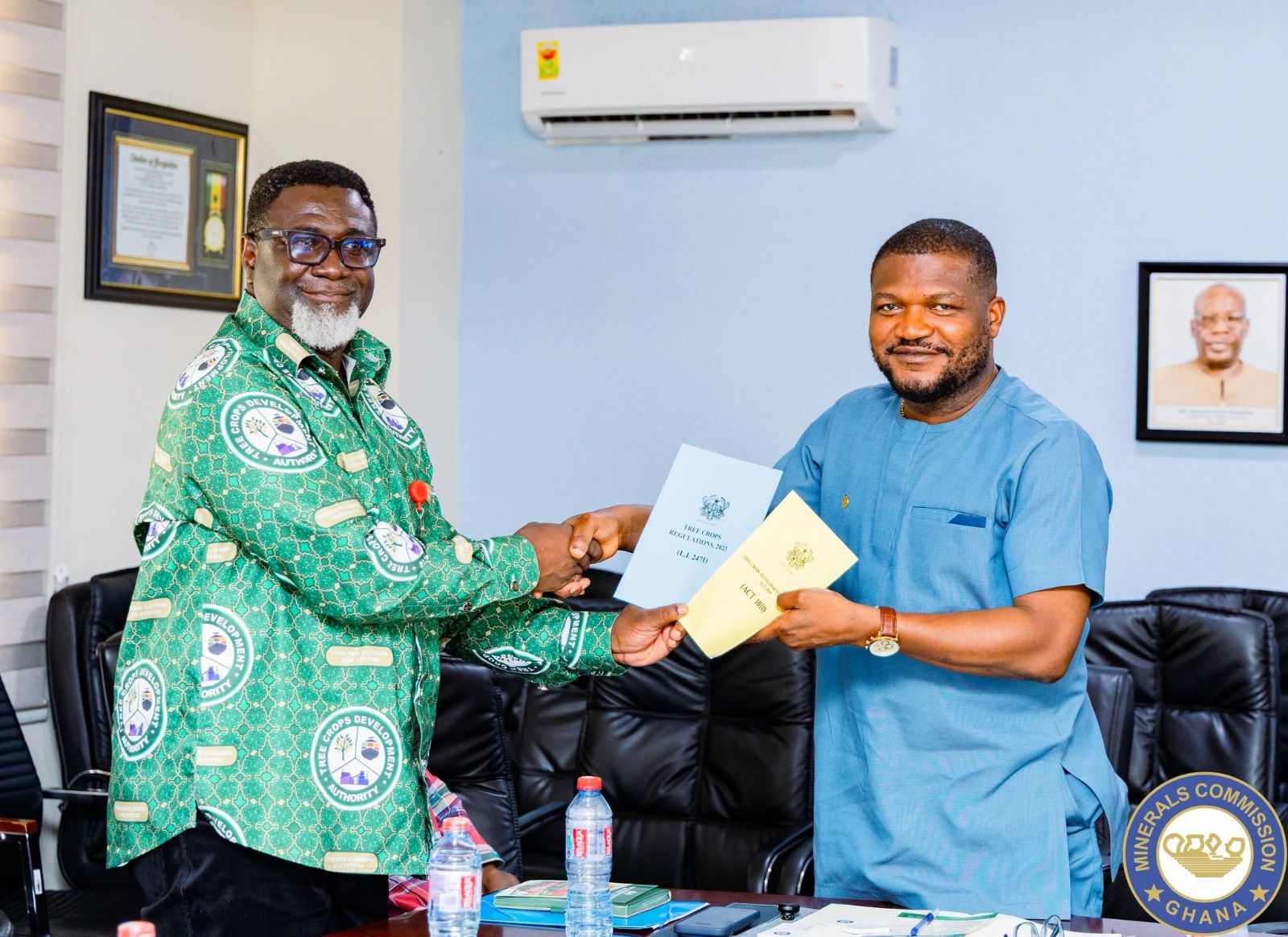

The Minerals Commission has held discussions with the Tree Crops Development Authority (TCDA) on a strategic partnership to reclaim lands degraded by mining and turn them into productive tree crop farms.
The TCDA delegation, led by its Chief Executive Officer, Dr Andrews Osei Okrah, paid a courtesy call on the Commission to explore areas of institutional collaboration, particularly in land reclamation and sustainable tree crop development.
Speaking during the meeting on November 6, Dr Okrah said the Authority is committed to building a strong and viable tree crops sector for Ghana.
“Our mandate is to regulate and create a conducive environment for the growth and development of tree and industrial crops in Ghana,” he said. “We believe that by working together, we can restore degraded lands and put them to productive use for the benefit of communities and the national economy.”
He said the TCDA is already implementing projects across the country and sees collaboration with the Minerals Commission as key to expanding its impact, especially in mining communities where large tracts of land have been degraded.
Welcoming the delegation, the Chief Executive Officer of the Minerals Commission, Mr Isaac Tandoh, commended the TCDA for its initiatives and said the Commission was ready to partner with it.
“Land reclamation and environmental restoration form an integral part of our mandate,” Mr Tandoh said. “Through our Alternative Livelihood Programme, we are already reclaiming degraded mining lands, promoting tree planting and creating sustainable livelihood opportunities for mining communities.”
He stressed that reclamation must go beyond restoring the environment to creating lasting economic value for affected people.
“It is not enough to just reclaim the land. We must ensure that reclaimed lands are put to productive use through sustainable tree crop cultivation, so that communities can earn a living from them for years to come,” he said.
Mr Tandoh added that aligning the mandates of the two institutions would ensure that restoration efforts translate into jobs, incomes and food security.
Both institutions agreed to strengthen cooperation and leverage their respective technical expertise to advance land reclamation, tree planting and sustainable livelihood initiatives.
The proposed partnership is expected to contribute to environmental restoration, sustainable agricultural development and economic empowerment, while supporting the national agenda of responsible mineral resource management and productive land utilisation.
The Minerals Commission reaffirmed its commitment to working with relevant institutions to ensure that lands affected by mining are restored and transformed into productive assets for communities and the national economy.