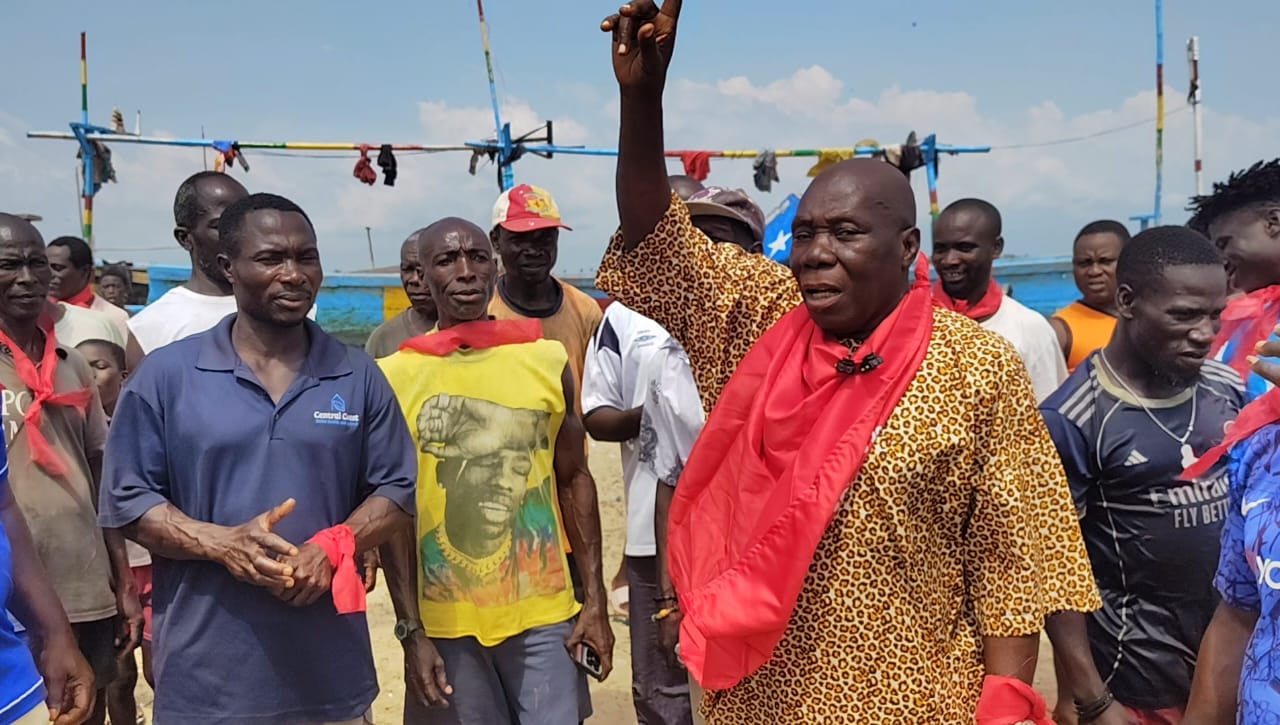

Fishers at Shama Apo in the Western Region are vowing to resist plans to mine gold in Ghana’s coastal waters, warning that the country must not sacrifice fishing grounds and coastal livelihoods for a new extractive industry.
Their opposition centres on Gold Coast Resources Corporation’s proposed offshore operations, which a marine scientist warns could threaten fish breeding grounds around major river mouths and undermine marine conservation efforts.
The company is targeting gold deposits along Ghana’s shallow offshore continental shelf. Its reconnaissance concession covers approximately 10,000 square kilometres across 10 contiguous blocks, stretching about 300 kilometres from Half Assini in the Western Region to Winneba in the Central Region and extending roughly 33 kilometres out to sea.
According to the company’s website, shallow-water dredging is scheduled to begin in 2027, followed by commercial production in 2028.
The Minerals Commission halted field and offshore activities under the company’s reconnaissance licences in October. The company has, however, continued engaging coastal communities.
For fishers at Shama Apo, those engagements have done little to ease fears about the future of their livelihoods.
Livelihoods at risk?
Ebenezer Amankwa Andoh, Assembly Member for the Apo Electoral Area, said the community had already surrendered access to some fishing areas to accommodate offshore oil operations. Fishers, he said, would not accept further restrictions that threatened their survival.
“Once they [government] told us oil has been discovered offshore. That was to the benefit of the entire country. As a result, we were barred from fishing close to the offshore infrastructure. We’ve kept quiet over this. We will therefore not agree to any attempt to extract oil or gold offshore that will cost us our livelihoods,” he said.
A fish processor in the community also rejected the proposed activities, saying residents did not want the company’s research.
“Let it be known to Gold Coast that we don’t want their research. We are told they already have one licence, and it’s left with one for them to commence operations. We don’t agree,” she said.
Francis Abban, Western Regional Financial Secretary of the Canoe and Fishing Gear Owners Association of Ghana, urged the government to respond to the community’s concerns without delay.
“From today to the end of the month, all we expect to hear in the news is that government has heard our cries and will not allow them to proceed,” he said.
Dr Anita Boateng-Ameyaw, Programme Coordinator of the Ocean Justice Programme at Friends of the Nation, said the debate must go beyond the company’s immediate research activities to the commercial mining those activities are intended to support.
Having monitored the company’s community engagements over recent weeks, she accused it of failing to explain that intended progression clearly.
“They are telling the communities they are just doing research. Beyond the research, what is the next line of action? Mining! They are not telling the communities this is the end game of what they intend to do,” she said.
“So, we should be prepared and not be misled that they just intend to do research. The end game of the research is to go into full-scale mining.”
Dr Boateng-Ameyaw identified the Ankobra, Pra and Tano river mouths as areas of particular concern, describing them as breeding grounds for fish species that sustain coastal fisheries.
She warned that mining in those areas could have devastating consequences for fish stocks and the people who depend on them.
“What is at risk is that at the end of the day our artisanal fishers, who are the small-scale fishers, their livelihood is going to be halted. Their families, their communities, their children, women’s livelihood depend on the marine space, depend on fishes,” she said.
In her assessment, fishing and mining cannot coexist in the targeted areas without putting fishing livelihoods at risk.
Calls for a legal ban
Dr Boateng-Ameyaw is calling on the government to stop the project from advancing beyond reconnaissance and on Parliament to enact legislation banning mining in Ghana’s marine waters.
She said the company had applied for a prospecting licence, particularly for the Ankobra catchment area, and had approached the Environmental Protection Authority for a permit.
“They have a reconnaissance licence. We are asking the government not to proceed with the prospecting licence that they have already applied for,” she said.
“We are also aware that they have talked to the Environmental Protection Authority for a permit, and we are asking EPA not to grant them that permit as well.”
Gold Coast Resources Corporation maintains that its proposed activities pose no threat to the environment. The company says the technology it intends to deploy has been proven to be environmentally sustainable.
That assurance has not persuaded the fishers of Shama Apo. For them, the prospect of offshore gold production raises a more immediate question: whether the waters that sustain their families will remain fishing grounds.
Their position is firm: they will resist any project that puts those livelihoods in jeopardy.
By Abraham Mensah