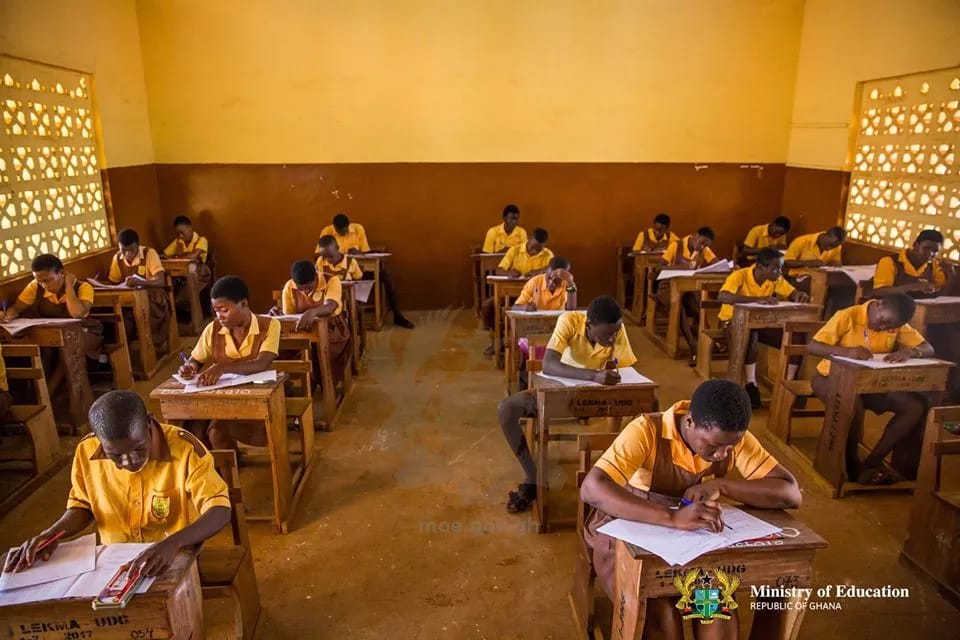

The Ministry of Education has defended the directive prohibiting Junior High School (JHS) 1 and JHS 2 students from registering prematurely for the Basic Education Certificate Examination (BECE), saying the measure is necessary to protect examination integrity, improve educational planning and prevent wasteful public expenditure.
In a statement issued by its Press Secretary, Hashmin Mohammed, the Ministry said the directive announced by the Minister for Education, Haruna Iddrisu, was intended to ensure that learners progress through the education system based on their academic competence and developmental readiness rather than the speed at which they complete school.
The Ministry explained that the BECE was designed to assess students at the completion of their Junior High School education and that existing regulations permit only final-year JHS students who meet the eligibility requirements to register.
It warned that allowing students in JHS 1 and JHS 2 to sit the examination undermines established educational procedures and could compromise the credibility of the national assessment system.
“The BECE is a national certification examination designed to assess learners at the completion of their Junior High School education,” the Ministry stated.
“Consequently, the registration of JHS 1 and JHS 2 learners who have not satisfied the established eligibility requirements constitutes an irregularity that must be addressed.”
Ministry Raises Concerns Over Educational Planning
The Ministry further argued that premature BECE registration and the subsequent advancement of students outside the established academic progression system could distort national enrolment projections and complicate educational planning.
According to the statement, the Ministry, the Ghana Education Service (GES) and other relevant institutions rely on accurate enrolment data to plan infrastructure development, teacher recruitment, textbook distribution and other essential educational services.
These include classroom construction, furniture, school feeding, dormitory accommodation and the financing of secondary education.
It said irregular progression could create unexpected pressure on available resources, particularly as the government continues to expand access to secondary education and improve school infrastructure.
“Although individual cases may appear insignificant, widespread irregular progression can undermine effective planning and the timely allocation of resources,” the statement noted.
Government Worried About Additional Examination Costs
The Ministry also cited the financial implications of premature registration, particularly the possibility of government paying examination fees for the same students more than once.
It explained that government currently supports eligible candidates in public schools by covering their BECE registration fees to ensure that financial difficulties do not prevent qualified students from taking the examination.
However, students who register prematurely and fail to obtain the required grades for progression to senior high school may have to return to their respective academic levels and register again when they become eligible.
The Ministry said such situations could result in avoidable public expenditure.
“Across several schools and districts, such practices could result in avoidable public expenditure that could otherwise support classroom infrastructure, teaching and learning materials and other educational priorities,” the statement said.
BECE Should Not Be Used As A Trial Examination
The Ministry stressed that the BECE should not be treated as a trial examination or an avenue for students to bypass established levels of basic education.
It said schools already had appropriate assessment mechanisms, including continuous assessment, diagnostic tests and mock examinations, to evaluate students’ academic progress and readiness.
By Daniel Opoku