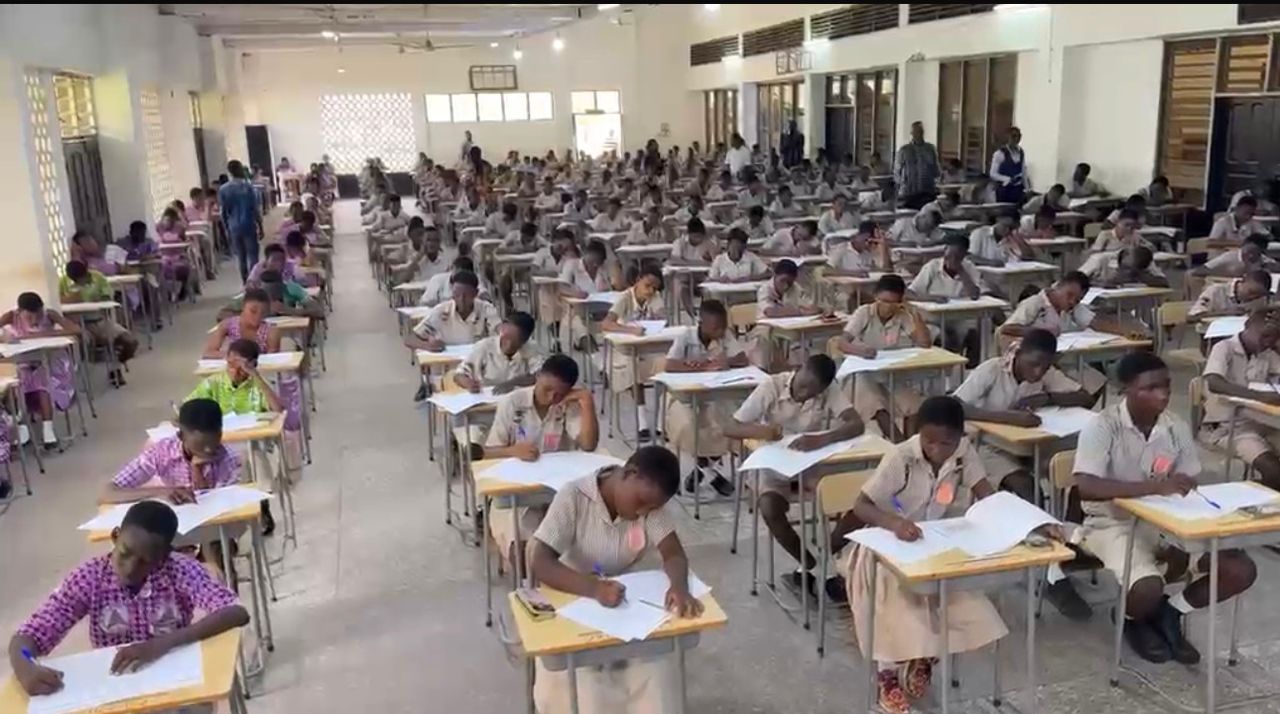

Offinso North Member of Parliament and member of the Education Committee of Parliament, Fred Kyei Asamoah, has called for an individualised approach to determining when Junior High School (JHS) students should be allowed to sit for the Basic Education Certificate Examination (BECE).
He argues that decisions on early registration for the examination must be guided by a student’s individual abilities and academic performance, rather than a blanket policy applied to all students.
Speaking in an interview on 3FM’s Hot Edition on November 27, Mr Kyei Asamoah said students have different talents, learning abilities and educational needs, making it necessary for authorities to adopt a more flexible and inclusive approach.
Earlier this week, the Education Minister, Haruna Iddrisu, announced on Monday that pupils in JHS 1 and JHS 2 who sit the Basic Education Certificate Examination prematurely will be barred from it for two years.
The Offinso North MP recalled that the New Patriotic Party (NPP) had earlier raised concerns about the proposal, insisting that a uniform approach could disadvantage learners whose academic abilities and learning needs differ.
He said the appropriate response should be the introduction of effective learner identification and assessment systems to track students’ progress and determine their readiness to sit for the examination.
“We are different students with different talents and different abilities. We should have proper identifiers for our learners and ensure inclusion. An inclusive education system must recognise and cater for the needs of all learners, including gifted students, children with disabilities and those who require additional academic support,” he said.
He maintained that students who demonstrate exceptional academic ability should be given opportunities to progress, but such decisions must be based on proper assessment rather than a general policy that applies indiscriminately to every learner.
Concerns Over Education Policy Consistency
Beyond the BECE debate, the MP expressed concern about what he described as frequent changes in government communication on education policies.
He argued that policy consistency and credibility were essential to ensuring effective implementation and building public confidence in the education sector.
According to him, the Ministry of Education must adopt a more coordinated and carefully considered approach to policy formulation and communication to avoid uncertainty among stakeholders.
Mr Kyei Asamoah called for greater attention to long-term planning and effective implementation, stressing that decisions affecting the country’s education system must be guided by the diverse needs of learners and the broader national interest.
By Richard Bright Addo