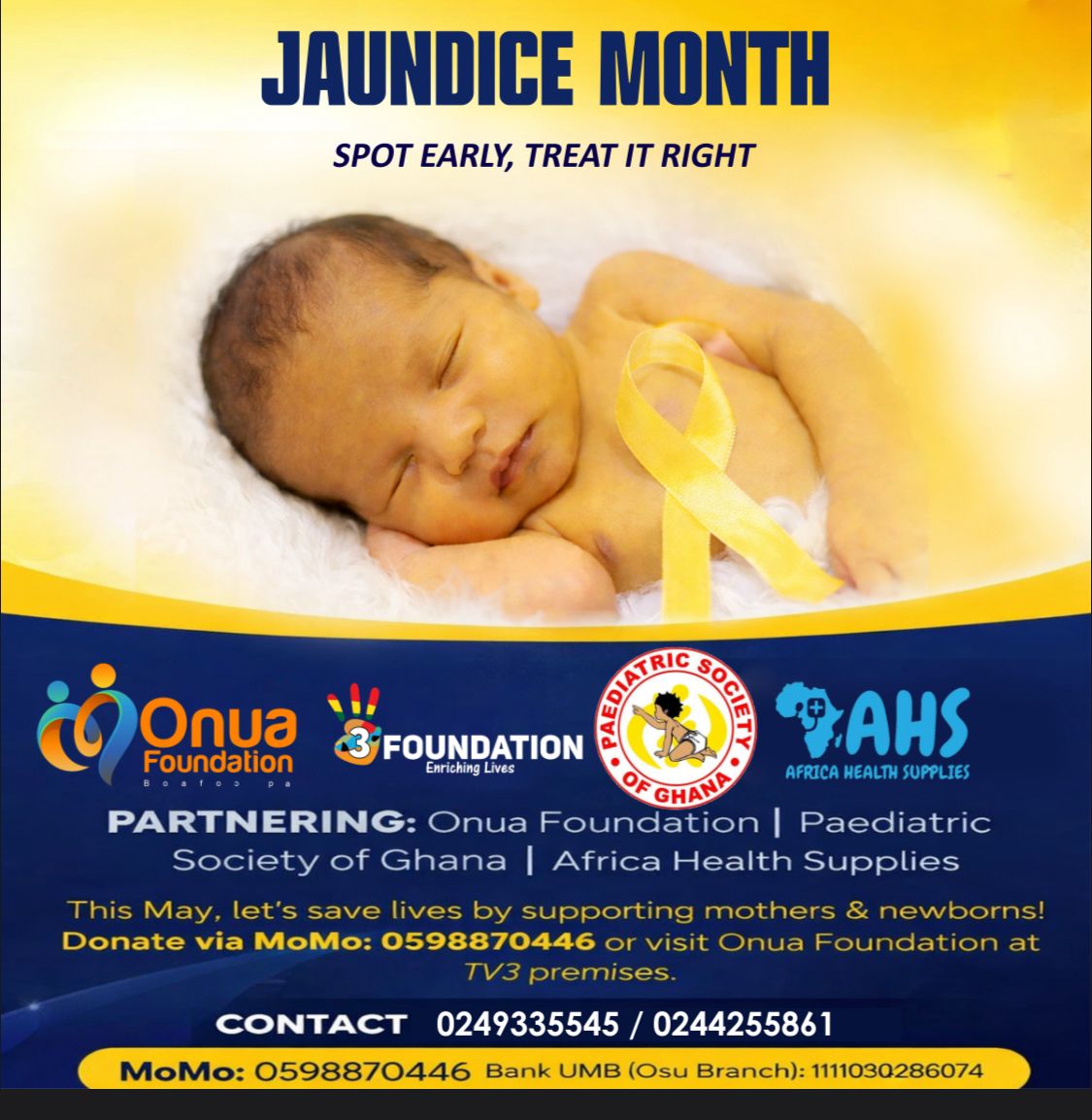

As global attention turns to Jaundice Month in May, Onua Foundation together with health experts are warning that deep cuts in international aid are quietly reversing years of progress in child survival across Africa — including Ghana.
What was once a steady decline in preventable child deaths is now under threat, as shrinking donor funding weakens the very systems designed to protect the most vulnerable.
A Silent Crisis in Child Health
Across Africa, health systems have long relied on international support to sustain:
- Immunization programmes
- Malaria prevention and treatment
- Neonatal and maternal care
- Nutrition interventions
With global aid declining, many of these services are being scaled back or stretched thin. The result is stark: conditions that were once preventable are becoming fatal again, particularly among children under five.
In Ghana, the pressure is already visible. Reduced external funding is forcing government and health institutions to stretch limited resources, raising concerns about service gaps in rural and underserved communities.
The withdrawal of about $78 million in USAID health funding has affected many child health programs in Ghana.
Government has had to reallocate budgets, increase NHIS funding, and seek private partnerships just to maintain service continuity.
Even with mitigation efforts (like drone delivery of medical supplies), the system is under pressure:
Reduced donor support = greater strain on domestic financing
Increased risk of service gaps, especially in preventive care. Impact on Child Mortality
Reversal of Decades of Progress
Global aid has historically:
Reduced child mortality by up to 39% between 2002–2021
Now, the trend is reversing:
Child deaths are rising again for the first time in decades
Progress toward ending preventable deaths by 2030 is slowing dramatically
Projected Increase in Child Deaths
The data is stark:
5.4 million additional child deaths could occur by 2030 due to aid cuts
A 20% drop in health funding could lead to 12 million more child deaths by 2045
Nutrition cuts alone could cause 369,000 additional child deaths annually
Jaundice: A Preventable Killer Still Claiming Lives
Against this backdrop, the observance of Jaundice Month in May — under initiatives like Project Clear the Yellow — a partnership between Onua Foundation, Paediatric Society of Ghana and Africa Health Supplies, takes on renewed urgency.
Neonatal jaundice, a common condition in newborns, is highly treatable when detected early. However, in low-resource settings:
- Delayed diagnosis
- Limited access to phototherapy
- Weak referral systems etc,..
can turn a manageable condition into a life-threatening one.
Health professionals warn that funding cuts are undermining early detection and treatment systems — precisely the kind needed to prevent jaundice-related complications such as brain damage or death.
From Funding Gaps to Rising Mortality
The link between reduced aid and rising child mortality is becoming clearer:
- Fewer outreach programmes mean less early screening for newborn conditions
- Weak supply chains limit access to essential treatment equipment
- Underfunded health facilities struggle to respond quickly
For jaundice and other neonatal conditions, timing is everything — and delays cost lives.
A Call for National and Corporate Action
Onua Foundation together with our trusted health experts say the solution cannot rely on global aid alone.
Government is being urged to:
- Prioritize child health in domestic budgets
- Strengthen primary healthcare systems
- Expand access to neonatal care equipment
At the same time, the private sector is being called upon to step up through strategic corporate social responsibility (CSR):
- Funding neonatal care units
- Supporting awareness campaigns during Jaundice Month
- Investing in health logistics and early detection tools
Innovation as a Lifeline
There is also growing recognition that technology — particularly AI and data-driven systems — can help bridge the gap.
Predictive tools can:
- Identify high-risk newborns earlier
- Improve resource allocation
- Support faster clinical decisions
In a resource-constrained environment, smarter systems could mean the difference between life and death.
Why Jaundice Month Matters Now More Than Ever
Jaundice Month is no longer just an awareness campaign — it is a national and continental call to action.
It highlights a simple but urgent truth:
No child should die from a treatable condition.
Yet without sustained investment, awareness, and innovation, that goal remains at risk.
The Bottom Line
Global aid cuts are exposing the fragility of health systems across Africa. But they are also creating a moment for reset and responsibility.
As Ghana marks Jaundice Month this May, the message is clear:
- Protect child health
- Invest in early detection
- Build resilient systems
Because in the end, the cost of inaction is measured not in budgets — but in lives.