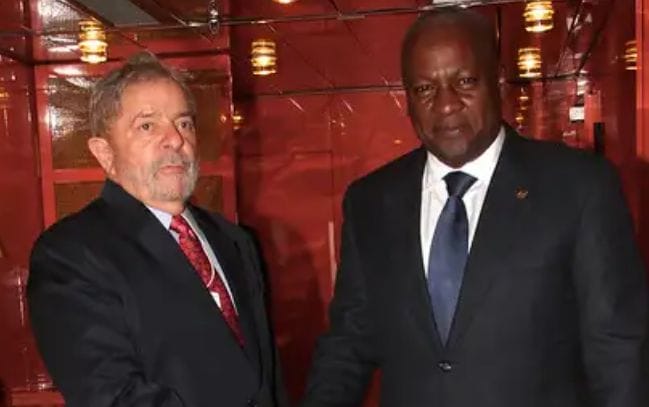

President John Dramani Mahama’s quest to table before the United Nations (UN), a resolution seeking a formal recognition of the transatlantic slave trade as the “gravest crime against humanity”, has been endorsed by Brazil’s President, Luiz Inácio Lula da Silva.
Lula da Silva, speaking at the Community of Latin American and Caribbean States (CELAC)–Africa Summit in Bogotá, Colombia, where he pledged support for the motion to be tabled at the UN General Assembly on Wednesday, March 25, 2026, by President John Dramani Mahama.
“Brazil supports the African Group at the United Nations in recognising human trafficking and the slave trade as among the gravest atrocities in human history,” President Lula said.
The proposed motion seeks the historical injustices of slavery to be formerly recognised, and also calls for the return of stolen artefacts regarded as symbols of African kingdoms, culture and heritage.
It also forms part of broader efforts to advocate structural reforms within the global system to ensure equal opportunities for people of African descent and African countries.
President Lula’s endorsement is expected to strengthen momentum for the resolution, particularly given Brazil’s historical role as a major destination during the transatlantic slave trade.
Historians estimate that more than 12 million Africans were forcibly taken from the continent, with Brazil emerging as one of the principal destinations where enslaved people were used on plantations and in other forms of labour across the Americas and Europe. Today, Brazil is home to one of the largest populations of people of African descent outside the continent.
Growing international support
Ghana’s diplomatic push has already secured backing from the African Union and the Caribbean Community (CARICOM), alongside expressions of support from several Asian countries.
Ghana’s Minister of Foreign Affairs, Samuel Okudzeto Ablakwa, in an interview with Russian Television said the coalition reflects a glowing consensus among countries in the Global South who express the need for the enduring legacy of slavery to be confronted.
Mr Ablakwa stressed that the resolution was grounded in historical accountability rather than financial claims.
“The call for reparatory justice is about a shared recognition of the profound injustices inflicted on Africans and their descendants. It is not merely a pursuit of monetary compensation,” he said.
Implications for global justice debate
During his address to the UN General Assembly in 2025, President Mahama, who serves as the African Union’s champion on reparations, first outlined plans to table the resolution.
If adopted, the resolution is expected to strengthen international legal and moral frameworks addressing the long-term socio-economic consequences of slavery, while intensifying global debate over reparations.
It is also likely to increase pressure on former colonial powers and institutions linked to the slave trade to acknowledge responsibility and consider restitution measures.
For Ghana, the initiative aligns with its broader foreign policy agenda of historical redress, diaspora engagement and positioning the country as a leading voice on issues of global justice.
Mahama to file historic motion on Transatlantic Slave Trade at UN assembly on March 25