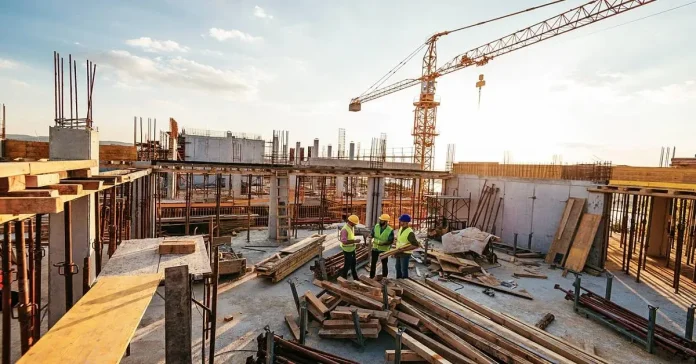

Ghana’s building construction inflation continued its steady downward trend in December 2025, easing to 4.4 per cent from 5.9 per cent in November, according to the latest Prime Building Cost Index (PBCI) released by the Ghana Statistical Service (GSS).
The December figure marks the eighth consecutive year-on-year decline in building cost inflation, signalling a gradual easing of cost pressures within the construction sector after a prolonged period of elevated prices. Government Statistician Dr Alhassan Iddrisu said the latest data underscore a sustained slowdown in construction inflation.
“Building inflation has declined for eight straight months. The December 2025 inflation of 4.4 per cent is 18.2 percentage points lower than the 22.6 per cent recorded in December 2024,” Dr Iddrisu noted.
Data from the GSS show that the PBCI stood at 131.0 in December 2025, marginally lower than the 131.3 recorded in December 2024, reinforcing the broader moderation in construction costs over the past year.
On a month-on-month basis, however, building input prices recorded a 0.2 per cent movement between November and December 2025, indicating mild price changes despite the overall annual decline. According to the GSS, this suggests short-term price adjustments even as longer-term inflation pressures continue to ease.
A closer breakdown of the data reveals differing trends across cost components. Labour costs remained relatively high, with year-on-year labour inflation at 10.7 per cent, although this represents a decline from 12.7 per cent in November. Materials inflation eased further to 2.7 per cent, while plant and equipment inflation edged up to 5.6 per cent, even as both categories recorded month-on-month price declines.
At the sub-group level, equipment, skilled labour and steel were the largest contributors to construction inflation. In contrast, cement and reinforcement recorded negative inflation, reflecting falling prices in those segments of the market.
The GSS said the stabilisation in construction costs presents opportunities for households, businesses and government. It encouraged individuals to consider starting or resuming building projects, advised businesses to lock in current prices through medium-term contracts, and urged the government to fast-track infrastructure projects while costs remain relatively lower.