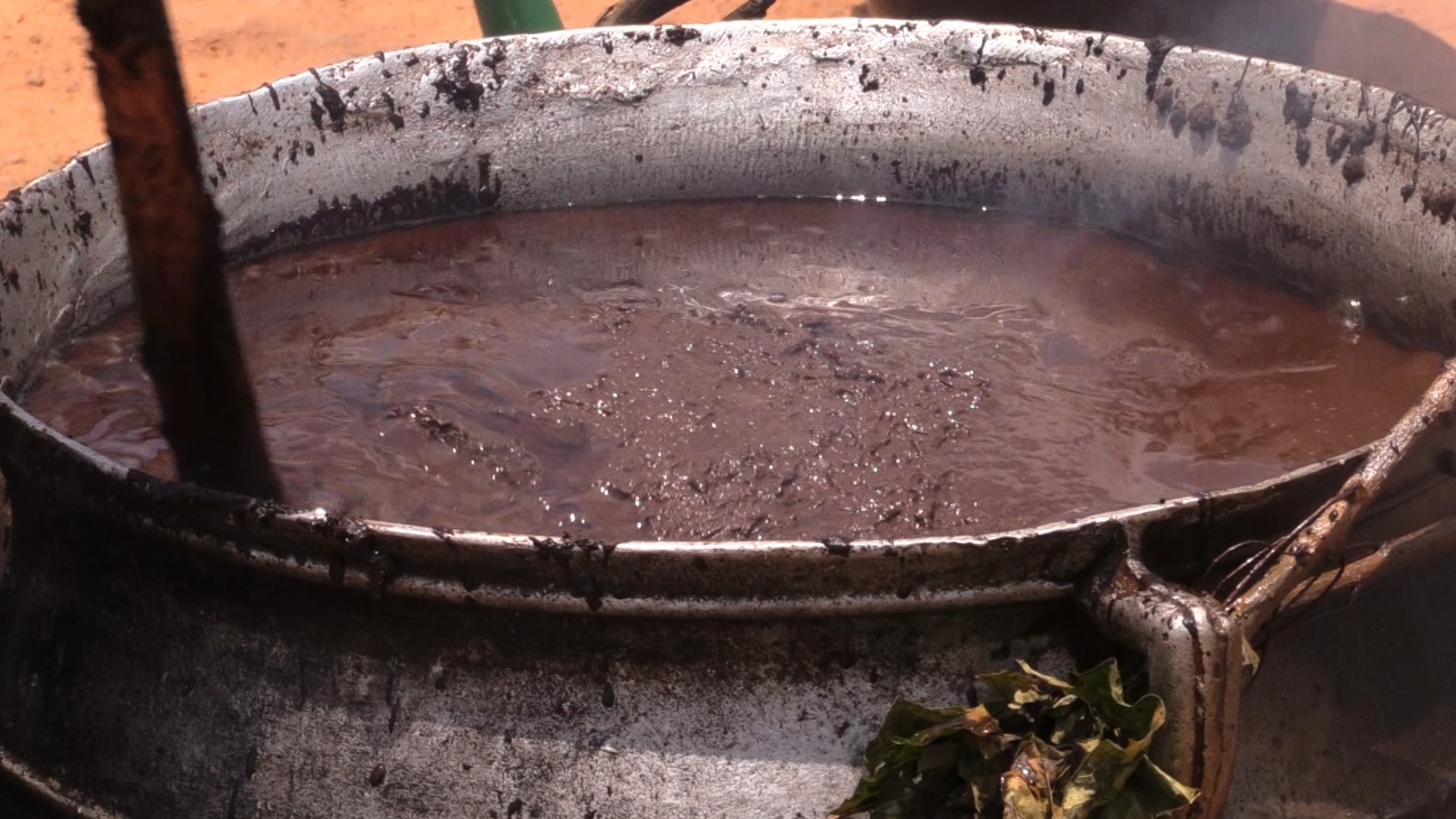

Many families in Omankrado Brom have been supported by the local palm kernel oil processing trade for decades.
Yet behind every gallon produced is a story of endurance and daily struggle.
Aunty Abena, has been in the trade for over thirty years. She describes the exhausting hours spent on sorting out kernels, sending it to the mill before cooking to extract the oil.

“We first sort out the raw kernel, crash it to get the fruit out, fry it and take it to the mill to be grinded and before final processing to extract the oil.”
She says most of the work is still done manually despite technological advancements.
“If we were to have machine, our work would have been easy and faster.”

For other processors the patronage and uneven pricing put all tedious work of stirring large pots under the blazing sun with no shelter in vain hence the need for a shelter.
“Patronage used to be high but after the reduction of the price of vegetable oil, production has decreased. Our working condition is not good. We appeal to the authorities to help us with a local factory and capital to enhance our production,”one of them appealed.

Another shared her experience, “If we get shelter it will really help us. There is no place for us to sit. We sit under the scorching sun to work. After everything we are left tired. If we get the machine too it will help support us.”

Professor of nutrition, Professor Debrah emphasized that palm kernel oil is more than a traditional staple.
“Palm kernel oil has a lot of vitamin K. In fact, it has a higher vitamin K level than that of palm oil. It also has some amount of vitamin E. Palm kernel oil has some fatty acids, but it doesn’t mean they are bad. They are used actually in cosmetics also. So that’s the nutritional value.”

For him, it is rather unfortunate that its full potential remains untapped due to limited market access and poor infrastructure.
“Even as we try to industrialize our oil extraction process, we need to actually look at those small-scale artisanal processes and then help for them to do their processes better. And I think when that is done and we are able to address this in palm kernel oil processing, you get palm oil, palm kernel oils that are attractive, that are healthy or safe and wholesome. As we think of investing to encourage large-scale processes of oil etc, we still need to look at what the traditional oil processes also do,” he said.

Community leaders are therefore calling on government and all stakeholders to support the women. They are calling for local processing facilities that will provide machines, shelter, and good road network for better access to market.
“We need our women to be supported. Especially, those with vocational skills so that they can build on it and support their families. We also need our roads fixed so that the transport of goods and services will be much easier.”
As the world continues to celebrate International Women’s Day, these producers remind us that true empowerment goes beyond recognition. For them, it means practical support, modern facilities, that allows their hard work to feed families, strengthen communities, and contribute to national development.