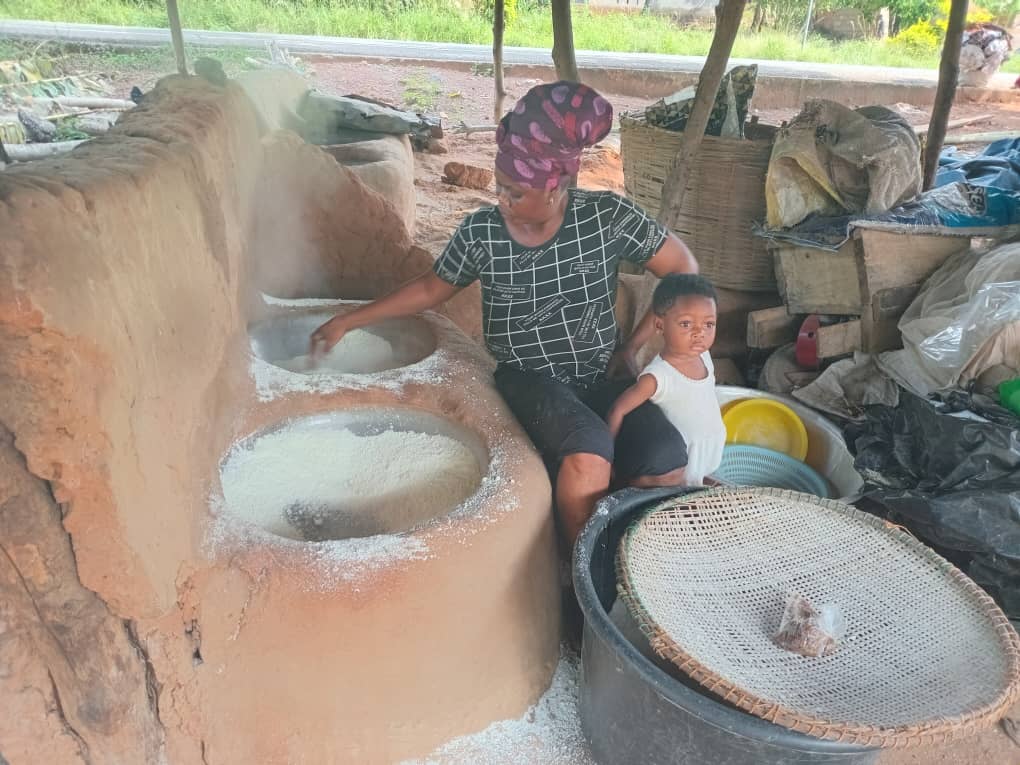

Growing market saturation and rising production costs are crippling gari processors in Abrewankor in the Yilo Krobo municipality of the Eastern Region.
This development is threatening livelihoods and prompting urgent calls for government intervention through the School Feeding Programme, Buffer Stock Company, establishment of factories and export linkages.
The processors, most of whom are women, say the once-thriving trade has experienced a sharp downturn due to market saturation and reduced patronage. They are therefore calling for inclusion in the national School Feeding Programme and support from the Buffer Stock Company to help stabilise demand.
Ms Salomey Oheniba, a processor in the community, explained that although sales were previously encouraging, buyers have recently stopped coming in significant numbers.

“Sales were good previously, but lately buyers have not been coming. Government should intervene to help us get buyers. The education of our children is being affected,” he said.
She noted that high labour, transportation and grating costs, coupled with expensive processing and packaging, have worsened their plight. She added that access to modern equipment would significantly improve productivity and product quality.
Georgina Tetteh Atta, a farmer and gari processor with three decades of farming experience and ten years in gari processing, said she ventured into processing to cushion herself against fluctuating cassava prices.

“Most times, cassava demand goes down, but gari can be processed and stored for a long time and sold later,” she explained to Onua TV News’ Nene Ayertey David.
However, she said increasing numbers of processors have led to stiff competition and reduced sales. According to her, Abrewankor currently has 79 gari processors, including eight men. Despite the effort, she said the market situation has resulted in a backlog of cassava on farms.

“We are appealing to government to buy gari from us for the School Feeding Programme to help us cater for our families,” she stressed.
Salomey Oheniba, who has processed gari for 20 years, said the business has become increasingly difficult.
“I have more than 20 bags unsold. Cassava and labour are expensive, and sales are slow. Many of us are stopping. We appeal for government’s intervention,” she said.
Georgina Tetteh, who has been in the trade for 25 years, described the current situation as dire.
“Previously, the business was good, but now things are bad. We cannot even cater for our families. This is our only work,” she said, urging government to include them in the School Feeding Programme.
The Chief of Abrewankor, Nene Tetteh Addey I, also added his voice to the appeal. He noted that gari processing is the main economic activity in the community and called on government agencies to support the processors.

He suggested that the Buffer Stock Company could help by purchasing their product, while investment in modern equipment or a processing factory would enhance production capacity.
“They currently use local methods and cannot produce in large volumes. Support for equipment or a factory will boost their output,” he stated.
“We want to be connected to exporters who come to Ghana to buy gari in large quantities,” he said, also urging the Regional Minister, the Municipal Chief Executive and managers of the School Feeding Programme to help.