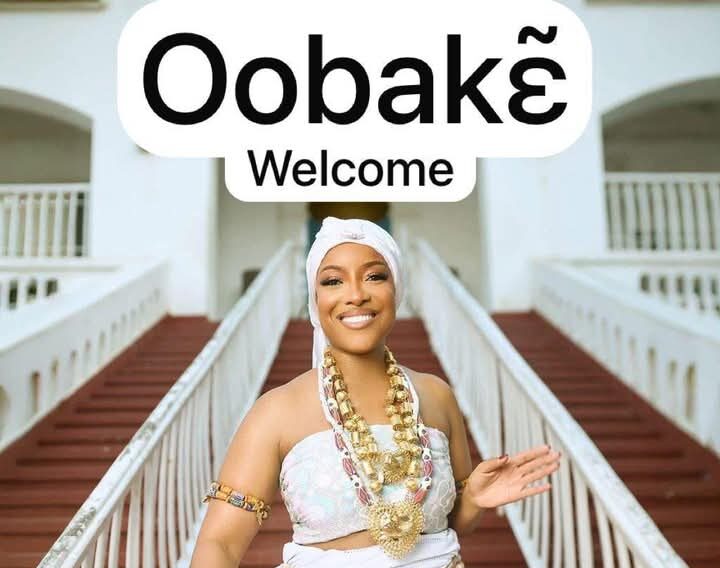

Oooh how a Ga word can set social media agog. Oobakɛ̃- fully expressed as Obaabakɛ̃, meaning you will definitely come, has become a pleasant discovery to some, while others poohpooh its emergence, nay, existence.
I am Ga, studied the language as a subject at Kinbu Sec Tech and Accra High School yet did not come across the word Oobakɛ̃.
It was when I took up the only vacancy at Datus Complex Schools, Bubuashie Branch at the time- Ga teacher, that I read about the word for the first time. It was during my research to treat the topic ‘The Homowo Festival.’
The story is that on the Thursday before Friday, when the Twins Yam Festival (Haajii ayɛlɛ yeli) is celebrated, Ga natives, wherever they are domiciled, returned home. They are called Soobii (Thursday People). Upon arrival, they are welcomed with the phrase, “Nyɛaabakɛ̃-plural or Oobakɛ̃- singular.
Subsequently, I heard my aunties use Oobakɛ̃ to welcome my brothers when they returned from abroad. So, I grant the benefit of the doubt to those who claim not to have heard the word, ever, in their over fifty years presence in this world, although they are Gas.
The good thing though, is that through the debate generated over Oobakɛ̃, one conclusion can be drawn- the Ga language is gradually becoming extinct. And the reasons are not farfetched:
Ga parents speaking English with their children
I look at them with sympathy while they do it with so much relish- a Ga mum telling baby Kpakpo in English- stop it, come here, give me the pen, say goodbye to grandma.
What this mum is inadvertently doing is depriving baby Kpakpo of a fundamental right to know and speak the Ga language. In the end, baby Kpakpo will grow into a handsome Ga man who does not know that stop is ‘Kpa’, come here is ‘Ba biɛ’, a pen is called ‘Niŋmaa tso’, goodbye is ‘Yaaba’ or ‘Yaakwɛ jɛi’ and his beloved grandma is called ‘Naa’ or ‘Nanaa.’
When he introduces himself proudly to anybody as Richmond Kpakpo Allotey and he is asked, ‘Owieɔ Ga lo?’ Do you speak Ga? He looks away briefly and smiles without a clue on how to respond to that question.
Back at home, he complains to mum who unashamedly tells him to respond- ‘Minuɔ, shi minyɛɛɛ mawie’- I understand but cannot speak. The time to stop this anti-culture practice is now!!
I hasten to add that those who speak the indigenous Ga are gradually reducing in number owing to resettlement and migration. So, Ga parents, please stop being more English than the King of England.
Here I am, my mum and dad spoke Ga with me at home, I grew up among my cousins who spoke Hausa, in a community full of Akan traders- Okaishie. So, I speak Ga, Twi and Hausa. Yet I made grade 3 in English language at the O-Level. And by the Grace of God, a journalist- a GJA award winning columnist at that. I may not speak fluent English like the British, but I know the language through and through.
The point is, speaking English with your child is no guarantee that they will excel at it. The only guarantee is that they will be denied knowledge and understanding of their native language.
Many languages in Accra
I have heard some persons who are described as Ga experts say that the phrase- ‘Ablekuma abakuma wɔ’ represents our hospitable nature.
So, we welcomed our fellow Ghanaians onto our land with open arms. And there are other nationals too- from across the world. They now share all we have with us. Thanks to the colonial administration, who in 1877, moved the seat of government from Cape Coast to this place.
From what I have read, this change was driven by a combination of factors, including security concerns, a more suitable climate and sanitation for European administrators, and Accra’s growing importance as a commercial and trade center with a natural harbour.
Therefore, any Ga child gets exposed to all manner of languages. I forgot to add the little Ewe I speak. As such, depending on where one is born in Accra, even if your parents speak Ga with you, you get exposed to other languages. While this may turn one into a polyglot, the down side is that you lose the opportunity to know your indigenous language into to.
So, the other day, a young Ga colleague of mine with a surname Tetteh, raised his eyebrows when I responded to a question by my boss- What is Good afternoon in Ga? At the hearing of ‘Minaokoo’, he shouted, “I’ve never heard it before. I know about Ojekoo”- Good morning. Quess what? Master Tetteh knows that ‘Maa ha’ is good afternoon in Twi. Indeed, Twi has become the language for all transactions in Accra.
Sometimes, as a Ga, I start a conversation in Twi with a trader, taxi driver, shop attendant or food vender, but upon carefully analyzing how they pronounce certain words and phrases, I determine that Ga is their first language. Then I switch, they respond and we go like hmmm…
Inter-marriages
Gas have married Akans, northerners, name it. And from what I hear, Ewe women love Ga men to bits. Good news for a united Ghana.
However, for many of such couples, English is the medium of communication. And when the children start arriving, there is conflict over which language should be spoken in the house. Usually, depending on the levels of education of the couple, the compromise language is English.
In other instances, mum speaks her language with the children and dad does same. If the dad is Ga, chances are that the children will bear Ga names but mum’s language shall predominate in conversations with them at home.
That reminds me, I have some nephews whose mum is Ewe. They can’t express one statement in Ga to save their lives. Haha! But it’s not their fault. Is it?
Non-teaching of Ga in schools within the Greater Accra Region
The situation gets murkier. In the scenario where English is the compromise language at home, one could take solace in the possibility of Ga being taught in school within the Greater Accra Region. But No.
Either the non-Ga proprietors don’t want it, or they cite the non-availability of Ga teachers-Tsɔɔlɔi for their inability to offer the subject as part of their curricula.
Consequently, Ga children are forced to learn Twi in the Greater Accra Region. If you are a Ga child and your parents do not speak the language with you at home and your school forces Twi on you, how else can you get to learn the language?
Maybe through friends and classmates. But that is only if what they know and speak is anything to go by.
No conscious effort by the custodians of our culture to protect the language
According to AI and I believe same to be true that, “a traditional chief serves as a spiritual, political, and social leader, responsible for administering justice, maintaining community welfare, managing land and resources, performing ceremonial duties, and acting as a link between the community and external authorities, all while preserving cultural traditions and fostering development and peace within their traditional area.”
“…all while preserving cultural traditions…” is what interests me here. AI adds and I agree that, “Culture encompasses national, regional, and community identities, influencing everything from language and food to social norms, laws, and moral frameworks.”
Unfortunately, ever since I have been around, I have never seen any conscious effort by our chiefs, Ga Traditional Council, to promote and protect the Ga language.
In this regard, let’s give the plaudits to the Ghana Broadcasting Corporation which has considered it a sacred duty to have shows in Ga on GTV as well as operate Ga Radio and TV channels (Obonu Radio and TV).
One would have thought that our traditional leaders would take a leaf from the GBC book by executing the mandate of promoting and protecting the language. I stand corrected, but none of them has invested the numerous royalties and proceeds from land sales into a radio or TV station.
I have never heard any of them sponsoring a best student in Ga in any primary or secondary school. I have never heard any of them sponsor a Ga quiz programme on TV or radio.
On Saturday, 13th September, 2025, I was scanning the channels on my car radio and chanced upon a discussion in the Ga language. Strange… I muttered. I looked at the frequency and it was 102.7 – Mothers FM. The topic under discussion made me stay tuned- the ‘Dying’ Ga language.
I took one message away as I alighted from my car- There are enough Ga language teachers in the Greater Accra Region and it is the duty of ‘wɔtsɛmɛi’ (our elders) to ensure that our language is saved from extinction.
It’s time to go
With my immense knowledge of the language, I am clear in my mind that the reference to ‘wɔtsɛmɛi’ is to no other group of persons than the Ga chiefs- Ga Mantsɛ, Osu Mantsɛ, La Mantsɛ, Tɛshie Mantsɛ, Nungua Mantsɛ, Tema Mantsɛ and Kpone Mantsɛ as well as their councils of elders.
In my opinion, here is what they have to do and fast:
- Set up radio and TV stations urgently to augment the efforts of the Ghana Broadcasting Corporation in protecting the language.
- Sponsor half-year inter-school Ga quiz at primary, Junior High and Senior High schools immediately.
- Negotiate with all Chief Executives of Metropolitan, Municipal and District Assemblies (MMDAs) within the Greater Region to display Oobakɛ̃, boldly at their entrances and receptions.
- Use the annual Homowo festival to rekindle interest in the language by:
- organizing symposia to discuss how to sustain the Ga language.
- hosting Ga drama sessions at the National Theatre and other cultural centres during the Homowo period.
- Showing self-sponsored Ga movies at cinema houses within the region- Jeffrey Nortey can lead this project.
- Negotiating with media owners in the region to offer some airtime for discussions on challenges confronting the Ga state as well as promoting the language during the Homowo festivities.
- Liaising with the Ghana Institute of Languages to address any possible shortfall in the required number of Ga teachers in the region. If it means sponsoring students for this purpose, why not?
- Collaborating with the Ghana Education Service (GES) and the Conference of Heads of Assisted Secondary Schools (CHASS) to enforce the teaching of Ga language in all primary and secondary schools within the region.
If ‘wɔtsɛmɛi’ are able to do these very well, I have no doubt that we will save the Ga language from imminent extinction. And they must do this because “Our language is the reflection of ourselves. A language is an exact reflection of the character and growth of its speakers.” – Cesar Chavez- An American labour leader.
If they don’t, by their inaction, they shall remain irrelevant to the majority of Gamɛi.
Wɔbaakpe ekoŋŋ – That’s another way of saying goodbye in Ga.
Let God lead. Follow Him directly, not through any human.
The writer is the Ghana Journalists Association (GJA) Columnist of the Year- 2022. He is the author of two books whose contents share knowledge on how anyone desirous of writing like him can do so. Eric can be reached via email [email protected]