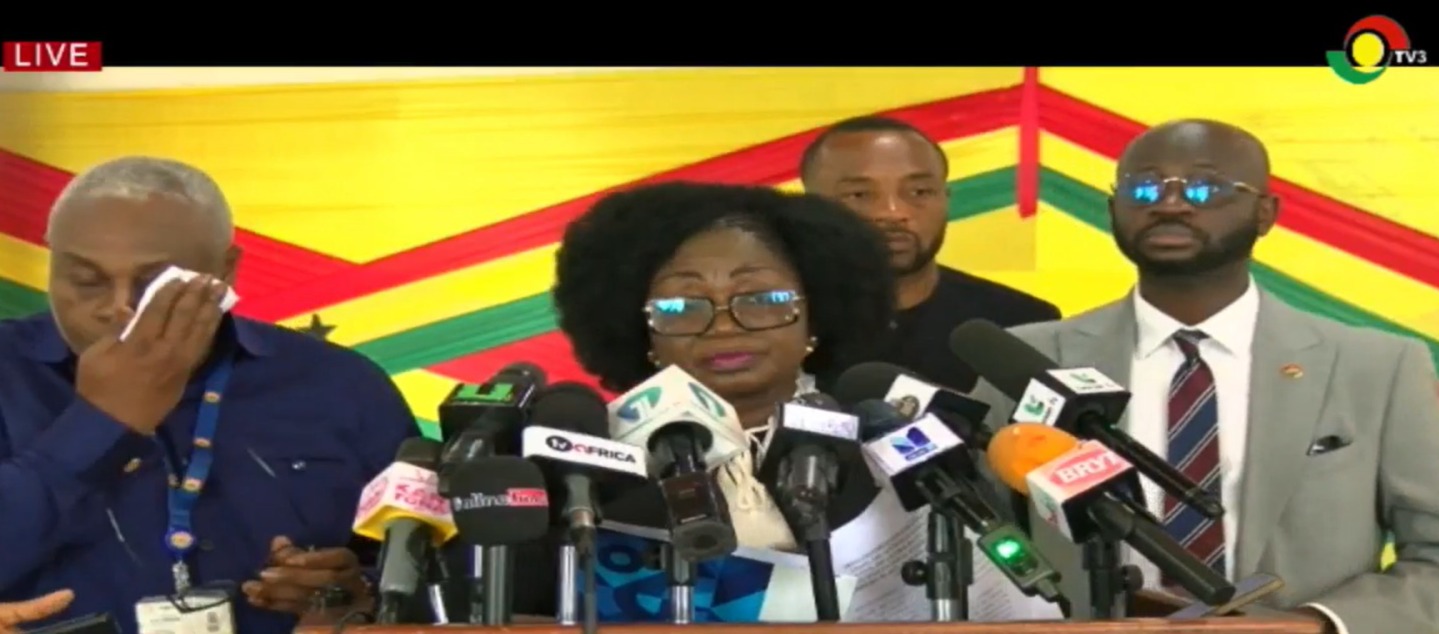

The Minority in Parliament has questioned circumstances leading to the release of an amount of GHC350 million from the Contingency Fund at a time when the fund in under a garnishee order.
Please read the full statement below:
PRESS CONFERENCE ON A REPUBLIC GOVERNED BY CHAOS: THE ATTORNEY-GENERAL’S UNLAWFUL DIRECTIVE, THE CENTRAL BANK’S DEFIANCE, AND THE UNCONSTITUTIONAL WITHDRAWAL OF GH¢350 MILLION BY HON. PATRICIA APPIAGYEI, DEPUTY MINORITY LEADER
Ladies and gentlemen, Good morning
Last week, this country suffered the worst flooding in its recorded history. Thirty-four(34) of our compatriots lost their lives. Ninety thousand were displaced across seven (7) regions. In that dark hour, we supported the swift release of emergency funds and asked only for transparency, accountability, and fairness to flood victims in every region of this country.
Today, we stand before you with a document and a revelation. The document is a letter, on the letterhead of the Office of the Attorney-General and Ministry of Justice, dated 1 July 2026, signed by the Attorney-General and Minister for Justice himself, and addressed to the Governor of the Bank of Ghana. Copies will be made available to you. The revelation is what happened after that letter was delivered, a sequence of events that exposes a government in constitutional chaos, where the Attorney-General directs illegality, the central bank refuses him, and GH¢350 million of the people’s money moves through channels Parliament never approved.
1. WHAT THE ATTORNEY-GENERAL’S LETTER SAYS
In this letter, headed “Release of Funds from the Contingency Fund for the National Emergency Flood Response Programme”, the Attorney-General writes to the Governor of the central bank, and we quote his exact words: “I am aware that the Contingency Fund is presently the subject of garnishee proceeding.”
Pause on that sentence, ladies and gentlemen. The Attorney-General of the Republic confirms, in writing, that the Contingency Fund, a fund established by the Constitution of Ghana is under garnishee proceedings before a court of this land. A judgment creditor has moved against the very fund from which Parliament approved GH¢350 million for flood victims. Until this moment, neither the government nor the Attorney-General had breathed a word of this to Parliament or to the people of Ghana.
And what does the Attorney-General do, confronted with a court process against a constitutional fund? Does he go before the court? Does he apply to vary or discharge the attachment? Does he plead the national emergency before a judge, as the law provides and as any diligent counsel would? No. He continues, and again we quote: “Notwithstanding those proceedings, it is my considered opinion that the exceptional circumstances surrounding this national emergency and the overriding public interest in safeguarding lives and property warrant the immediate release of the approved funds.” He then advises the Bank of Ghana to “give effect to the approvals and directives already issued” and to release the GH¢350 million from the Contingency Fund “without delay”.
There it is, in his own hand. The Attorney-General, aware of a subsisting court process, directed the central bank of the Republic to proceed notwithstanding it on no authority but his own “considered opinion”. In the Republic of Ghana, court processes are not overridden by the considered opinion of any Minister. They are varied, discharged or set aside by the courts that issued them, and by no one else.
2. WHAT HAPPENED NEXT: THE MONEY MOVED, BUT NOT AS PARLIAMENT APPROVED
Now to the revelation. The Attorney-General’s letter speaks for itself. It directed the Governor of the Bank of Ghana to give effect to the release of funds from the Contingency Fund notwithstanding the pending garnishee proceedings. Yet the Ministry of Finance subsequently announced that the GH¢350 million had been released, while the court process remained unresolved. The unavoidable question therefore is: how did the money move?
One conclusion is difficult to escape. If the Contingency Fund remained under attachment and could not lawfully be accessed, then the emergency disbursement could only have proceeded through another public account. In other words, when the approved source became unavailable, an alternative source appears to have been used. If that is what occurred, then Parliament was never asked to approve that alternative source, and the constitutional requirements governing withdrawals from public funds were bypassed.
Yet the Ministry of Finance’s official statement announced, without qualification, that the money had been released from the Contingency Fund. If the funds were in fact drawn from another account, then that statement did not accurately reflect what transpired.
We say to the government: these are your records. The garnishee order, the Bank of Ghana account statements, the Controller and Accountant-General’s transfer advice, all of it sits in your custody. If the GH¢350 million truly came from the Contingency Fund as you told the nation, lay the records before Parliament and prove it. If it did not, then tell Ghanaians which account was used, who authorised the withdrawal, and under what law.
3. THE CONSTITUTIONAL VIOLATIONS
Consider, first, the supremacy of the Constitution and the rule of law under Articles 1(2) and 125. When a court attaches funds by garnishee, the law freezes those funds pending the court’s determination. Every lawyer in this country knows the lawful responses: appear before the court, resist the order, apply to set it aside, or plead the urgency of the public interest to the judge. “Public interest” is an argument addressed to a court. A government whose Attorney-General certifies his own exemptions from judicial process has placed itself above the courts, and a government above the courts is a government outside the Constitution.
Consider, second, Articles 177 and 178. Parliament’s Finance Committee, acting under Article 177(1) on 29th June 2026, authorised a withdrawal from the Contingency Fund from that fund and no other. An authorisation under Article 177 is not a blank cheque cashable against any account of the state that the Executive finds convenient. Article 178 commands, in clear language, that no moneys shall be withdrawn from the Consolidated Fund or from any other public fund of Ghana except upon authorisation given by or under an Act of Parliament or as the Constitution provides. If the GH¢350 million was drawn from any account other than the Contingency Fund, then the approval Parliament granted was never executed, the withdrawal that was executed was never approved, and the Constitution and the Public Financial Management Act, 2016 (Act 921) which criminalises unauthorised withdrawals of public funds have been violated in broad daylight.
Consider, third, Article 88. The Attorney-General is the principal legal adviser to the government and is responsible for the conduct of all civil proceedings against the state. His letter of 1 July 2026 is a written admission of failure on both fronts. As the officer responsible for civil proceedings against the state, he presided over litigation in which a constitutional fund of the Republic was attached and there is no indication that the attachment was resisted or that any application was made to discharge it. As principal legal adviser, when the moment came to counsel lawfulness, he counselled the opposite and was rebuffed by the very central bank he sought to direct.
Consider, fourth, the deception of Parliament and the nation. On 29th June, the Finance Committee approved a withdrawal from a fund the Executive knew, or ought to have known, was under garnishee attachment. Days later, the Ministry of Finance announced to the nation a Contingency Fund release that, on the information available to us, never occurred as described. Concealment of material facts from Parliament, compounded by a false official statement to the public, strikes at the foundation of parliamentary oversight, the power of the purse, and the basic covenant of honesty between a government and its people.
4. THE QUESTIONS GOVERNMENT MUST ANSWER
The Minority therefore demands immediate and complete answers to the following questions. Which court is seized of the garnishee proceedings against the Contingency Fund? In respect of which judgment debt, in which suit, and for what amount? When was the Republic served, and what did the Attorney-General’s office do about it? Did the government know of the proceedings on 29th June, when it stood before the Finance Committee and obtained approval and if so, why was the Finance Committee not told? Did the Bank of Ghana decline to give effect to the Attorney-General’s directive, and on what legal advice? From which account, precisely, was the GH¢350 million withdrawn, on what date, on whose instruction, and under what authorisation? And the question that towers above all the others: by what law does an Attorney-General’s “considered opinion” suspend the process of a court of the Republic?
5. THE FINANCE MINISTER’S ACCOUNT TO PARLIAMENT
The role of the Minister for Finance in this affair demands independent scrutiny by Parliament. On 29 June 2026, the Minister came before Parliament’s Finance Committee seeking approval to withdraw GH¢350 million from the Contingency Fund. At that moment, one of two things must have been true. Either the Minister knew that the Contingency Fund was already the subject of garnishee proceedings and failed to disclose that material fact to Parliament, or he sought parliamentary approval without knowing that the constitutional fund under his stewardship had become entangled in court proceedings. Neither possibility inspires confidence.
Matters become even more troubling if, as the information available to the Minority suggests, the funds were ultimately released from an entirely different public account. If the Minister authorised or became aware of that alternative arrangement, why did he not return to Parliament for fresh approval? Why did the Ministry of Finance subsequently announce that the funds had been released from the Contingency Fund? Was Parliament misled? Were Ghanaians misled? These are questions that only a full parliamentary inquiry can answer.
6. THE CORRUPTION DIMENSION AND THE JUDGMENT DEBT BEHIND THE ORDER
Let no one mistake this for a technical dispute among lawyers. When GH¢350 million of public money moves out of an account Parliament never approved, under cover of an official statement naming a different source, outside every control that the Constitution and the PFM Act erect around public funds, the conditions for corruption are perfect. Which account was debited? What else sits in that account, and what other withdrawals have been made from it on the strength of Executive instruction rather than parliamentary approval?
7. A CATALOGUE OF GOVERNANCE FAILURES
Step back and observe the picture, ladies and gentlemen. A constitutional fund of the Republic was dragged into garnishee proceedings and the government told no one. Parliament approved an emergency withdrawal without being told the fund was encumbered. The Attorney-General, guardian of legality, overreached by directing the central bank to disregard a subsisting court process on the strength of his personal opinion. The money then moved from an unapproved account. And the Ministry of Finance announced to the nation a version of events that the government’s own records will not support. The Attorney-General’s letter itself referencing a telephone conversation with the Governor that very afternoon and directives “already issued” paints the picture of a government scrambling in panic to paper over a problem it should have seen coming and should have handled in open court.
This is chaos. A government cannot preach fiscal discipline while its Attorney-General treats court processes as inconveniences. It cannot claim to be resetting the economy while demonstrating to every investor, every development partner and every judgment creditor that in Ghana, the state’s accounts are managed by ambush, improvisation and concealment. And it cannot look flood victims in the eye while the institutions meant to protect the funds for their relief are at war with one another over whether to obey the courts.
8. THE ATTORNEY-GENERAL MUST RESIGN
Ladies and gentlemen, offices of state are defined by their moments of trial. For the Attorney-General, this was such a moment. But that moment did not begin with the letter of 1st July 2026. It began much earlier.
We are in possession of court processes relating to these garnishee proceedings. Those processes reveal that the Republic was not ambushed. The litigation followed the ordinary course of judicial proceedings. Court processes were served. Procedural opportunities existed for the Republic to respond, to protect its interests and where appropriate, to seek relief from the court. Yet despite all these opportunities, a constitutional fund of the Republic became entangled in garnishee proceedings. That is the product of neglect.
An Attorney-General who presides over the attachment of a constitutional fund has failed in diligence. An Attorney-General who conceals that attachment from Parliament has failed in candour. An Attorney-General who directs the central bank to proceed “notwithstanding those proceedings” on the strength of his own opinion has failed in fidelity to the very Constitution he swore to uphold — and has exposed himself to proceedings for contempt of court. And an Attorney-General whose directive is so plainly unlawful that the central bank of the Republic refuses to carry it out has been repudiated not by his political opponents, but by the institutions of his own government.
Let no one plead the emergency in his defence. The emergency demanded speed before a judge, not a coup against the court’s process. Any competent Attorney-General could have secured the lawful release of these funds within twenty-four hours by moving the court, disclosing the urgency and letting the judicial process work as it was designed to. The flood victims of this country deserved that Attorney-General. They did not get him. The Minority Caucus accordingly calls on the Attorney-General and Minister for Justice to resign forthwith. Should he fail to do the honourable thing, we call on the President who swore an oath to preserve, protect and defend this Constitution to relieve him of office without delay.
9. THE DEMANDS OF THE MINORITY
The Minority accordingly demands:
First, that the Attorney-General and the Minister for Finance appear before Parliament without delay to lay before the House the garnishee order, the full record of the suit that produced the judgment debt, the letter of 1st July 2026, and every correspondence exchanged among the Attorney-General, the Ministry of Finance, the Controller and Accountant-General and the Bank of Ghana concerning the attachment, the directive and the withdrawal.
Second, that the Governor of the Bank of Ghana state publicly whether the Bank declined to give effect to the Attorney-General’s directive, from which account the GH¢350 million was in fact released, and on whose instruction.
Third, that the Auditor-General immediately conduct a special audit of the flood response disbursement from source to destination and report to Parliament.
Fourth, that the Attorney-General resign or be removed from office. The Minority further serves notice that, should candid answers not be forthcoming, we shall pursue every parliamentary and legal avenue available to us including a motion for a full-scale parliamentary inquiry and recourse to the Supreme Court for the enforcement of the Constitution under Articles 2 and 130.
10. CONCLUSION
Let us be abundantly clear. The Minority stands with the victims of these floods fully and without reservation. Not one pesewa of relief should be delayed, and we shall support every lawful measure to get help to those who need it. Our issue is with a government that conceals court processes from Parliament, directs its central bank into illegality, moves the people’s money through unapproved channels, and then tells the nation a story its own records contradict.
The greatest danger to a constitutional democracy is when those entrusted to uphold the law decide that the law no longer applies to them. In this affair, the Attorney-General presumed to overrule a court by letter. The Executive presumed to substitute Parliament’s approval with its own convenience. The Ministry of Finance presumed that an official statement could replace the truth. That is not the conduct of a government committed to the rule of law. It is the conduct of a government that has begun to confuse power with permission.
We shall not relent and we will continue to keep government to account.
Thank you.