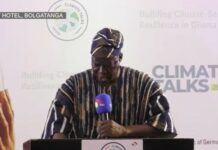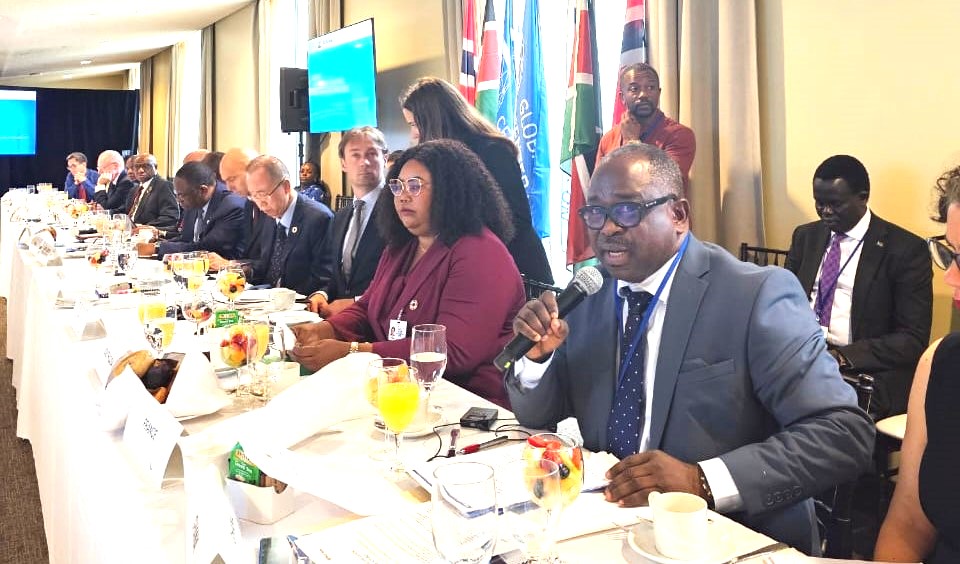

Ghana’s Minister of State for Climate Change and Sustainability, Seidu Issifu, has described the Africa Adaptation Acceleration Programme (AAAP) as a practical and urgent response to the realities faced by millions of Africans.
He recalled Ghana’s own experience with the Akosombo Dam floods, which displaced thousands, and the worsening droughts destroying harvests across Africa.
“Adaptation is not optional for us — it is a necessity,” Mr Issifu stated. “For Ghana, the AAAP is building resilience into the foundations of our economy.”
He highlighted Ghana’s concrete interventions:
• Agriculture: The Tree Crop Diversification Project is safeguarding the future of cocoa, cashew, coconut, and rubber production through climate-smart seeds, digital advisory services, and sustainable land management.
• Energy: The Scaling Up Renewable Energy Programme is expanding solar mini-grids and rooftop systems across the country, embedding climate risk assessments to secure Ghana’s clean energy future.

Debt, Fiscal Space, and the Future of Adaptation
During the discussion, Issifu raised a critical point that resonated across the room: excessive debt burdens are undermining locally led adaptation efforts.
“Creating fiscal space is not only a necessary condition but a sufficient condition for locally led adaptation,” he emphasized. “We must have an honest conversation about financial engineering that allows vulnerable countries to invest in climate resilience without being trapped in cycles of unsustainable debt.”
He urged development partners, sovereign wealth funds, and multilateral institutions to step up with debt relief, climate-aligned financing, and innovative financial instruments that unlock capital for adaptation at scale.

Partnerships for a Resilient Africa
Mr Issifu expressed Ghana’s strong support for AAAP 2.0 – “Blueprint for a Resilient Africa”, which was advanced at the 2nd Africa Climate Summit, and called for partners to scale commitments rather than step back. He stressed that success would depend on sustained collaboration between governments, communities, and the private sector.
Looking ahead to COP30 in Brazil, he reiterated that adaptation must remain front and center of the global climate agenda, and that Africa’s voice — and Africa’s solutions — must be amplified.

A Strong African and Global Presence
The Leaders’ Dialogue featured contributions from H.E. Umaro Sissoco Embalo (President, Guinea-Bissau), H.E. Philip Mpango (Vice President, Tanzania), H.E. Mia Mottley (Prime Minister, Barbados), H.E. Faure Gnassingbé (President, Togo), H.E. Allah-Maye Halina (Prime Minister, Chad), H.E. Luc Mercelina (Prime Minister, Sint Maarten), and H.E. Lamine Zeine Ali Mahman (Prime Minister, Niger).
Dozens of ministers, development partners, and private sector leaders from around the globe reaffirmed their commitment to advancing adaptation solutions for vulnerable nations.
Ghana’s Leadership on the Global Stage
Minister Seidu Issifu’s participation at UNGA80 underscored Ghana’s rising profile as a leader in climate governance and adaptation finance. Through the establishment of the Office of the Minister of State for Climate Change and Sustainability, Ghana is building a governance architecture that places climate action at the heart of development planning, ensuring no community is left behind.
Source: Office of the Minister of State for Climate Change and Sustainability