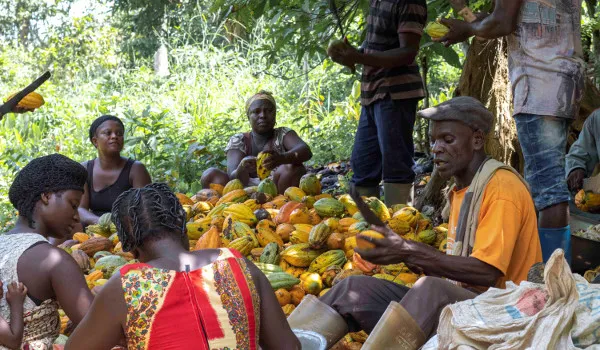

Researchers are calling for a fundamental rethink of cocoa sector policy in Ghana, warning that climate change is increasingly affecting the health, wellbeing, and productivity of cocoa farmers themselves, rather than only the cocoa trees they cultivate.
The call was made at a Research and Policy Breakfast held in Accra, where leading academics, policymakers, cocoa farmer cooperatives, development partners, private sector actors, civil society organisations, and representatives from Ghana’s cocoa sector gathered to discuss findings from a new study titled “Towards a Cocoa Producer-Focused Climate Policy in Côte d’Ivoire and Ghana.”
The research, led by scholars from the Kwame Nkrumah University of Science and Technology (KNUST) and partner institutions such as Harvard University, the Institute for Cacao and Chocolate Research and the Institute National Polytechnique Félix Houphouët-Boigny (INP-HB) in Côte d’Ivoire, argues that current climate adaptation strategies remain overly focused on cocoa production while paying insufficient attention to cocoa producers.
Presenting the findings, Dr. Albert Arhin of KNUST’s Institute for Rural Development and Innovation Studies (IRDIS) noted that climate change is increasingly undermining the human foundations of cocoa production.
“Much of the discussion around climate change and cocoa has focused on yields, pests, diseases, and deforestation. Our findings suggest that climate change is also affecting farmer health, labour productivity, and adaptive capacity. The biggest climate threat to cocoa may no longer be the cocoa tree alone, but the cocoa producer,” he stated.
The study, conducted across some cocoa-growing communities in Ghana and Côte d’Ivoire, found that farmers are experiencing rising temperatures, prolonged droughts, erratic rainfall, declining yields, increasing production costs, physical exhaustion, and growing concerns about the future of cocoa farming.
Researchers reported that many farmers now work fewer hours on their farms because of extreme heat and physical fatigue. Others expressed anxiety about the future of cocoa production, while some indicated they had considered leaving cocoa farming altogether.
The findings come at a time when Ghana’s cocoa sector is facing significant production challenges. National cocoa output has declined in recent years from historical averages of around 800,000 tonnes to approximately 600,000 tonnes, despite substantial investments in mass spraying programmes, rehabilitation initiatives, extension services, and farmer support schemes.
According to the researchers, climate-related production losses are increasingly reducing the effectiveness of price-based interventions such as the Living Income Differential (LID). Although cocoa prices have increased, many farmers continue to struggle financially due to declining yields, rising input costs, and increasing climate risks.
The policy brief launched at the event proposes an Eight-Point Agenda for a Cocoa Producer-Focused Climate Policy. The recommendations call for a shift from yield-centred policies towards producer-centred resilience, greater investment in climate adaptation and water management, increased attention to farmer health and wellbeing, adaptation financing, stronger farmer participation in decision-making, and the integration of cocoa resilience into broader national development planning.
The researchers argue that sustaining cocoa production increasingly requires sustaining cocoa producers.
“A climate-resilient cocoa sector cannot be achieved without climate-resilient cocoa farmers,” Dr. Arhin emphasized.
Participants at the breakfast meeting engaged in discussions on the implications of the findings for cocoa policy, sustainability initiatives, and future investments.
Stakeholders also reflected on how Ghana’s cocoa sector can better respond to the growing challenges posed by climate change while protecting rural livelihoods and national economic interests.
The researchers hope the findings will stimulate a broader policy conversation on how climate adaptation investments can move beyond protecting cocoa farms to protecting the people whose livelihoods depend on them.
Story by: Nana Yaw Reuben Jr.