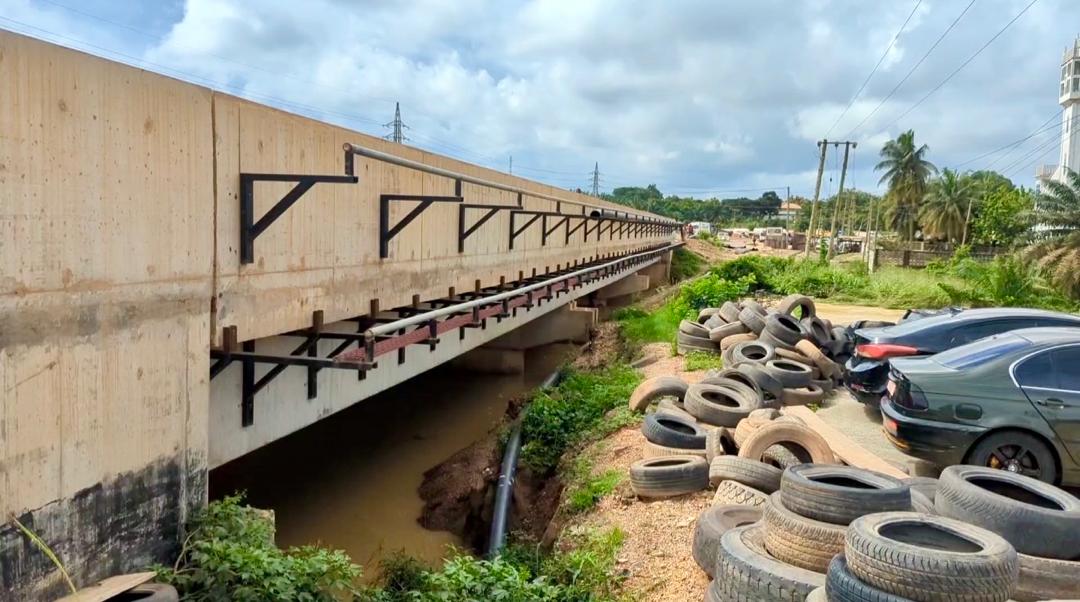

A newly constructed bridge at Apremdo on the Takoradi – Agona Nkwanta dual carriageway is facing a threat of structural failure after one of its water channels was illegally backfilled and converted into a commercial car washing bay.
The 60-metre-span bridge over the River Whin at Apremdo forms part of the Takoradi–Agona Nkwanta dual carriageway project, a flagship intervention under the Government of Ghana’s ambitious Big Push infrastructure programme.
The bridge is one of three major river crossings being constructed to improve traffic flow and support economic activity along the strategic highway corridor.
Unlike the aging bridge it is replacing, the new structure was designed with three wide spans to improve hydraulic capacity and efficiently convey floodwaters from the River Whin, particularly during periods of intense rainfall.
Residents had praised the contractor, Justmoh Construction Limited, for what many described as a forward-looking engineering design capable of significantly reducing perennial flooding that has plagued portions of the Apremdo enclave for years. However, those anticipated gains are now under threat.
Investigations at the site reveal that one of the bridge’s major waterways has been completely filled with earth and debris and transformed into a commercial washing bay. The unauthorized development has drastically narrowed the river channel, restricting the natural flow of water beneath the bridge and already the consequences are becoming evident.
Hydraulic flows are being obstructed, forcing water to back up upstream and increasing flood risks in nearby communities. Even more worrying, engineers have observed signs of scour and erosion around sections of the bridge substructure, particularly near the piers and abutments, an early warning sign that could eventually undermine the stability of the entire structure if left unchecked.
Chief Executive Officer of Justmoh Construction, Dr. Justice Amoh, described the situation as deeply troubling. According to him, the blocked watercourse is reversing the river’s flow dynamics and contributing to flooding in surrounding areas.
“One of the waterways for the 60-metre-span bridge has been filled and converted into a washing bay. When the water reaches the bridge, its natural path is blocked, causing it to reverse and create flooding. This is one of the causes of flooding in the area. We are pleading with the Assembly because this is unacceptable. All the materials must be removed.”
Ghana Highway Authority’s consultant for the Takoradi – Agona Nkwanta Road who inspected the site with Dr. Justice Amoh expressed similar concerns, warning that the encroachment poses a direct threat to the bridge’s structural integrity.
He noted that although the bridge was designed with sufficient hydraulic openings to accommodate flood flows, unauthorized human activities have significantly reduced the effective waterway area.
“The channels were designed to be wider, but because of the activities of individuals, they have been narrowed. This has created a constriction in the river flow, leading to flooding upstream. It is also causing erosion around the abutments and affecting the integrity of the bridge.”
The situation has become even more alarming against the backdrop of recent devastating flood incidents recorded across the country, where blocked waterways, indiscriminate developments and encroachment on drainage corridors have repeatedly been identified as major contributors to disaster events.
He is therefore urging the Ahanta West Municipal Assembly and the National Disaster Management Organisation (NADMO) to take immediate enforcement action to remove all structures and materials obstructing the river course.
“…restoring the bridge’s full hydraulic capacity is essential to preventing future flooding, protecting public investments and preserving a critical transport asset expected to serve thousands of motorists daily.”
By Eric Yaw Adjei