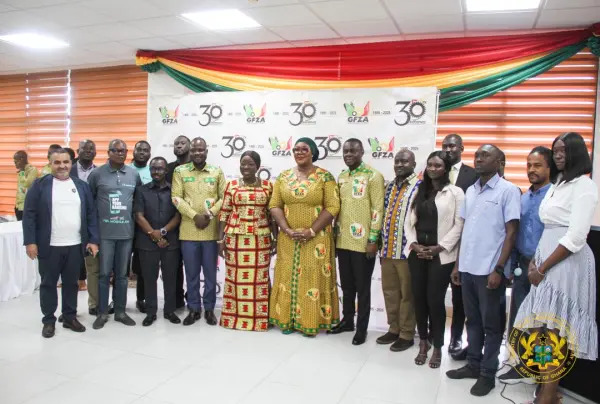

The Ghana Free Zones Authority (GFZA) has officially launched its 30th anniversary celebrations, marking three decades of transforming the country’s export landscape.
Since its establishment in 1995, the Authority has generated cumulative export revenues exceeding $35 billion and created more than 40,000 jobs, positioning itself as a cornerstone of Ghana’s industrialization and trade diversification strategy.
The milestone celebration, launched in Accra under the theme “Three Decades of Impact: Empowering Businesses, Transforming Trade in Ghana,” comes at a moment of unprecedented growth.
GFZA reported that Ghana’s non-traditional export (NTE) values reached $2.25 billion by the end of 2024, representing a staggering 1,447% increase from $145.5 million in 1997. Furthermore, in the first quarter of 2025 alone, GFZA companies recorded $1 billion in NTEs, underscoring the Authority’s growing significance in Ghana’s export economy.
Board Chair and Minister of Trade, Agribusiness and Industry, Elizabeth Ofosu-Adjare, emphasized government’s commitment to repositioning Ghana’s investment landscape. She announced plans to transition from traditional Export Processing Zones to Special Economic Zones (SEZs), which will integrate multiple industries and services into comprehensive economic hubs.
The new SEZ model will prioritize agribusiness, renewable energy, ICT, logistics, and advanced manufacturing, reflecting both global investment trends and Ghana’s long-term development vision. By providing advanced infrastructure and regulatory flexibility, SEZs aim to attract larger-scale and more sustainable investments compared to traditional free zones.
This strategic pivot aligns with Ghana’s ambitions under the African Continental Free Trade Area (AfCFTA), with the country seeking to become a preferred hub for companies targeting Africa’s growing markets. GFZA is actively advocating for the passage of the Special Economic Zone Act, which will provide the necessary legal framework to drive this transformation.
Chief Executive Officer of GFZA, Dr. Mary Awusi, described the 30-year journey as nothing short of transformational. She reflected on the Authority’s modest beginnings near the Ministry of Trade and its evolution into a major economic driver with Export Processing Zones (EPZs) across the country.
Today, GFZA is expanding its infrastructure base with major developments in the Ashanti and Greater Accra regions, setting the stage for a new phase of industrial growth.
“The GFZA story is a testament to Ghana’s resilience, innovation, and adaptability in global trade. Our 30-year journey is not only about what we have achieved but also about the future we are building,” Dr. Awusi stated at the launch.
The 30th anniversary launch brought together officials from key trade and investment institutions including the Ghana Investment Promotion Centre (GIPC), Ghana Export Promotion Authority (GEPA), and Ghana International Trade Commission (GITC). Their participation highlighted the collaborative approach needed to drive Ghana’s export diversification and investment attraction agenda.
GFZA’s strategic pillars for the future include investment promotion, digital transformation, strategic partnerships, and infrastructure expansion. These initiatives are designed to enhance Ghana’s competitiveness in the global marketplace while deepening economic integration within Africa.
The anniversary celebrations will feature business forums, exhibitions, awards ceremonies, and corporate social responsibility programs, showcasing both GFZA’s history and its ambitions for the future. These events aim to strengthen relationships with existing investors while positioning Ghana as a top destination for new partnerships.
Reflecting on GFZA’s success, Dr. Awusi noted that the Authority’s achievements demonstrate the power of targeted policy interventions. By creating over 40,000 jobs and generating $35 billion in export revenues, GFZA has shown the multiplier effects of free zones in driving sustainable economic growth.
As Ghana moves into its next phase of industrialization, the transition to SEZs positions the nation to attract forward-looking investments in technology, green energy, and advanced industries.
The focus on sustainable development and intra-African trade expansion under AfCFTA reflects Ghana’s ambition to be a leader in the continent’s economic transformation.
GFZA’s 30th anniversary is therefore not just a celebration of the past, but the beginning of a bold new chapter. By combining lessons from its three-decade journey with global best practices in economic zone management, GFZA is charting a future where Ghana stands as a competitive, innovative, and sustainable investment hub in Africa.