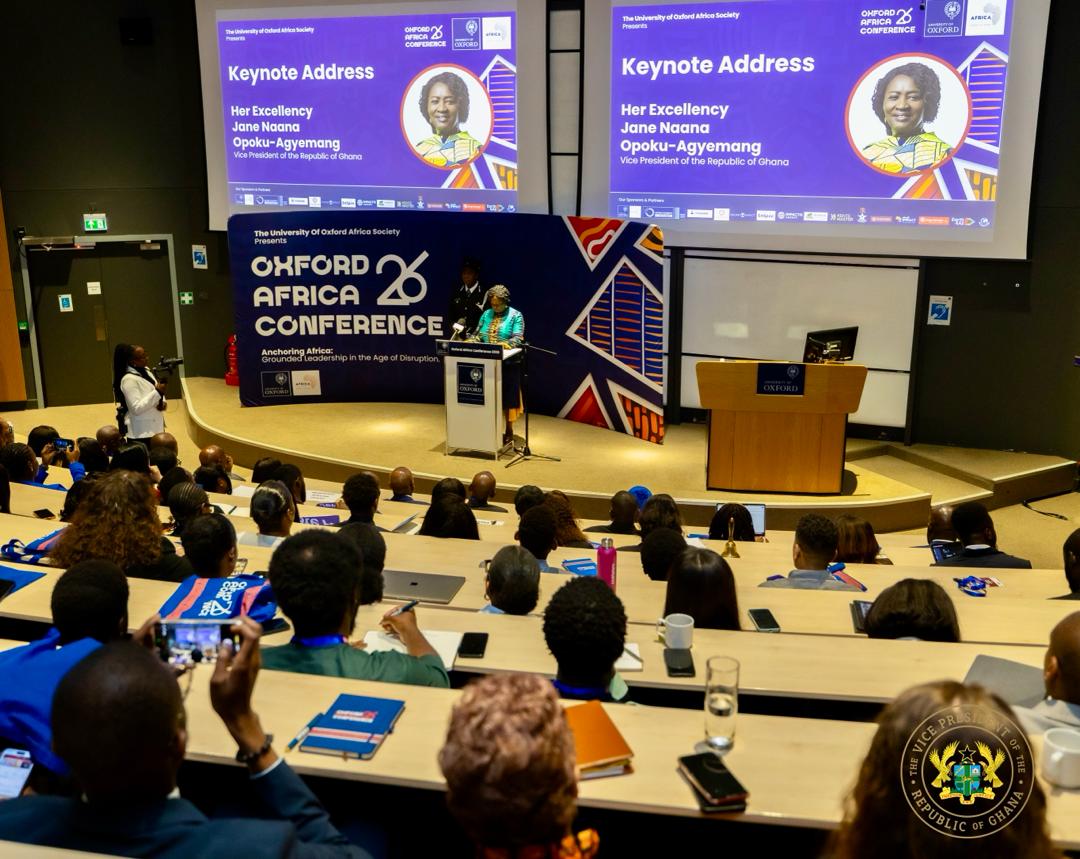

The Vice President, Prof. Naana Jane Opoku-Agyemang, has called for urgent reforms to global governance systems, insisting that institutions must become more responsive to contemporary realities if they are to maintain legitimacy in an increasingly unequal world.
She was speaking at the Oxford Africa Conference 2026 at the University of Oxford in the United Kingdom on May 16.
Delivering the keynote address, the Vice President said Africa’s limited representation in key global decision-making bodies particularly the United Nations Security Council continues to reflect a structural imbalance in global power relations.
She stressed that legitimacy in governance is not determined by representation alone, but also by outcomes that directly affect citizens, especially in developing countries.
According to her, many governments continue to operate under severe structural constraints, including high borrowing costs, rising debt burdens, and unequal access to international finance conditions she says undermine growth, stability, and opportunity.
The Vice President described this as “one of the defining governance challenges of the era”, questioning whether global and national institutions can adapt quickly enough to remain credible amid rapid change.
On Ghana’s economic situation, Prof. Opoku-Agyemang acknowledged encouraging signs of recovery and reform.
She cited improving macroeconomic indicators, rising investor confidence, and ongoing institutional reforms as “positive developments”.
However, she cautioned against premature celebration, warning that strong results should not lead to complacency.
The conference is organised by the Oxford University Africa Society (AfriSoc), a student-led platform that convenes policymakers, scholars, entrepreneurs, and global leaders to advance dialogue on Africa’s development and future trajectories.
By Evelyn Tengmaa