
When Heath Goldfields took over the Bogoso-Prestea Gold Mine—once an immense source of life for thousands of miners, families, and communities who drew their livelihoods from these grounds—they found only disrepair, brokenness, and the desperate question of how to breathe life into what could best be described as nothingness.
Led by Managing Director Patrick Appiah Mensah, who has a proven knack for turning around “dead assets,” the team set out to shine a ray of hope on everything Heath Goldfields touches.
The Bogoso-Prestea Gold Mine stood for more than a century as one of Ghana’s most historic mining operations, once a backbone of the Western Region’s economy and a symbol of the country’s gold dominance.
Yet, in recent years, the mine fell into severe decline, weighed down by technical challenges and financial distress, Mr. Appiah Mensah recalls. They were met with this situation: “Operations had ground to a halt, workers went unpaid, contractors were left with mounting debts, and entire communities lost hope as the mine’s future seemed uncertain.”

To steer the mine back to life and sustain it, the team needed a purpose grounded in the resolve “to enrich lives through sustainable gold mining,” guided by the values of Safety, Integrity, Innovation, Respect, Sustainability, and Prosperity. They pledge to “restore confidence, create value, and bring life back” to the company and its host communities.
Barely a year after the takeover, the wheels of fortune are grinding slowly, but with visible progress. Pledges made on paper are beginning to echo in Bogoso, Prestea, and nearby towns, where shops, schools, and taxis had long depended on the wages and contracts generated by the mine.

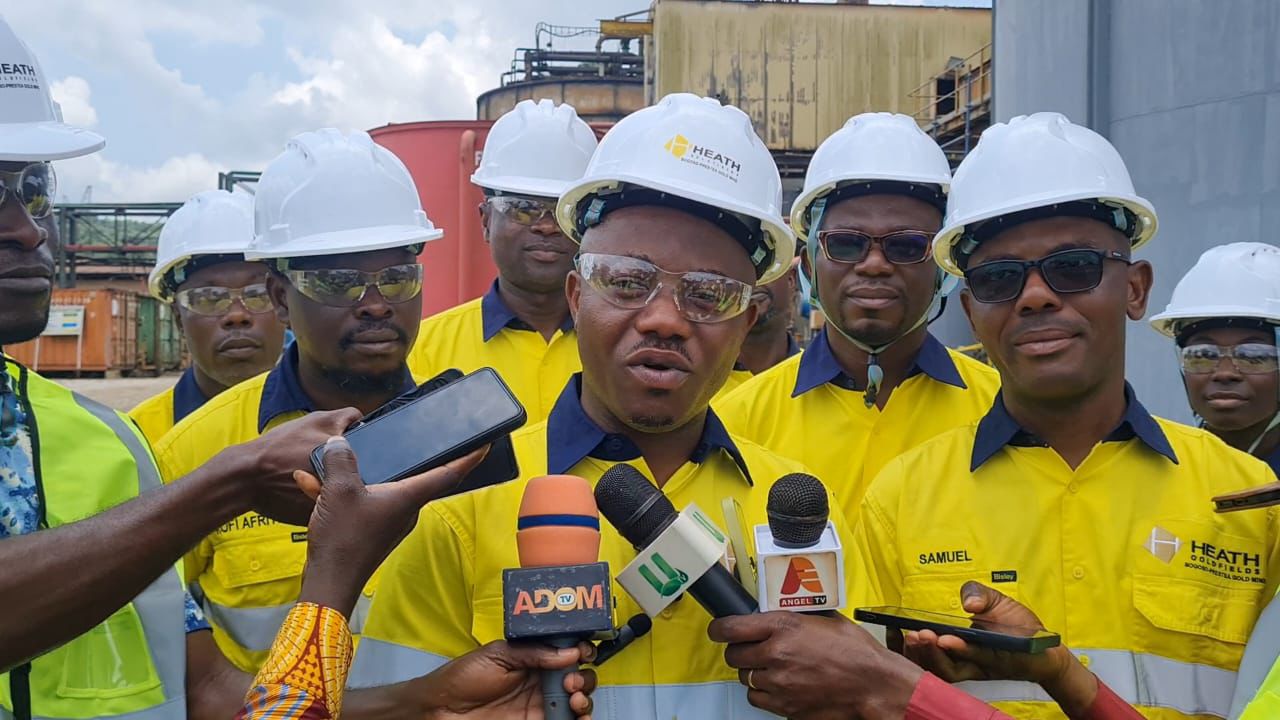
In a demonstration of openness and commitment to its “restoration drive,” Heath Goldfields opened its doors to the media, embarking on a progress tour with members of the Western Region Press Corps last week.
Management has injected millions of cedis into critical areas to lay a foundation for a restart, even as analysts and civil society groups question whether the company has the financial muscle to sustain such a long and capital-intensive revival.
Mr. Appiah Mensah highlighted the payment of over GHS 100 million in outstanding employee salaries and provident funds inherited from the previous leaseholder, alongside engagement with the Ghana Mineworkers’ Union on additional benefits. For a workforce that had endured months of uncertainty, such payments were crucial in restoring morale and credibility.

Other payments included: “Settlement of GHS 16.8 million owed to local contractors, restoring trust and enabling local businesses to get back on their feet. Investment of more than GHS 34 million in critical safety and infrastructure upgrades, including restoration of the mine’s winder to meet regulatory standards.”
He added that Knight Piésold has been reinstated as the engineer of record for the Tailings Storage Facility, as dewatering works are underway to secure both the environment and the surrounding communities.
Environmental and safety concerns have long plagued Bogoso-Prestea, making this a sensitive issue for both regulators and residents. However maintaining a baseline record of tailings data and implementing targeted reductions, Heath Goldfields aims to reassure stakeholders of its dedication to sustainable practices.
“Settlement of annual mineral rights obligations with the Minerals Commission, demonstrating full compliance with Ghana’s mining laws. Strengthened engagement with regulators, traditional leaders, and local government to align on a shared vision for the mine’s future. Continuous pumping at Prestea underground, supported by the procurement of additional pumps to accelerate progress, and other interventions are being vigorously pursued.
The scale of the challenge is daunting but not insurmountable. For two years, there had been no pumping of water underground, crippling the mine’s underground architecture. Since dewatering is one of the most critical steps in restarting operations, the company has completed winder maintenance and safety certification, procured and installed new high-capacity pumps, and replaced damaged pipelines.
“With these in place, active dewatering began in July. We are currently removing up to 6,800 cubic meters of water daily, and by October, this will rise to over 10,000 cubic meters per day. Already, water levels are down 25 feet below 17 Level—visible progress that shows the mine is on the right path,” Mr. Appiah Mensah says with great pride.

Even with progress, Mr. Appiah Mensah urges caution. “Two years of neglect cannot be unwound in just a matter of months,” he said, noting that full dewatering will take time. The company insists it is committed to doing things properly, safely, and transparently, while providing regular updates to stakeholders.
Notably, all “these investments and interventions have been made ahead of any gold production,” which the Managing Director explained as a reflection of Heath Goldfields’ long-term commitment to the mine, its workforce, and host communities.
Mr. Appiah Mensah is confident that with support from the reinvigorated workforce, community, partners, and government, the story of Bogoso-Prestea will no longer be “one of despair, but of renewal,” where jobs are being restored, businesses are regaining confidence, and communities once without hope are finding new optimism.
For the residents, contractors, businesses, and communities around the mine, these efforts are not to be taken for granted. The mine represents life, and any efforts to revive it also mean a guaranteed life for them.
“The mine’s revival is existential,” says Kojo Fletcher, a journalist with Bogoso-based Trinity FM.
Taxi operators in Prestea talk of renewed fares, market traders of returning customers, and landlords of miners coming back to occupy long-vacant rooms. “We’ll judge the turnaround by payslips, not press releases,” said one shopkeeper at the Prestea market.
With bullion prices near record highs, the stakes are also national: gold accounts for more than half of the country’s export earnings, and any delay in stabilising Bogoso–Prestea carries macroeconomic implications. The test will also be how well a Ghanaian-owned operator can steer one of the country’s most storied mines.