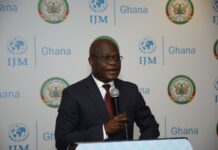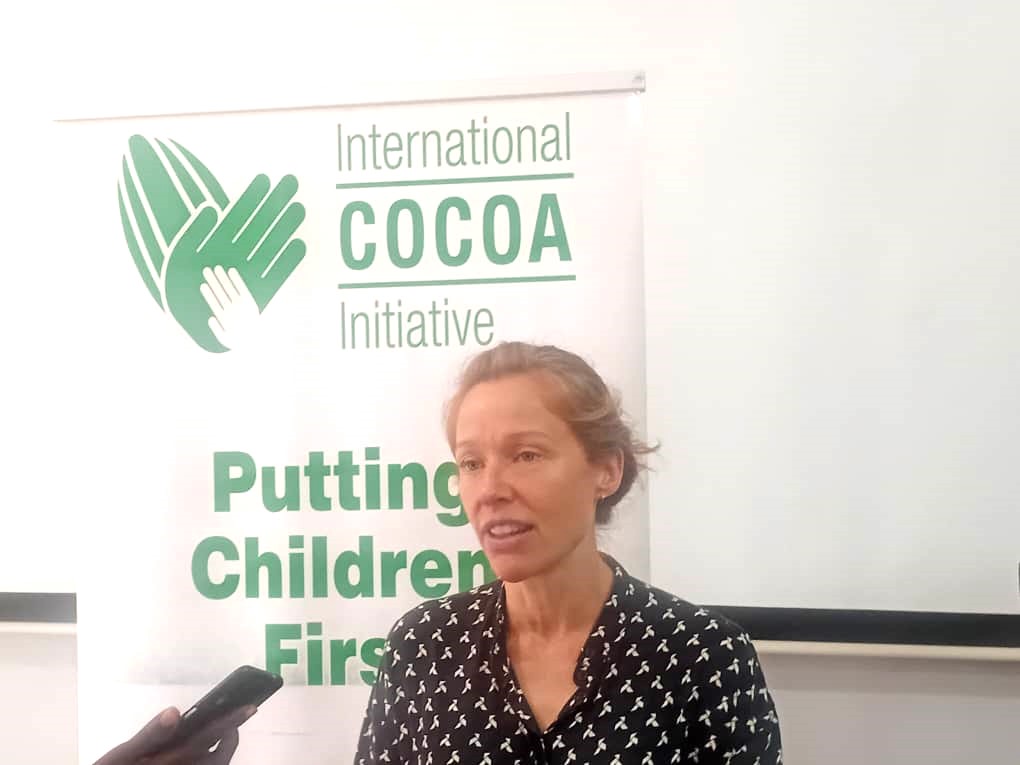

The Director of Communications at International Cocoa Initiative (ICI), Katie Bird has urged journalists to highlight the predicament of children who find themselves engaged in hazardous work in the cocoa sector.
She said such children are supposed to be in school to attain their highest potential.
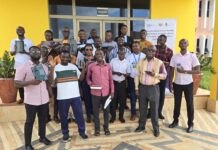
Madam Bird said this at a two-day workshop for senior editors at Tutu-Akwapim on October 3, 2025.
“The majority of these children are within their family structure, but they’re doing tasks that have been deemed to be hazardous. So, there’s something called the hazardous activity framework that Ghana has developed, which has a list of activities that children should not be doing because they’re dangerous. That includes things like carrying heavy loads that are too heavy for the age and the strength of the child,” she explained.
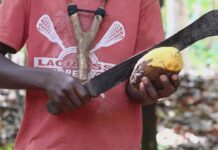
According to her, “that includes using sharp tools. That includes, for example, anything around manipulating agrochemicals. Those kinds of chemicals are much more dangerous to a developing child than they would be for an adult.”
She therefore urged the journalists to bring such happenings to the attention of the duty bearers for redress.
“We believe that there is a very important role for the Ghanaian media in tackling child labour and forced labour in Cocoa. Firstly, we think the media has an important role to bring these issues to light, to bring these issues to the forefront. Secondly, to help the wider Ghanaian society to understand some of these concepts in more detail,” Madam Bird noted.
Reports indicate that approximately 2.1 million children in the Ivory Coast and Ghana work on cocoa farms, most of whom are likely exposed to the worst forms of child labour.

“… and very importantly, to help hold duty bearers and those in positions of power to account. So that’s the kind of objective of the last few days. And what we’d like to happen is to create some strong networks and strong relationships so that we can build on this strong foundation and work together in the future to bring these issues to light,” she added.
The Director of Communications at ICI revealed that they have a number of projects in Ghana that include activities that help to reduce child labour and forced labour.
“For example, we work a lot on improving access to quality education. That can be either through actually building schools, creating school infrastructure, perhaps improving infrastructure that exists already, for example, adding latrines or boreholes in schools,” she cited.
Madam Bird added that “There’s also a big piece around empowering women, gender empowerment, as we know that that can help tackle child labour. We have other things around, for example, apprenticeship programs. So, helping older children to access skills and training so that they can be more financially independent in the future.”
The event was organised in collaboration with the Ghana Journalists Association (GJA) and Ghana Agricultural and Rural Development Journalists Association (GARDJA).