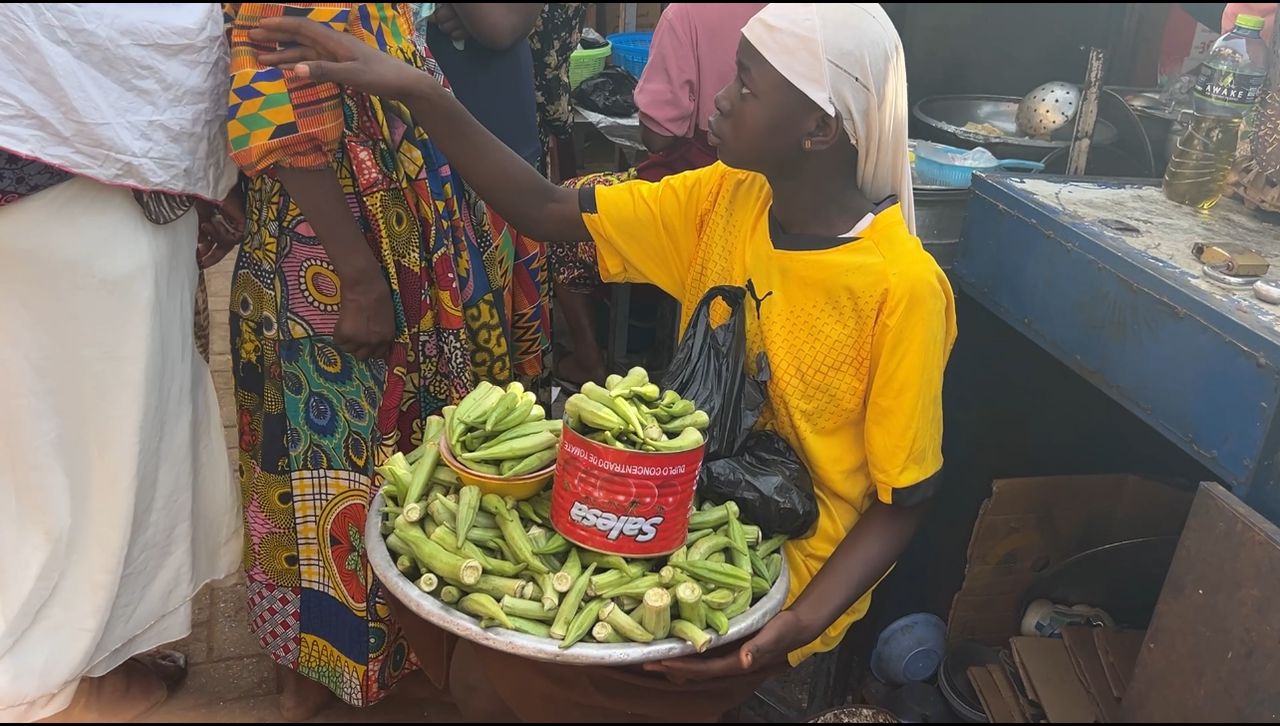

In Lepusi, a farming community in the Nanumba North Municipality, market day is more than a day of trade. For many children, it has quietly become a day away from school.
As traders fill the local market, classrooms in the community are left unusually silent, with many school-going children choosing trading over lessons.
This situation raises concerns about the community’s progress towards Sustainable Development Goal Four (SDG 4), which seeks to ensure inclusive and quality education for all.

A visit to the Lepusi Primary and Junior High Schools during school hours reveals a worrying pattern of low turnout, quiet classrooms, and missing pupils.
Just a few kilometres away, the Lepusi market is already alive with activity. Among traders and buyers are children who, on a normal school day, should be seated in classrooms.

For many pupils in the community, market day means choosing the market over school.

On such days, classrooms that should be full fall silent. By mid-morning, the sound of learning is replaced by the noise of trading, as children assist traders or hawk items to earn money.

A practice linked to child labour and economic hardship, which undermines efforts to reduce poverty under Sustainable Development Goal One (SDG 1).
School attendance records confirm the trend.
In Basic Five class of 82, 20 were absent, basic Six class has 87 pupils, 35 were absent, basic Seven class of 62 pupils, 16 were absent on market day. In Form Two, 10 were missing, while even some final-year students preparing for examinations failed to show up.
A teacher at the Lepusi Junior High School, Mark, described the situation as worrying.
“On market days, we hardly get students. Many of them absent themselves to go and sell at the market. They say they need money to take care of their basic needs,” he said.

At the market, Mariam and Fatima, both of school-going age, were seen hawking sachet water. They told this reporter their mother asked them to help because it was market day.
The Assemblyman of the area said he has received several complaints from headteachers and teachers about the situation.
He is therefore calling for stronger school-level enforcement, including disciplinary measures, to discourage absenteeism on market days and protect children’s right to education.
The Director of Education for the Nanumba North Municipality, Patrice Situ Komola Egbadewe, attributed the growing absenteeism to economic pressure on families, child labour, and indiscipline among some pupils.

He revealed that some affected children are fostered pupils who are compelled to work for their guardians in exchange for food and basic care.
“In some cases, these children are fostered and are forced to work as a condition for receiving food and basic care. This is clearly a form of child labour,” Mr Egbadewe stated.
He said the Municipal Education Directorate has intensified community sensitisation to educate parents on the dangers of keeping children out of school, noting that education remains central to breaking the cycle of poverty.

Mr Egbadewe further cautioned that children who drop out of school are more vulnerable to social vices, including drug abuse and criminal activities, posing a broader threat to society.
As economic realities continue to weigh on families in Lepusi, education stakeholders say a collective effort from parents, schools, and local authorities is needed to protect children from child labour and keep them in school.
They warn that unless the issue is addressed, communities like Lepusi risk falling behind on national and global commitments to quality education, poverty reduction, and decent work, as outlined in the Sustainable Development Goals.