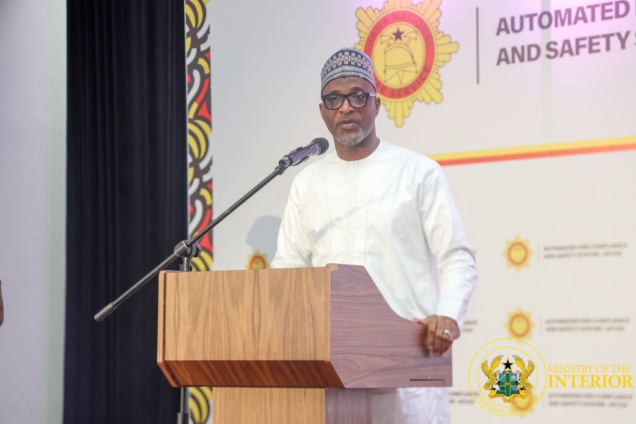

The Minister for the Interior, Muntaka Mohammed-Mubarak, has officially launched Ghana’s Medicinal Cannabis Programme, describing it as a historic step toward strengthening the country’s drug control framework while unlocking new economic opportunities.
Speaking at the launch in Accra on Thursday, February 26, 2026, the Minister said the programme follows the passage of key legislation, including the Narcotics Control Commission Amendment Act, 2023, and the Cannabis Cultivation and Management Regulations, 2023. These laws establish the legal framework for the cultivation and management of cannabis strictly for medicinal and industrial purposes.
“Today’s event marks a significant milestone in Ghana’s commitment to responsible drug control, public health and safety and economic development,” he stated.
However, Mr. Mohammed-Mubarak stressed that recreational cannabis use remains illegal under Section 45 of the Narcotics Control Commission Act, 2020.
As part of the rollout, the government has introduced strict licensing requirements for investors. The Minister announced that applicants must secure confirmed buyers, known as off-takers, before licences will be granted.
“We won’t give you the licence if you don’t show us who you are going to sell it to. You need to have an off-taker,” he said.
He explained that this measure is designed to prevent diversion of cannabis into illegal markets and ensure the programme operates within strict regulatory controls. The requirement applies across the entire cannabis value chain, including farmers, processors, exporters, and transporters.
Mr. Mohammed-Mubarak disclosed that the regulatory regime requires 11 separate licences covering various activities such as cultivation, processing, transportation, import, and export. Each licence is specific to a particular activity and cannot be transferred.
“You cannot cultivate and assume you can transport. You need another licence for that,” he added.
General requirements (APPLICABLE TO ALL LICENCES)
- Property documentation (lease/title deed)
- National ID (Ghana card/passport)
- Financial information form
- List of persons with financial interest
- Police clearance certificate
- Business formation documents
- Security plan
- Tax clearance certificate (GRA)
- SSNIT registration
- Standard operating procedures
- Personal certification
- Record keeping documentation
The Minister revealed that Ghana currently does not produce the specialised low-THC cannabis seeds required under the programme. As a result, licensed operators must import seeds.
“Government is not positioning itself to provide the seeds. It is a business opportunity for those who want to import,” he said, encouraging research institutions to develop local seed capacity in the future.
Strong surveillance and enforcement measures
To ensure compliance, the Interior Ministry will collaborate with the Narcotics Control Commission and other security agencies to implement strict monitoring systems. These include GPS tracking, drone surveillance, and unannounced inspections of licensed facilities.
Security agencies such as the Ghana Police Service, Ghana Immigration Service, Ghana Prisons Service, and the National Investigations Bureau will support enforcement efforts.
Licensed cannabis facilities must also be located at least 100 metres away from schools and residential areas and are required to submit quarterly operational reports.