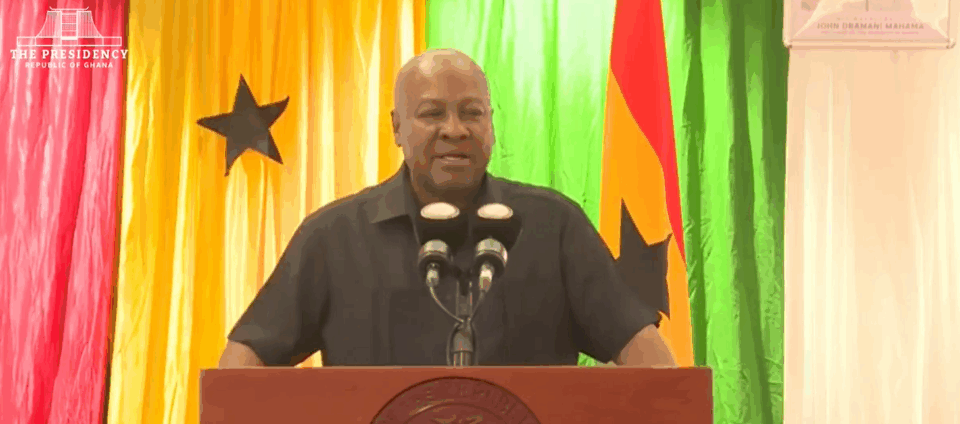

At a High-Level Dialogue with the Private Sector, President John Dramani Mahama delivered a compelling case for repositioning sports and recreation as a core economic driver rather than merely a social activity.
In his concluding remarks at the event, the President shifted attention to what he described as a sector “often seen as social, but fundamentally economic”.
He emphasized that modern sports now influence global markets, tourism, media rights, youth employment, the creative industry, and international investment flows.
President Mahama highlighted that 2026 will be a defining year for Ghana on multiple global sporting platforms.
Ghana’s senior national football team, the Black Stars, is preparing for what would be its fifth appearance at the FIFA World Cup.
The senior women’s national football team, the Black Queens, heads into continental competition with renewed credibility and growing international respect.
Beyond football, Ghana is also preparing for participation in the Commonwealth Games and the Summer Youth Olympics in 2026 global showcases that present the country before millions of viewers, investors, and commercial stakeholders worldwide.
“These moments position Ghana before global audiences and investors in ways that few sectors can do,” the President noted.
To ensure structured and sustainable development, President Mahama announced that the already established Ghana Sports Fund, a transparent financing framework designed to support grassroots sports development, school sports expansion, athlete welfare, infrastructure modernization, long-term talent identification and development pathways, will play a vital role.
He stressed that no country achieves sporting excellence without deliberate and sustainable funding systems.
In a direct appeal to business leaders, President Mahama urged corporate Ghana to see investment in sports not as charity, but as a strategic partnership in national development.
“I invite corporate Ghana to view this not as charity, but as a partnership in national development,” he stated.
He called for a covenant between government and the private sector, one built on shared responsibility and mutual commitment.
According to the President, government has created the necessary policy framework.
The next step is collaboration to build the systems that will sustain Ghana’s sporting and economic ambitions.
In return, he pledged that government would commit to maintaining stable macroeconomic policies — a foundation he described as essential for private investment confidence.
President Mahama’s remarks signal a broader policy direction: positioning sports as an economic strategy capable of generating employment, attracting foreign investment, boosting tourism, and strengthening Ghana’s global brand.
As Ghana prepares for a pivotal 2026, the success of this vision may well depend on how strongly the proposed public-private covenant takes root.
By Isaac Ansah Apagya|Onua Sports|Onuaonline.com|Ghana
![Kurt Okraku [L] was congratulated by Kofi Adams [R] on his recent CAF Executive Committee election](https://onuaonline.com/wp-content/uploads/2025/03/GFA-President-meets-Kofi-Adams-218x150.jpg "GFA, Ministry agree on 5-member committee for resident Black Stars coach")