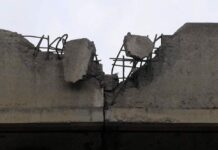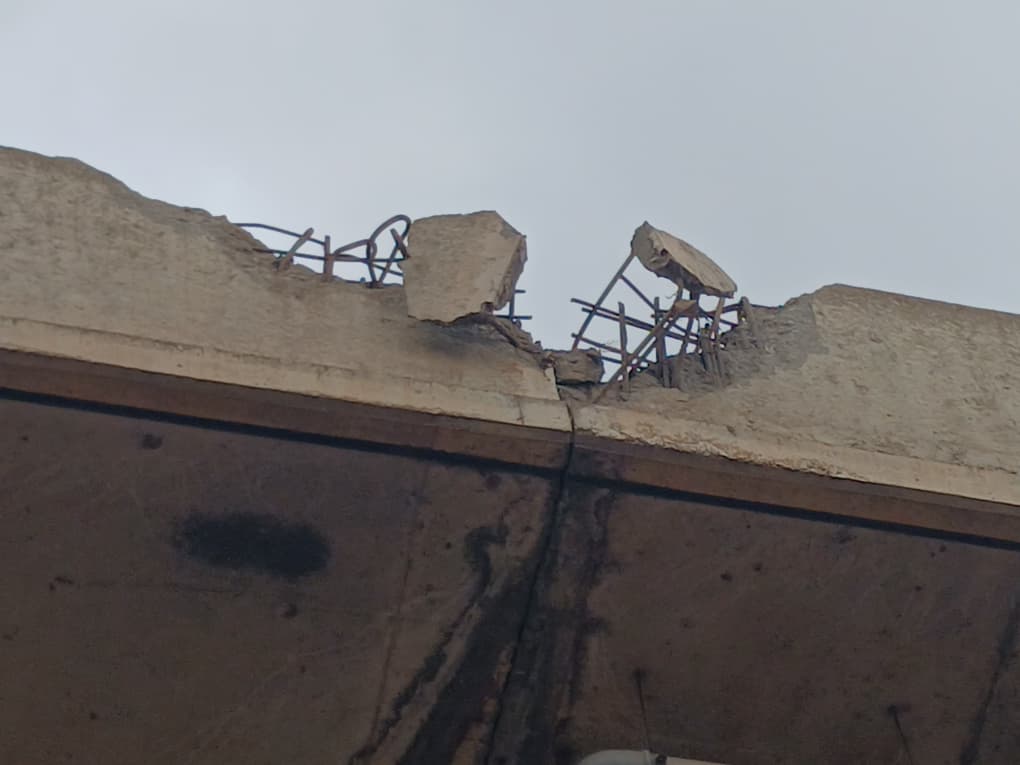

On July 27, 3news reported on cracks and broken sections of the concrete barrier on top of the Mallam Interchange.
More than a month later, the cracks remain, with broken sections of the concrete still hanging precariously.
The iron rods holding the structure together are also exposed.
And on top of the interchange, we found what appears to be a remnant of an accident — a motorbike helmet left behind.
For motorists and residents who use this busy corridor, the concern is whether these visible signs of deterioration are being addressed quickly enough.
In an interview with 3news, one resident shared that, off late, some vehicles have been caught up in that section.
“It has not been even a week; two motors have fallen off from that side. They must fix it and do proper maintenance before something happens.”
One pedestrian also said, “I always walk here in fear because I don’t know when the concrete will fall, seeing it hanging. The authorities should check on it for us.”
But how serious are these defects?
Structural engineer Ing. Prince Kas-Avortri says the condition of this section of the interchange poses a serious threat to commuters and other road users.
“The purpose of the barrier is to give us protection against any vehicle, so that you don’t fall off because of the high level of the bridge deck. And, if there is other vehicle movement, this might be serious.
Also, looking at the falling debris, should an accident happen in the same area, vehicles are moving on the side of the road and beneath it, some pedestrians will ply that side of the road, so lives will be at risk.”
He maintains that, although the damage does not affect the structural integrity of the entire interchange, regular maintenance and prompt repairs are essential.
“If you have a structure of such nature, which is, of course, as important as it is, because it’s the N1 Highway, there should be periodic maintenance on it. But the entire structure, the integrity of the structure itself, I think we’ve now gotten to a stage that we should start questioning it. However, once that part of the barrier becomes exposed, it’s something that should be fixed within days or maximum weeks.”
While residents say they have seen officials in reflective clothing inspecting the area sometime after our first visit, there is little evidence on the ground that any repair work has begun.
3news again attempted to get the Ghana Highways Authority to respond to the current state of the interchange and explain what action, if any, is being taken.
Those attempts have so far proved unsuccessful.
For now, the cracks remain visible above one of Accra’s busiest road corridors.
And for those who use, work and live around the interchange, the demand is simple: fix the problem before the deterioration becomes a bigger safety concern.
By Samuel Yeboah Adams