

Majority Chief Whip in Parliament, Rockson-Nelson Etsi Kwami Dafeamekpor, has expressed the readiness of the governing National Democratic Congress (NDC) to defeat any candidate the NPP presents for the 2028 general elections.
Dafeamekpor says there is no candidate amongst the five currently contesting the flagbearship of the opposition New Patriotic Party (NPP) that will be a match for the NDC in 2028.
According to him, wining an election goes beyond the candidate leading the party, stressing that the structure and organisation of the party equally accounts for the outcome of an electoral contest.
Speaking on The KeyPoints show on TV3 on Saturday, January 31, 2026, the day for the NPP’s presidential primary, the South Dayi lawmaker indicated that the NDC is properly structured to meet any candidate the opposition presents, adding that the visibly structured party is even taking a reorganisation to become more formidable.
“We’ve done our own analysis and so whether the pendulum swings to Ken or to Bawumia, they are not a match for us, either way. None of them is a match. What we shouldn’t forget or gloss over is that, most importantly, the candidate that wins the election is only about 30 per cent. But it’s the party structure. If you let the most favourable candidate [win] and he has a very weak party structure, it’s not likely the person will sail through.
“So it’s a combination of a more appealing candidate plus the party’s formidable structure that will deliver the executive power to you. So we have a formidable party structure and we are even reorganising that formidable structure so we want to be more formidable so it’s immaterial who will be leading us when H.E. John Dramani Mahama leaves,” he stated.
A total of 211,849 delegates are expected to take part in the NPP’s presidential primary today, Saturday, January 31, 2026, according to official data from the party.
The delegates are drawn from the party’s 16 regions, the national headquarters, and the diaspora, following adjustments for deceased members and forfeitures.
Originally, 213,617 delegates were on the register, but 2,827 deaths and 653 forfeitures have reduced the final voting strength.
According to the data, the Greater Accra Region has emerged as the single largest voting bloc, with 40,162 delegates, representing approximately 19 per cent of the total electorate.
Closely behind is the Ashanti Region, traditionally the party’s strongest base, contributing 36,620 delegates, or about 17 per cent.
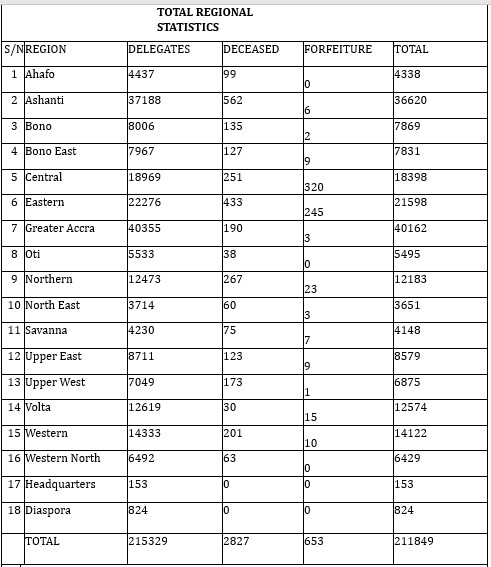
The Greater Accra and Ashanti regions together account for over one‑third of all delegates, making them decisive battlegrounds for all flagbearer hopefuls.
Also, the Eastern region, often described as a political bellwether within the NPP, contributes 21,598 delegates, representing about 10 per cent of the total.
This places it third on the list and firmly positions it as a region candidates cannot afford to overlook.
The Central Region follows with 18,398 delegates (9 per cent), while the Western Region accounts for 14,122 delegates (7 per cent).
Together, these three regions add more than 54,000 votes, reinforcing their strategic importance in a tightly contested primary.
Meanwhile, in the Volta enclave, where the NPP has been working to expand its support base, 12,574 delegates (6 per cent) are expected to vote.
The Northern region contributes 12,183 delegates (6 per cent), highlighting its growing influence within the party’s internal elections.
The Bono, Bono East, and Upper East regions each provide between 7,800 and 8,600 delegates, accounting for roughly 4 per cent apiece.
The Upper West and Western North regions contribute 6,875 and 6,429 delegates respectively, each representing about 3 per cent of the total vote.
Smaller regions and special voting centres
Among the smaller voting blocs, the Oti region will field 5,495 delegates, while the Ahafo region contributes 4,338 delegates.
The Savanna region has 4,148 delegates, and the North East region records 3,651 delegates, each accounting for about 2 per cent of the national delegate pool.
In addition, the NPP National Headquarters will have 153 delegates, while the Diaspora chapter contributes 824 delegates, reflecting the party’s growing international footprint, though together they make up less than one per cent of the total vote.
Deaths and forfeitures
The regional statistics also reveal the scale of attrition within the delegate list.
The Ashanti region recorded the highest number of deceased delegates (562), followed by Eastern (433) and Central (251).
The Central region also recorded a notably high number of forfeitures (320), with Eastern (245) and Northern (23) also affected.
With more than 211,000 delegates voting nationwide, today’s primary is expected to be one of the largest internal elections in the party’s history.
NPP Polls: I don’t see a second round – Mussa Dankwah insists Bawumia will win