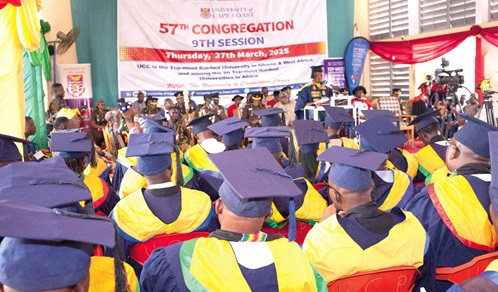

At the Nsawam Medium Security Prison in the Eastern region, 63 inmates have bagged their degrees after graduating from the University of Cape Coast (UCC).
The 63 inmates successfully undertook courses in various disciplines under the UCC’s Prison Inmates Tertiary Education Programme (PITEP).
They were awarded certificates including a Bachelor’s degree in Commerce (Accounting and Management options) and a Bachelor’s degree in Education (Junior High School Education) where they were issued certificates through the UCC’s College of Distance Education (CoDE).
Being the University’s maiden graduation under the PITEP, the ceremony which was held at the Nsawam Prison marked the ninth session of the UCC’s 57th Congregation.
The PITEP is an initiative of Plan Volta Foundation, a non-governmental organisation (NGO) that supports prisoners with free access to higher education to enable them pursue university degrees while serving their sentences.
The programme was introduced in partnership with the Ghana Prisons Service, aimed at rehabilitating inmates by equipping them with academic and professional skills to boost their reintegration into society after serving their sentences.
Best graduating student
Matthew Milluzieh, the best graduating student of the class, in his speech indicated that the degrees they have obtained goes beyond acquiring knowledge and skills but a positive experience that enabled them to critically examine their past actions and understand the consequences of their choices.
“We entered these walls not as students but as individuals to be reformed. Today, we are not just degree graduates but renewed and ambitious individuals that will prove wrong society’s perception that once an inmate, always a criminal,” he said.
Mr Milluzieh is currently serving a 20-year prison sentence since 2018.
Two other inmates were also awarded special scholarships to further their education in recognition of their exemplary academic performance during their studies.
The ceremony also saw the presentation of plaques of honour and citations to various stakeholders for their outstanding contributions to the success of the programme.
Additionally, individuals and organisations that have consistently supported the welfare and rehabilitation of inmates were recognised for their efforts.
On his part, the Deputy Minister for the Interior, Ebenezer Okletey Terlabi, described their graduation as a testament to what strength, character and commitment to personal growth and desire for rehabilitation could achieve.
He urged them not to view their accomplishments as the end of their journey because they were now change markers, leaders and role models who would inspire others to pursue personal development and academic excellence.
Mr Terlabi commended the Ghana Prisons Service for its forward-thinking approach to rehabilitation and reformation, stressing that education was a tool for transformation and a platform to enable inmates to contribute their quota to society.
“Government remains committed to the continuous rehabilitation of all inmates because we recognise it as an essential component of our justice system.
“So we are ready to partner all stakeholders, including civil society organisations (CSOs) to achieve this goal,” he added.
Mindset change
The Director-General of the Ghana Prisons Service, Patience Baffoe-Bonnie, also admonished the inmate graduates to adopt a complete change in mindset, emphasising that their education should go beyond academic excellence to truly transform their lives.
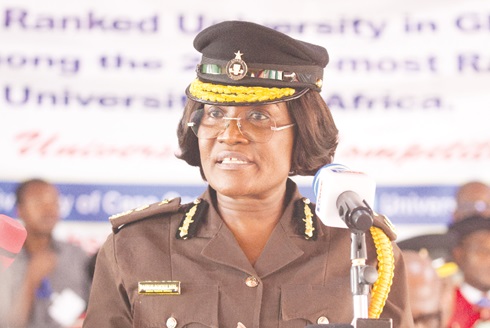
She gave an assurance that the service would seize every opportunity to improve the well-being of inmates, reinforcing its commitment to rehabilitation and called for a dedicated budget to support inmate education, stressing the need for sustained investment in their future.
In a speech read on his behalf, the Vice-Chancellor of the University of Cape Coast (UCC), Prof. John Nyarko Boampong, reaffirmed the University’s commitment to sustaining the programme.
He disclosed that UCC had so far spent over GH¢2.5 million on the initiative through its fee-waiver policy, which covered face-to-face tutorials, printing of modules, examinations and other academic services.
Prof. Boampong emphasised that student inmates are not required to pay any fees to access the programme.
However, he lamented that the high cost of running the initiative had made it challenging to extend the training to other prisons across the country.
He, therefore, called for greater support from stakeholders to ensure its continuity and expansion.
Make them centres of reformation not incarceration – Mahama charges new D-G of Ghana Prisons Service