
From a teenager in Germany to a thirty-nine-year-old in New Jersey, Lionel Messi’s World Cup story closed on a final defeat that could not undo everything that came before it.
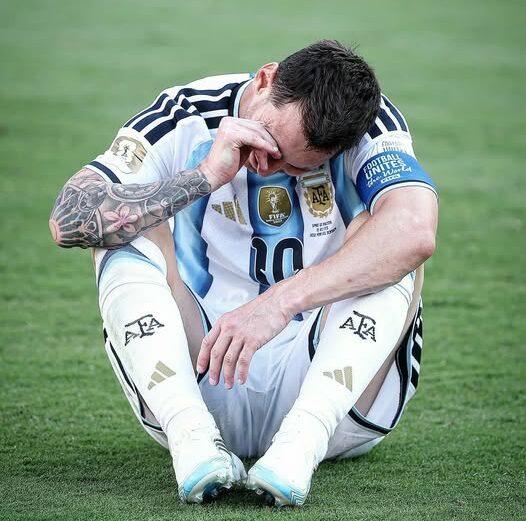
Lionel Messi cried on a football pitch in New Jersey on Sunday night, and this time there was no bisht robe, no golden trophy, no fairy-tale ending waiting for him at the final whistle.
Argentina lost the 2026 World Cup final one goal to nil, beaten by a Spain side that had conceded a single goal all tournament and simply refused to let this one slip. It was a cruel way for a story this long to end, but it was also, in its own way, a fitting final chapter to a World Cup career that has never followed a straight line toward glory.
Argentina finished the game with ten men, unable to lay a serious glove on a Spanish side that dominated possession and shots from start to finish, before Ferran Torres broke the deadlock deep into extra time.
For long stretches, Messi, at thirty-nine, was simply not the player capable of turning a match on his own the way he once could over ninety minutes, and manager Lionel Scaloni had built his entire team around protecting that reality, packing the side with tough, trusted runners so that Messi could conserve his energy for the moments that mattered.
Those moments arrived across the tournament far more than they did in the final itself.
A remarkable send-off, even in defeat
Whatever happened in the final, the numbers behind Messi’s last World Cup are extraordinary for a player his age. He finished the tournament with eight goals and four assists, dragging Argentina to the final almost single-handedly at times, including a dramatic late comeback against England in the semi-final that owed almost everything to him.
Messi’s involvement with the World Cup now stretches back two full decades, across six tournaments played on four continents, under different coaches, different generations of teammates, and dramatically different versions of himself as a footballer.
Few careers in any sport offer a data set that long, and fewer still end with the player still being the most important figure on the pitch for his country, at an age when almost every one of his contemporaries has long since retired from international football.
Six tournaments, one long argument settled and reopened
Messi’s first World Cup came in Germany in 2006, as an eighteen-year-old brought on mostly from the bench behind a golden generation of Argentine attackers, with the team eventually falling to hosts Germany on penalties in the quarter-finals.
Four years later in South Africa, an older but still developing Messi could not inspire an ageing Argentina side past the same opponent, beaten comprehensively in the last eight.
By the time Brazil hosted the tournament in 2014, Messi had become the focal point of the entire team, and he carried Argentina all the way to the final, only to lose in extra time to a Germany side that scored the only goal of the game late on.
He won the Golden Ball as the tournament’s best player that year regardless, a personal honour that could not soften the disappointment of losing the match that mattered most.
Russia in 2018 was, by Messi’s own standards, the low point. A shaky group stage nearly ended Argentina’s tournament before the knockout rounds even began, and when the team did reach the last sixteen, a young Kylian Mbappe announced himself to the world by inspiring an electric French win that eliminated Argentina in one of the most entertaining knockout matches the tournament has produced in years.
It left Messi’s international career at a genuine crossroads, with serious questions being asked about whether a World Cup winner’s medal would ever arrive at all.
What followed in Qatar four years later was the culmination of everything that had come before it. Argentina survived an opening defeat to Saudi Arabia, steadied themselves through the group stage, and then went on an unbeaten run through the knockout rounds that ended in one of the greatest finals the tournament has ever produced, a three-three draw with France that Argentina eventually won on penalties.
Messi scored twice in that final, was named the tournament’s best player for a second time, and lifted the one trophy that had somehow avoided him for his entire career. The image of him draped in a traditional bisht robe, trophy in hand, became instantly iconic, not just for Argentine football but for the sport as a whole.
What the loss changes, and what it does not
None of that history is erased by what happened in New Jersey. Messi has now lost two World Cup finals, in 2014 and 2026, and won one, in 2022, a record that places him alongside rather than clearly above several of the game’s other greatest players when it comes to major tournament finals specifically.
Diego Maradona, by comparison, played in two World Cup finals and won one. Pele won three World Cups but missed a final through injury along the way. Arguments about who stands where in football’s all-time hierarchy will continue exactly as they did before Sunday, July 19, 2026, because Messi’s case was never built on a single afternoon in any one stadium.
What is different now is the sense of an ending. Whether or not this was genuinely Messi’s last match in an Argentina shirt is still an open question, one that will likely take time to be answered properly rather than in the immediate aftermath of a painful defeat.
But a six-tournament World Cup career that began with a teenager watching from the bench in Germany and closed with a thirty-nine-year-old dragging his country to one last final is, by any reasonable measure, a complete story already.
The tears on Sunday were real, they read more like those of someone taking in the full distance travelled since 2006, from a boy who barely played a minute to the player fans across the stadium still wanted to acknowledge regardless of the scoreline.
The warmth shown to him afterward, from Argentine and neutral supporters alike, said as much about what those two decades had meant to the people watching as it did about him.
They do not, however, change what the two decades before them actually added up to.
Spain crowned world champions after extra-time win over Argentina
By: Joseph Okan-Mensah Khartey Esq, Sports Enthusiast and Trainee Associate; Afrimore Advisors PRUC