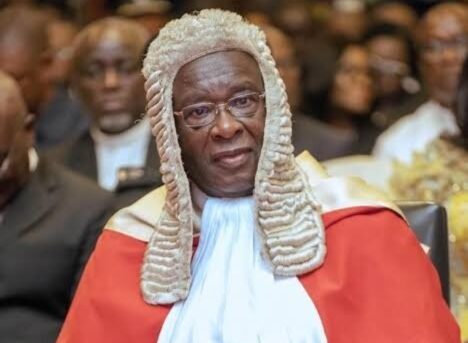

Chief Justice Paul Baffoe-Bonnie has urged judges and magistrates not to lose their humanity in the discharge of their judicial responsibilities.
He noted that the demands of the Bench should not prevent them from maintaining meaningful relationships and a balanced life outside the courtroom.
Speaking at the 45th Annual Conference of the Association of Magistrates and Judges of Ghana (AMJG), the Chief Justice said judicial officers must learn to combine the discipline required by their office with the realities of being human.
The conference is being held on the theme: “Balance Beyond the Bench – Harmonising Duty, Justice and Life.”
Chief Justice Baffoe-Bonnie acknowledged that judicial office comes with significant demands, requiring intellectual discipline, emotional restraint, patience and courage.
According to him, behind every judgment is a human being who must read, listen, deliberate and make decisions that can have profound consequences for others.
“A person’s liberty may depend upon a ruling. A family’s home may depend upon it. A business may survive or collapse because of it. The future of a child may be determined by it,” he explained.
The Chief Justice therefore stressed the need for judicial officers to remain conscious of their own humanity while carrying the burdens associated with the office.
“I have, in recent times, run into some trouble in this office precisely because I allowed my humanity to overtake my official restraint,” he indicated.
He referred to occasions when he made public appearances to honour close friends and relatives, as well as official engagements undertaken in his capacity as Chair of the Council for Legal Education and Training.
While acknowledging that a more cautious approach might sometimes have been preferable, the Chief Justice said the experiences reinforced the importance of not abandoning one’s humanity after assuming judicial office.
“The robe may require restraint, discipline and distance, but it must never require us to cease being human,” he said.
He noted that the challenge for judicial officers was not to choose between being a judge and being a person, but to learn how to be both without allowing either identity to compromise the other.
Justice Baffoe-Bonnie implored judicial officers to make time for their families and relationships outside the Bench.
“When we leave the courtroom, we return to homes and communities. We are spouses, parents, siblings, friends and members of communities.”
He said family relationships should not be viewed as distractions from judicial responsibilities, describing them as an essential part of the humanity of judicial officers.
He further cautioned against waiting until retirement to realise that too much time had been spent serving an institution at the expense of loved ones.
“The Judiciary needs our best years, but our families deserve some of them too.”
He intimated that a balanced judicial officer was better positioned to serve the public, stressing that the welfare of judges and magistrates has implications for judicial independence, institutional integrity and the quality of justice.
The Chief Justice, however, emphasised that the pursuit of balance must not become an excuse for neglecting judicial duties.
“The litigant who has waited for years cannot be told that the case has been delayed because the judge is seeking balance,” he said.
He therefore urged the Association to promote a professional culture in which excellence and accountability coexist with the welfare and humanity of judicial officers.
By Laud Adu-Asare