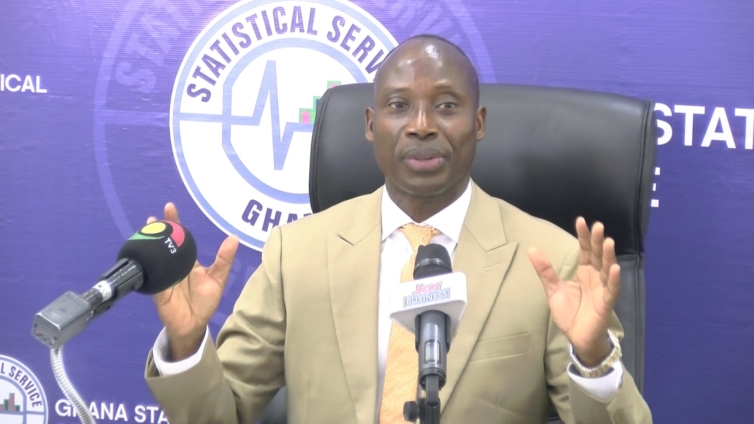

This is a good time to plan budgets with greater confidence, prioritise essentials, avoid non-essential spending, and save where possible, Government Statistician, Dr Alhassan Iddrisu, has told the general public.
This is on the back of the drop in the inflation rate to 3.8%, he said.
Dr Alhassan Iddrisu also told the government of Ghana to sustain fiscal discipline and to continue efforts to stabilise food prices.
The GSS Boss also urged the government to invest in storage, irrigation, transport, and market access to reduce regional disparities.
“Easing inflation provides room to invest in efficiency, strengthen local supply chains, reduce unnecessary costs, and translate savings into more stable prices for consumers,” Dr Iddrisu said after announcing that the year-on-year inflation rate for January 2026 stood at 3.8%.
“This is a good time to plan budgets with greater confidence, prioritise essentials, avoid non-essential spending, and save
where possible,” he further stated.
“The government should also sustain fiscal discipline, continue efforts to stabilise food prices, and invest in storage, irrigation, transport, and
market access to reduce regional disparities,” he added.
The 3.8% imnflation represents a significant decline from 23.5% recorded in January 2025, underscoring a sustained slowdown in price increases across the economy.
The data show that the CPI for January 2026 rose to 262.3, up from 252.6 in January 2025, translating into the 3.8% year-on-year inflation rate. On a month-on-month basis, inflation was 0.2%, indicating that the general price level increased marginally between December 2025 and January 2026.
January 2026 inflation marks the 13th consecutive decline in year-on-year inflation and is the lowest rate recorded since the CPI rebasing in 2021. It also represents a 1.6 percentage point drop from the 5.4% inflation recorded in December 2025, and a sharp 19.7 percentage point decline compared to January 2025.
Food inflation, a major driver of household cost pressures in Africa’s second-largest cocoa producer, also eased further, declining to 3.9% in January 2026 from 4.9% in December 2025. The moderation reflects softer price movements across key staples, supported by improved supply conditions.
Non-food inflation followed a similar downward trend, dropping sharply to 3.9% from 5.8% in December 2025. The decline points to easing cost pressures in housing, transport, utilities and other core consumer categories.
Regionally, inflation outcomes remained mixed. The Savannah Region recorded the lowest inflation rate at negative 2.6%, indicating outright price declines, while the North East Region posted the highest inflation at 11.2%, underscoring persistent spatial disparities in price dynamics.
The sustained disinflation comes just weeks after the Bank of Ghana cut its policy rate by 250 basis points to 15.5%, a move that now appears aligned with emerging price trends and could shape expectations ahead of future monetary policy decisions.
Speaking at a press briefing in Accra, the Government Statistician, Dr Alhassan Iddrisu, urged government to maintain fiscal consolidation efforts to help sustain the gains made in stabilising prices and strengthening macroeconomic conditions.
The steady fall in inflation from 23.5% in January 2025 to 3.8% in January 2026 reflects a broad-based easing in price pressures and points to improving macroeconomic conditions.