
The Parliamentary Select Committee on Education has appealed to the government and the Ghana Education Trust Fund (GETFund) to prioritise infrastructure development at Dr Hilla Limann Technical University in Wa, particularly the construction of an auditorium and completion of student hostel facilities.
The Committee said the absence of an auditorium at the University, which forced first-year students to undergo orientation in an open space on campus, highlights the urgent need for investment in the institution.
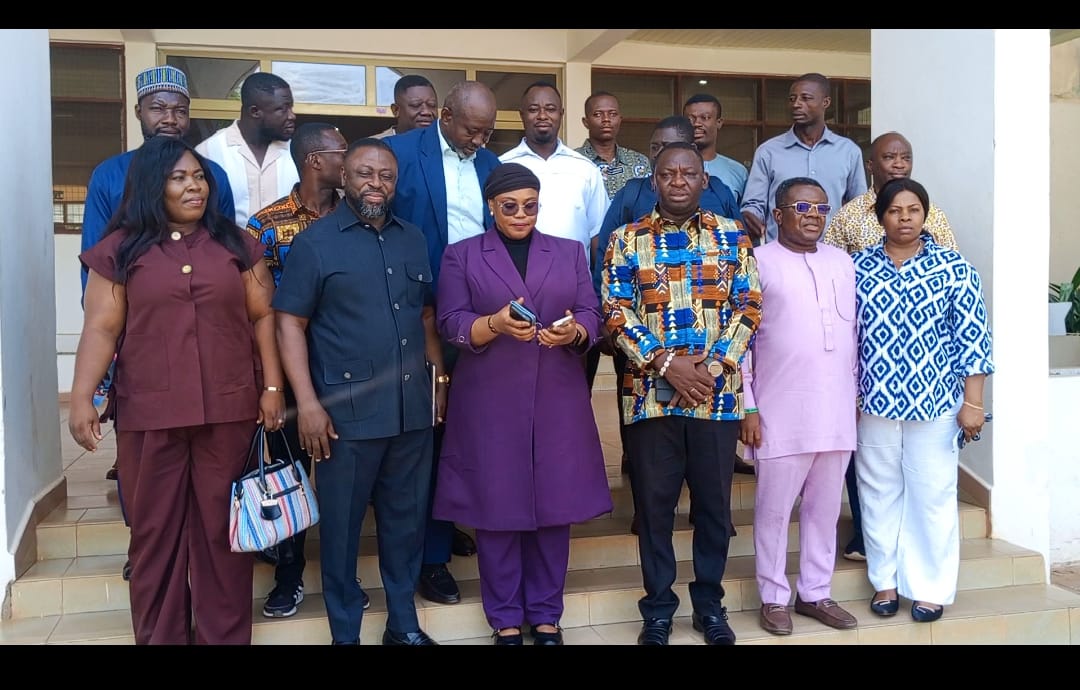
A member of the Committee, Dr Fred Kyei Asamoah, made the appeal during a visit to the University on Thursday, October 29, 2026, as part of an assessment of challenges confronting tertiary institutions in the Upper West Region.
He challenged the government to provide the University with a new auditorium before the current first-year students complete their second year.
“Before you complete your second year, they should have given you a brand-new auditorium to support you,” he said, urging the Ministry of Education and GETFund to act on the request.
Dr Kyei Asamoah also called for increased government investment in technical and vocational education, describing it as critical to addressing unemployment and creating opportunities for young people.
He said technical education, although more expensive to provide than conventional university education, equips students with practical skills needed by industry.
According to him, the mining and agricultural sectors in the Upper West Region offer significant opportunities that could be harnessed through investment in the university.
He believes strengthening the institution would help create employment locally and reduce the migration of young people from the north to southern Ghana in search of opportunities.
“TVET is a bit expensive. It’s like applied education, and that is what helps students to acquire skills. Government will need to spend about three to four times what you’ll be spending in a regular grammar university,” he said.
Dr Kyei Asamoah further identified the absence of student accommodation as a major concern, describing Dr Hilla Limann Technical University as the only technical university without a hostel facility.
He acknowledged ongoing efforts to complete an abandoned hostel project but urged the government to provide additional funding to accelerate the work.
The Committee member, however, encouraged university management to maximise available resources and strengthen maintenance practices rather than depend entirely on government support.
The Vice-Chancellor of Dr Hilla Limann Technical University, Professor Hamidatu Dramani, said inadequate funding continues to constrain the university’s expansion and delivery of quality technical education.
She said completing the two hostel projects allocated to the institution would significantly improve student enrolment and enhance campus life.
Professor Dramani explained that the absence of accommodation makes it difficult for the university to attract students who wish to experience residential university education.
She also identified inadequate workshop facilities as another major challenge, explaining that the rapid expansion of academic programmes and the arrival of new equipment have placed pressure on existing spaces.
The Vice-Chancellor further appealed for the completion of an abandoned faculty building project, the construction of an auditorium and the provision of improved access roads.
She said the university had submitted a request for a nine-kilometre road network, adding that even the construction of 4.5 kilometres would make a significant difference.
Professor Dramani also highlighted the absence of an entrance gate, although management had begun efforts to construct one.
She expressed confidence that addressing the challenges would strengthen the university’s ambition of becoming a centre of excellence for technical education in Ghana.
Meanwhile, the Parliamentary Select Committee subsequently visited the Simon Diedong Dombo University of Business and Integrated Development Studies (UBIDS), where the Vice-Chancellor, Professor Emmanuel Kanchebe Derbile, appealed for a fairer distribution of academic and administrative staff among public universities.
He said UBIDS has a student population of nearly 10,000 but only 470 staff members, a situation he said was putting pressure on the institution’s academic operations.
Professor Derbile called for a special recruitment initiative to support newly established universities, arguing that their staffing needs must be considered in national recruitment and resource allocation.
The Committee’s visit to the two universities was aimed at assessing their operational and infrastructural challenges and identifying areas requiring government intervention.
The engagements provided an opportunity for university authorities to present their concerns and appeal for increased investment to improve teaching, learning and institutional development in the Upper West Region.
By Ibrahim Abubakari Wangara