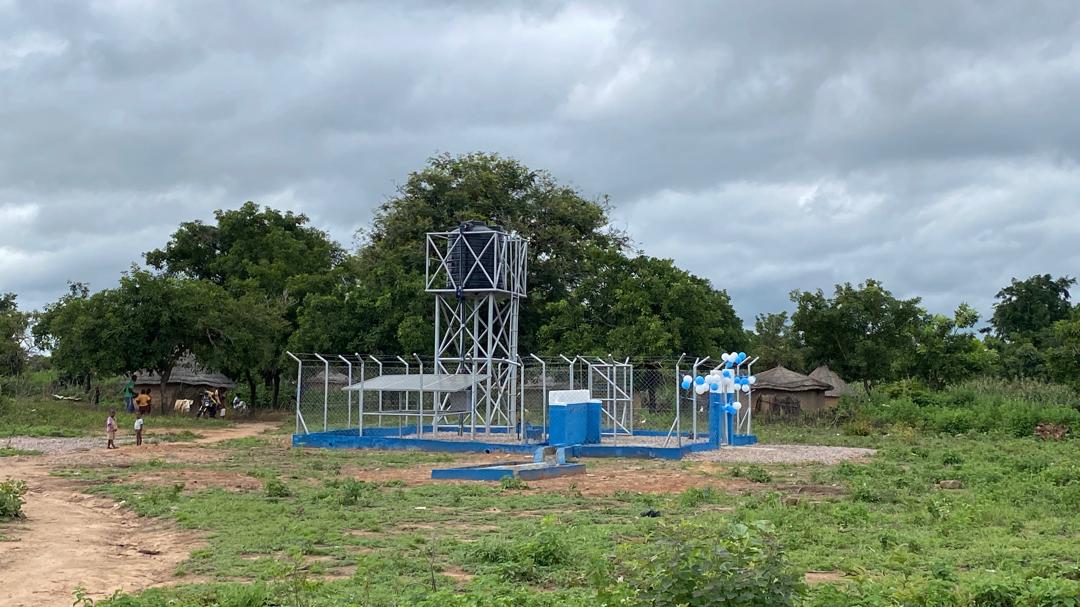

Changing Lives in Innovative Partnership (CLIP) Ghana, in collaboration with Acting for Life (AFL) and with funding from the French Ministry for Europe and Foreign Affairs and the Crisis and Support Centre, has provided a solar-powered mechanised borehole for the Kupulima community in the Sissala West District of the Upper West Region.
The facility is to support peace between transhumance communities, mainly Fulbe herders from the Sahelian region, and host communities in Ghana.
The project is under the ‘Support for Cross-Border Communities Vulnerable to Insecurity and Fragility’ (ACTIF) programme, which seeks to protect citizens from other countries, especially asylum seekers and pastoralists who are sometimes involved in communal conflicts with host communities over access to water and grazing fields.
As part of its efforts to foster social cohesion between the Fulbe and Ghanaian communities, CLIP Ghana has created platforms and forums for dialogue among stakeholders involved in transhumance activities.
The solar-powered mechanised borehole, financed by the Ministry for Europe and Foreign Affairs and the Crisis and Support Centre, will further promote peace and reduce the hardship residents and the Fulbe community face in accessing water.
Kupulima is one of the communities in northern Ghana that receives and hosts a large number of herders. Residents and herders have been living together peacefully, but water scarcity sometimes strains relations between the two groups.
With the new facility located close to their settlements, cattle and other livestock belonging to the Fulbe community will have an automatic flow of water. This will prevent animals from destroying farmlands and other property while searching for water.
The Executive Director of CLIP Ghana, Lukman Yussif, expressed satisfaction with the peaceful coexistence between the Fulbe and Kupulima communities. He said the water project was initiated after concerns were raised about water for residents and livestock, and was subsequently funded, executed and handed over after discussions with CLIP’s partners.
Mr Yussif said such projects are managed by a functional management committee to ensure sustainability, adding that committee members have pledged to maintain the facility properly.
The Technical Advisor of CLIP Ghana, Mohammed Alhassan Shaibu, reiterated the objectives of the ACTIF project, which is to foster social cohesion and peaceful coexistence in areas where transhumance occurs.
“So, the project is to foster peaceful coexistence between both communities, and already there is that sense of peaceful coexistence in the community. But before we started this project, we held a dialogue platform, and one of the challenges they mentioned was the need for a water facility to reduce pressure on the existing one. We foresee that, with the increasing population, if there is no additional water facility, there will be pressure on the existing ones,” he said.
The District Chief Executive for Sissala West, Abudu Gbena Fusheini, expressed appreciation to CLIP Ghana and its partners for reducing the burden on the District Assembly in meeting the water needs of communities.
“This project will only cement and solidify the level of cohesion in the community. I can only express my sincere appreciation to CLIP for this strong partnership and appeal to them. There are several other communities within the district that are perhaps facing similar challenges like Kupulima, if not more. So we are counting on them to help get many of these communities out of the water situation in the district,” he said.
The Assembly Member for the Kupulima Electoral Area, Katarah Batong, recounted how the community and the Fulbe have lived together without conflict.
“Since I was born, I met the Fulbe in our community and we have been living well. We had many problems. If they destroyed somebody’s farm, that was where we had issues,” he said.
“With the intervention of other NGOs, water was also a very big problem for us. Even in our community, we have about three functioning boreholes. One broke down, and that is where they [the Fulbe] also fetched water for their cattle. This solar-powered mechanised borehole is going to solve all our water problems,” he added.
Abiba Barry, who spoke on behalf of Fulani women in Kupulima, expressed profound appreciation to CLIP Ghana for providing the facility and pledged that they would ensure its proper maintenance.
By Tanko Mohammed Rabiu