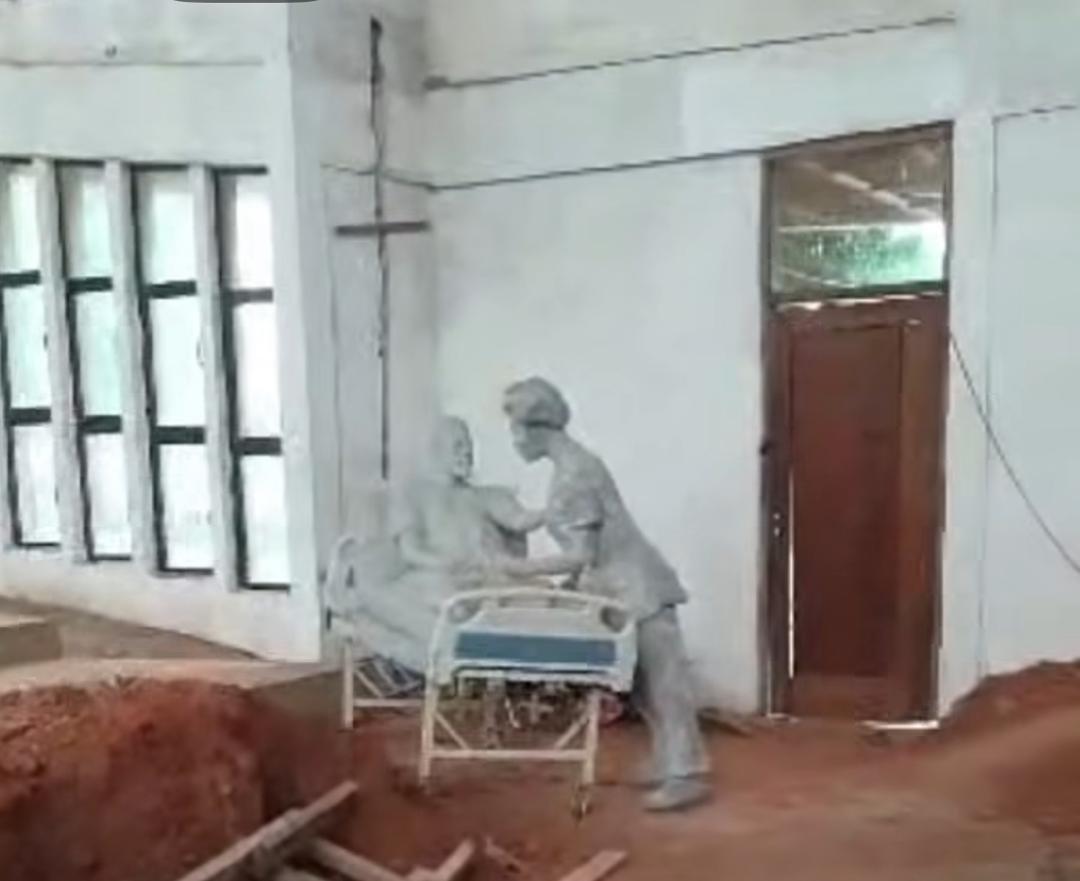

Media General’s ConnectNews has sighted a “mysterious” sculpture at the Centre for National Culture in Sekondi, Western Region.
The work depicts two figures: one seated in what resembles a hospital bed, the other standing nearby as a caregiver or nurse. Its imagery is unambiguous. But for many in the Western Region, even in this unfinished state, it stirs up memories of a far more contentious statue from not too long ago.
That earlier statue, of former President Nana Addo Dankwa Akufo-Addo, once stood at the roundabout near the Effia Nkwanta Regional Hospital. Nana Addo’s statue and its placement, immediately triggered intense debate. To supporters, it was a fitting tribute to a sitting president; to critics, it was just premature hero worship, inappropriate with the setting, and mirrored political opportunism.
The statue was defaced and pulled down after a change in government. The episode remains etched in local political memory as an example of how public art can quickly become entangled in partisan narratives when intentions are unclear.
Now, with Effia Nkwanta Regional Hospital undergoing a major upgrade including a new 500-bed facility designed to transform healthcare delivery in the region, the new sculpture may feel different. Its hospital motif appears carefully chosen, harmonising with the institution’s evolving identity. For many residents, it resonates more naturally with its surroundings than the political likeness of a former head of state ever could.

A brief vox pop conducted by ConnectNews reflects this shift. “Effia Nkwanta is undergoing massive renovation. I hear they are building a new 500-bed block. That is massive. We have a new roundabout and a road running around it. I think a statue of such nature will be in order,” one resident remarked.
The managers of the Centre for National Culture are tight-lipped on the sculpture’s origins or purpose. That silence, adds an air of mystery to an otherwise straightforward work of art. Is it also a deliberate yet cautious attempt to avoid politicising what could simply be a symbol of care and progress?
For now, the statue stands quietly in scaffolding, free from the fury that engulfed its predecessor. Could it also be the case of someone just wanting to be creative and has nothing to do with any health facility?
Effia Nkwanta Regional Hospital: A Promise on Pause
For decades, the Effia Nkwanta Regional Hospital (ENRH) has been both a lifeline and a limitation. Built in 1938, it has carried the weight of an entire region’s medical needs, even as its ageing infrastructure struggled to meet modern demands. Calls for expansion grew louder with each passing year, culminating in a government promise to transform it into a 500-bed teaching hospital — a step intended to put Western Region healthcare on par with the country’s leading facilities.

In 2022, the project took off. Old wards were demolished, departments moved into temporary container units, and contractors rolled out plans for a modernised hospital. A complementary 250-bed facility at Apemanim was also part of the vision, together forming a twin-hospital network to serve the growing population. The future seemed tangible.
By late 2023, however, momentum stalled. Construction has effectively paused, leaving behind incomplete structures and a site frozen mid-renovation. Finance Minister Cassiel Ato Forson confirmed that ENRH is among 55 projects stalled due to Ghana’s IMF-backed debt restructuring, with contractors demobilised and funds inaccessible.
The consequences are immediate and personal. Advanced care — including oncology, kidney treatment, trauma response, and intensive care — remains out of reach for local patients. Families are forced to travel long distances to Cape Coast or Accra for critical services, often at great cost. Staff operate in cramped temporary spaces, struggling to maintain standards. One nurse noted, “We do our best, but sometimes there’s just no room. We have to make hard choices about who gets care first.”
The halt has turned a bold promise into a long-term challenge. What was meant to be a centre of excellence now stands as a stark reminder of how national fiscal policies ripple into local realities. Yet, even amid delays, the hospital’s management continues to introduce incremental improvements — installing dialysis machines, creating a paperless records system, and expanding diagnostic services — demonstrating resilience in the face of stalled infrastructure.
Effia Nkwanta today is a hospital caught between past and future. Its grand vision waits in limbo, a symbol of deferred ambition for a region eager for world-class healthcare.