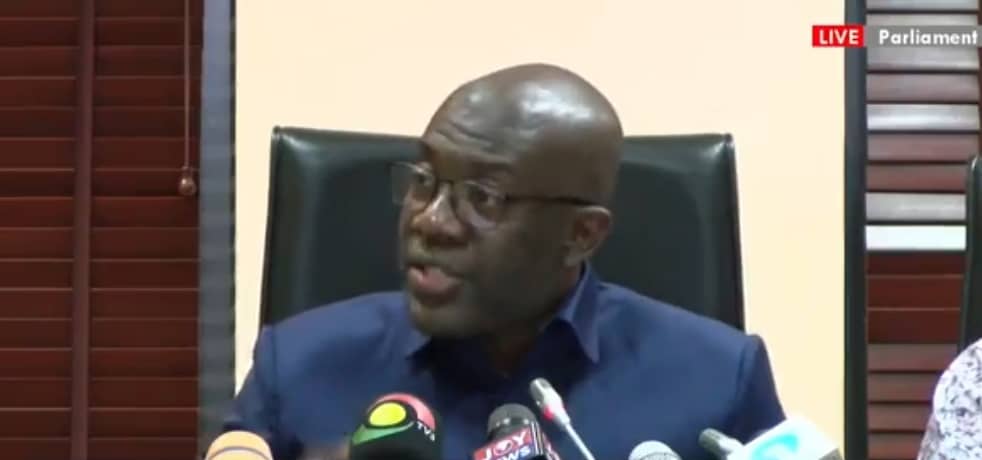

Member of Parliament for Ofoase Ayirebi, Kojo Oppong Nkrumah (KON) has told the Minister of Education, Haruna, not only to complain about the weaponisation of bail under the Mahama administration, but he must ensure that the practice is stopped because he is a minister in the present government.
Oppong Nkrumah said that when members of the New Patriotic Party (NPP) and others complained about the weaponisation of bail, some members of the governing National Democratic Congress (NDC) denied it, but now, government officials are admitting to it.
“In the past weeks we’ve been complaining about the weaponisation of law enforcement to suppress dissenting voices. Initially, some members of the NDC denied it and claimed we were being partisan.
“For some reason I’m seeing clips of Ministers of state now agreeing with us. Dear Ministers, we are grateful. But don’t just agree with us. Don’t wait for constitutional amendments. Instruct the agencies doing this to stop.
“You only complain when you either lack power to stop it or are scamming the people that you care, while indeed you condone it,” the former Minister of Works and Housing wrote on his X page.
Haruna Iddrisu, also the Member of Parliament for Tamale South, has condemned what he describes as growing abuses of power by some state institutions, particularly in the handling of bail for accused persons.
Speaking at the funeral rites of Dr Mahama Sayibu on Thursday, May 28, 2026, the senior NDC lawmaker took direct aim at the Ghana Police Service, the courts, and the Economic and Organised Crime Office (EOCO), accusing them of using bail as a punitive instrument rather than a legal safeguard.
“In Ghana today, we have seen excesses; excesses from the Police, excesses from the Court, excesses from EOCO denying persons bail, and using bail as punishment for accused persons. That is not law,” he said.
Iddrisu stressed that it is both settled law and basic legal principle that accused persons should neither be denied bail arbitrarily nor subjected to excessive bail conditions as a form of punishment, a position firmly grounded in Ghana’s constitutional and statutory framework.
Under Section 96(3) and (4) of the Criminal and Other Offences (Procedure) Act, 1960 (Act 30), the amount and conditions of bail must be fixed with due regard to the circumstances of the case and must not be excessive or harsh. Additionally, Article 19(2)(c) of the 1992 Constitution guarantees that every person accused of a criminal offence is presumed innocent unless and until proven guilty by a competent court.
The Education Minister reiterated that bedrock principle in his remarks, insisting it must translate into practice.
“Don’t deny an accused person bail or ask an accused person to pay excessively as a punishment,” he urged, adding: “Every person is presumed innocent until after fair trial.”
His comments come amid a growing public conversation about the use of bail in recent times. Legal commentators and media analysts have in recent years criticised what they describe as an increasing trend toward restrictive and burdensome bail conditions, particularly in politically sensitive prosecutions, with many accused persons remaining in custody despite technically being granted bail because they cannot meet conditions such as high monetary guarantees or landed-property sureties.
Iddrisu called for systemic reform, appealing to all institutions involved in the administration of justice to exercise restraint and fairness.
“I expect that in Ghana today we must end the high-handedness and excessiveness in matters relating to bail and its denial and its charges,” he stated.