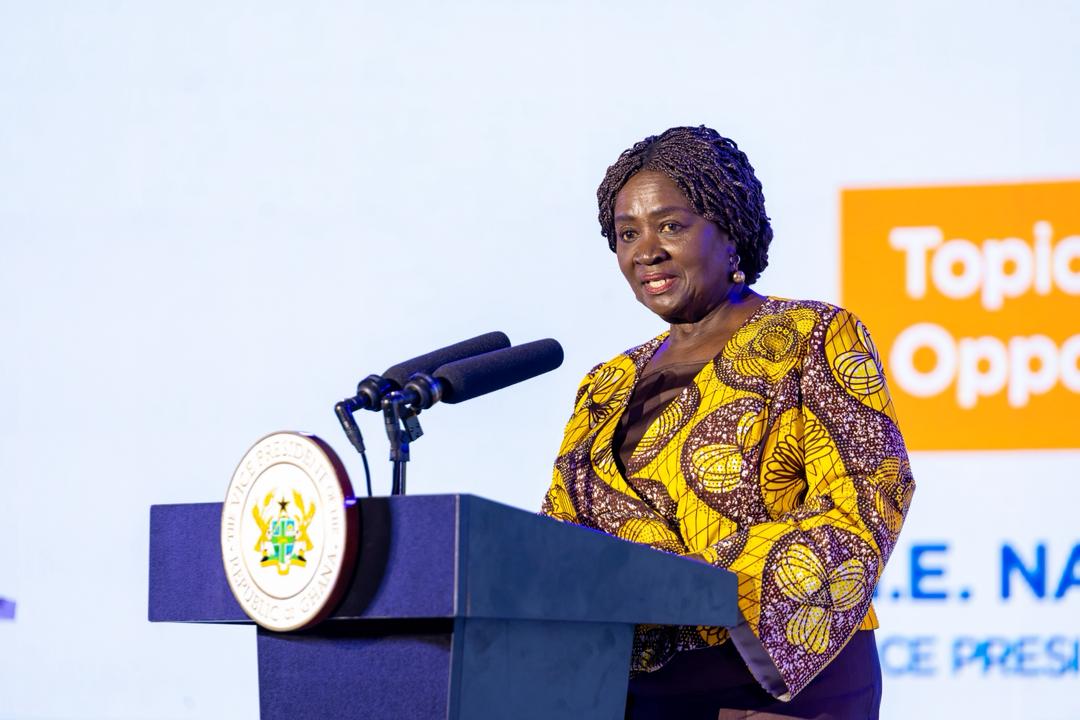

The Vice President, Professor Naana Jane Opoku-Agyemang, has announced plans for a continental digital trade corridor pilot aimed at accelerating cross-border payments, identity verification and e-commerce across Africa.
Speaking at the 3i Africa Summit in Accra on Wednesday, May 6, 2026, the Vice President said the initiative will be implemented in collaboration with several African countries, including Rwanda and Zambia, as part of efforts to deepen digital and economic integration on the continent.
The summit, organized by the Bank of Ghana, brought together policymakers, central bankers, fintech leaders and investors to chart the next phase of Africa’s digital finance evolution.
In her address, Prof. Opoku-Agyemang stressed that Africa’s future growth will depend not just on potential, but on how effectively countries organise themselves to compete, integrate and build systems at scale.
She noted that while Ghana is often described as a “gateway to Africa,” the designation must go beyond rhetoric. “A gateway is not just a title, it is a system measured by whether transactions clear efficiently, businesses connect seamlessly and markets operate with certainty,” she said.
The Vice President highlighted Ghana’s strategic position, citing its political stability and its role as host of the African Continental Free Trade Area Secretariat as key advantages in driving regional integration.
She emphasized that Africa’s economic transformation now hinges on digital integration, particularly in payments, identity systems, regulation and infrastructure.
On payments, she pointed out that many intra-African transactions are still routed through systems outside the continent and settled in foreign currencies, leading to higher costs and delays. She referenced initiatives such as the Pan-African Payment and Settlement System as critical to reversing this trend and enabling faster, local-currency transactions.
The planned digital trade corridor, she explained, will test solutions including mobile money interoperability, mutual recognition of digital identities for cross-border Know-Your-Customer (KYC) processes, and harmonized electronic invoicing systems.
“Systems we build today will determine whether Africa participates in the global digital economy on its own terms or operates within frameworks defined elsewhere,” she said.
Prof. Opoku-Agyemang also underscored the importance of digital identity, noting that millions of Africans still lack verifiable identification, limiting their access to financial services and cross-border trade opportunities.
On regulation, she called for greater alignment across African countries, arguing that fragmented regulatory environments increase business costs and slow innovation. While acknowledging that uniform laws are not necessary, she stressed the need for compatibility and shared standards.
The Vice President further highlighted infrastructure gaps as a major constraint, pointing to limited broadband access, high costs and Africa’s relatively small share of global data centre capacity. She warned that reliance on external data systems raises concerns about performance and digital sovereignty.
Despite these challenges, she expressed optimism about Africa’s prospects, noting its young population and rapid technology adoption. She said the continent is well-positioned to shape the next phase of global digital growth, particularly in sectors such as agriculture, health, education and public service delivery.
Ghana, she added, is committed to ensuring that regional integration is not only discussed at high-level forums but implemented through practical, scalable systems.
The 3i Africa Summit, the second edition continues in Accra with discussions focused on innovation, investment and integration in Africa’s financial and digital economy.
Veep Opoku-Agyemang calls for urgent reforms in healthcare system after visit to Mahama Cares