
It’s a Saturday morning, and mourners gather at the Sekondi Train Terminal for a funeral reception.
The melancholic chords of a funeral hymn echo through the deserted platforms, reverberating against the old iron rails, amplifying the somber mood. Among those present is a couple from Asankragua in Amenfi West, visiting Sekondi–Takoradi for the first time. They are disappointed, having looked forward to riding the once-promising commuter train.
Now, the terminal, like the service itself, sits stripped of purpose, relegated to an event ground. “At its peak in 2018, the service boasted over 2,000 daily passengers with an average of five trips per day,” a source at Ghana Railways Company told ConnectNews. This scene starkly highlights the collapse of an initiative that once promised to transform daily life in the region but has instead become a symbol of wasted potential.

The Promise of a People’s Train
Strategically positioned in Kojokrom, the suburban terminal was built to tap into the swathes of households that surround it. At peak, commuters would stream in every morning, Monday to Friday, boarding the train to work, school, or business in Takoradi. Its counterpart in Sekondi served fishers and traders at the Albert Bosomtwi Fishing Harbour and Sekondi Landing Beach, who used the train as a cheaper, faster alternative to transporting produce by road. A handful of residents would also join.

With long tailbacks choking roads into Takoradi, a journey of less than 15 minutes could stretch to half an hour or more. This means commuters could be losing up to 15 minutes each way, which amounts to an average of 2.5 hours per week per person. Over a year, this totals roughly 130 hours lost per commuter due to traffic.
For residents and workers in the harbour enclave, these delays not only increase stress but also represent a significant hidden economic toll, potentially costing hundreds of cedis annually in lost productivity. The train promised a much-needed alternative, offering reliability and affordability.

Sekondi–Takoradi is not just another line but one that holds immense history. It birthed Ghana’s railway services in the early 20th century, designed to carry minerals and goods from the hinterlands to the Port of Takoradi.
For the older generation, the revival of passenger services in 2016 evoked deep nostalgia — the sound of wheels on metal rekindled memories of Ghana’s rail heyday in the 1970s and ’80s. For the younger generation, the service offered not only relief but novelty: children boarding with excitement, families reliving stories of old.

A Short-Lived Rebirth
Amid pomp and pageantry, President John Dramani Mahama commissioned the $165 million Sekondi–Takoradi via Kojokrom suburban rail network in November 2016. Two brand-new Diesel Multiple Unit (DMU) trains were deployed. The project, part of the Western Rail Line, was hailed as the rebirth of commuter rail in Ghana.
In the beginning, the trains ran smoothly. Students rode free up to primary six, while junior and senior high school students paid between GHS 1 and GHS 3. Adults paid just GHS 4. Patronage grew steadily. “At its peak, people were using it,” the source admitted.
But there was a catch: “We were not breaking even. We were running it almost as a CSR project. To put the financial challenge into perspective, for every cedi earned from ticket sales, the railway operation required an additional two cedis in subsidies to cover operational costs, highlighting a substantial gap between revenue and expenses,” the source added.

The operation was sustained by freight. Haulage of manganese from Nsuta was the primary lifeline that kept passenger services alive. However, once those freight lines deteriorated and manganese trains stopped rolling, it triggered a broader disruption in the financial witherwithal of the company. This cessation highlighted the systemic vulnerability of relying solely on passenger services for revenue. By 2020, without the critical freight support, the DMUs at Sekondi were silent.
Terminals in Ruins
Today, the two terminals are pale shadows of themselves.
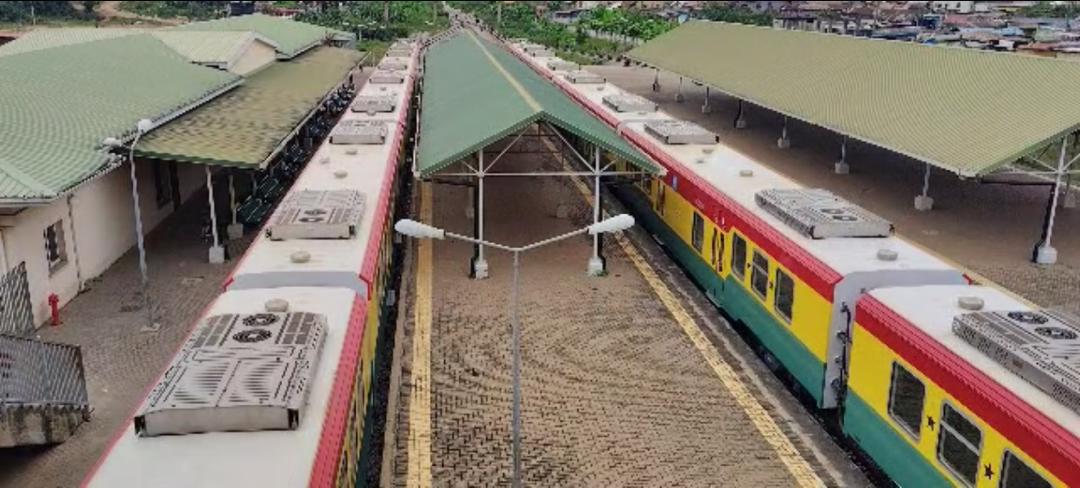
At Sekondi, the DMUs sit idle. Copper pipes and air-conditioning units at the terminal have been stolen, while the roofs of passenger bays are ripped open. The rails are overgrown with weeds, and spikes and clamps rust away. The once-proud station now doubles as a funeral reception ground, with a station mistress charging GHS 500 for events and GHS 100 for cleaning, the source revealed.

The situation at Kojokrom is no better. A terminal designed for commuters now stands frozen, unused, becoming a monument to neglect. Together, they present a striking picture of decay that is both unpleasant and symbolic of Ghana’s wider rail struggles: ambitious beginnings that fade into abandonment.
Missed Opportunities
Rail commuters in other countries tell a different story. In Nairobi, the revived suburban service integrates with buses and runs multiple trips daily for workers. In Lagos, the Blue Line was deliberately aligned with urban transit to ensure feeder access and regular timetables. In the United Kingdom, small DMU lines in towns comparable in size to Sekondi–Takoradi thrive because of frequent services — sometimes every 15 minutes during peak hours.
It appears Sekondi–Takoradi’s service, by contrast, was never scaled to meet the needs it was built to address, running only a few trips per day — too few to be practical for most. Its ticketing system was misaligned with road transport options, and missed connections to buses and trotros left commuters stranded. Poor maintenance and minimal marketing meant public confidence never took root. These missteps undermined the initiative’s central promise: to provide a reliable, accessible transit alternative capable of reshaping urban commuting in Sekondi–Takoradi.
The Way Forward: Linking Revival to Expansion
The silence at Sekondi and Kojokrom does not have to be permanent. Ongoing works on the Western Rail Line — particularly the extension from Kojokrom through Tarkwa and beyond — offer a real chance to restore life to the abandoned commuter service. Freight haulage, especially manganese from Nsuta, is expected to resume once the upgraded tracks are complete, and this could again provide the financial backbone that once kept the Sekondi–Takoradi passenger trains alive.
Crucially, passenger revival is tied to this expansion. A functioning line to Tarkwa would not only reconnect mining towns to the Port of Takoradi but also create a stronger case for frequent suburban services. More towns feeding into the corridor means higher ridership, greater fare revenue, and a more sustainable model than the short shuttle alone.
If government couples this freight-led expansion with deliberate investment in stations, rolling stock, and integrated ticketing, Sekondi–Takoradi’s abandoned DMUs could run again — not as a nostalgic experiment, but as a viable commuter service. For residents, that would mean shorter journeys, fewer hours lost in traffic, and a renewed sense that rail can once again serve the public good.