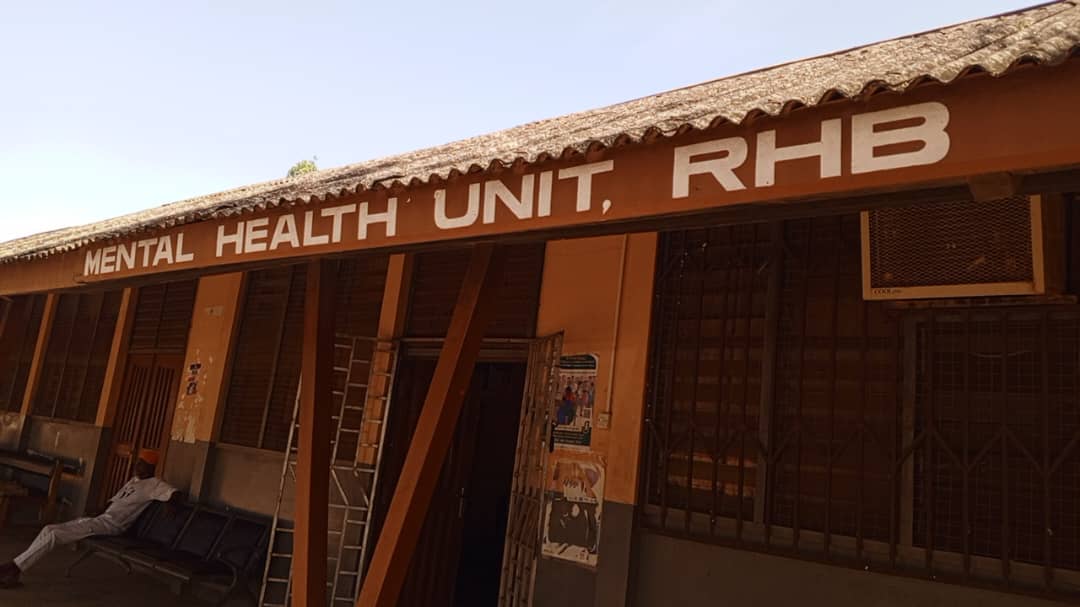

Mental health issues are taking center stage in health cases in the five regions of the North especially with the lack of a state-owned mental health hospital.
To worsen the mental health situation, there is only one psychiatrist in the Upper East Region who has been supported by few mental health nurses.
According to the Upper East Regional Health Directorate, mental health conditions account for more than 2,000 outpatients visits each year.
Data from the District Health Management Information System paints an alarming picture as follows; 210 cases of depression were recorded in 2023, dropped to 137 in 2024, and 108 cases already in the first quarter of 2025.

Suicide remains a pressing concern with seven deaths in 2023, rose to thirteen in 2024 and seven deaths in the first quarter of 2025. The region also recorded a total of 269 attempted suicides.
At the Mental Health Unit of the regional hospital, mental health nurses only consult, detain and prescribe medications to clients who visit daily.
Serious mental cases are referred to the Southern part of Ghana due to the lack of State-owned mental hospitals in the five regions of the North.
The wards at the regional hospital are used for admission of clients whose conditions can be fairly managed. Clients who can afford the private mental hospitals are referred there for medical attention.

Angelina Najat Anduba , a mental health nurse shared how the lack of state-owned mental hospital and facility is affecting quality mental health delivery in the region
“…we also have the challenges of being able to tell our patients to adhere to treatments because the majority of them don’t have enough money to pay for their treatment like to buy medications. Also, some don’t even have money to enroll themselves on the national health insurance because they have been neglected by their families and because of the stigma.
So, the majority of our clients end up falling on us for us to get medication. And availability of the medication for the various facilities too is also a problem because if there is medications for free, we can give them for free but they cannot purchase it and it’s making a lot of our patients relapse now and then. But if maybe the need comes for us to get more medication, I think they will be able to be better,” she said.
According to her, “Some of the challenges are that, we don’t have a bed capacity for admission. Majority of the cases that come are psychiatry emergencies that need to be admitted but we don’t have a ward facility made for psychiatry wards so that all our clients will be admitted there. Also, we also face the challenge of not having a psychiatrist in the facility because the whole upper east region has one psychiatrist who is working in a child hospital, it means we have to refer our cases from our regional hospital to the child hospital which shouldn’t be so. So, we really need a psychiatrist so that it will lessen the burden of the nurses. We are equally tasked to do the work of a nurse and the work of a doctor at the same time.”
Another mental health nurse, Janet Adu Asante outlined the frustration they go through and has made some recommendations that can help reduce the challenges in mental health treatment.
“As a facility, at least 10 bed capacity wards will go a long way in helping the people so that we can admit when they need me. Then secondly, I think medication, patients find it very difficult purchasing medication, so at least if the health insurance can take parts and patients topping up a little or even the one that is supposed to be taken home by the health insurance, it will be very, very important for the patient and they will be less burdened.
And also, patients health insurance, there are some that cannot enroll themselves in case their health insurance is expired, so we plead that if the government can take it up that when their health insurance expires, they can renew it for them without any payments as is being done to those who are pregnant, it will be very, very good as well,” she said.

On the cases the facility records daily, Janet Adu Asante said, “We have suicide, depression, then drugs, substance abuse. As we said earlier, when it comes to suicide, the treatment is psychotherapy and here lies a case we don’t have the psychologist, so we need to stand in as a psychologist to psych the person. So during this time, that is what we do, we counsel the person to reinstate the person’s mind that whatever you are doing, maybe this is what is going to end, so we counsel the person.
And when it comes to substance abuse, we as psychiatric nurses, we play the role of a psychologist, so we assess and we prescribe the medication and administer, and even at a point that the person is going to withdraw, we make sure that we stabilize the person to come back to their normal states”.
Ms. Gifty Atampugbire, a clinical Nursing Auditor at the University of Ghana Medical Center who is passionate about mental health issues calls for human resources in mental health especially training of mental health nurses to handle serious cases.
“Out of the five northern regions, there is not a single State-owned mental hospital, yet the first point of contact for anyone in crisis is usually a nurse or midwife -people who are on the frontline but often lack the skills to provide quality mental health care,” she lamented.
Meanwhile, the Ghana Mental Health Authority has reported a 40% increase in suicide deaths nationwide in 2024 with 475 suicide attempts recorded in just the first half of 2025.