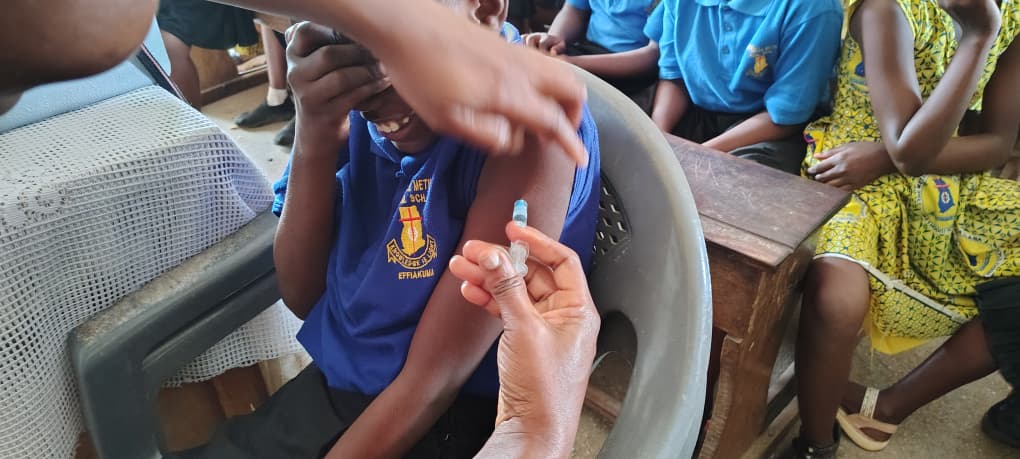

The Ghana Health Service reports that about 28,000 girls [aged 9-14 years] were vaccinated against the Human Papillomavirus (HPV) on Day 1 of the vaccination campaign in the Western Region.
Coordinator for the Expanded Immunization Program in the Western Region, Nicholas Asare Adomako opines that the number is impressive considering the instances of vaccine hesitancy that were reported across the region and the country.
Speaking exclusively to Media General’s Connect 97.1 FM in Takoradi on October 9, Mr. Asare Adomako remarked that statistics suggest the campaign by the Ghana Health Service (GHS) is on course in meeting its target for the region.
“We have been able to vaccinate about 28,000 of the girls, representing 18 percent of the target. So that is a considerable number for a first-day exercise, and we are hoping the numbers will improve as we continue,” he added.
The vaccination campaign in the Western Region is targeting a total of 148,320 girls. Further to that, a total of 257 vaccination teams have been deployed across the region. Eligible girls started receiving the vaccine on Wednesday, 8 October 2025, in school.
The Ghana Health Service plans to end the vaccination on Sunday, 12 October 2025, and when necessary, undertake a brief mop-up to ensure maximum uptake.
Measures Taken to address Vaccine Hesitancy
Across the country, reports were rife of parents hesitating to consent to having their girls vaccinated. From the Western Region, Connect FM reported similar cases in the Effia Kwesimintsim Municipality, a situation which prompted the Ghana Education Service to schedule a consultative meeting with the Parents Association.
The meeting is to afford the Ghana Health Service the opportunity to engage parents on the vaccination program and, importantly, demystify any misconceptions.
Commenting on this phenomenon, Mr. Asare Adomako indicated that they [GHS] anticipated such behaviours, and did put in measures to address them.
“We anticipated that, and it was reported across the districts… and it was mainly because some parents are yet to understand and appreciate the essence of the HPV vaccination.
“We have measures in place to mitigate this. The District Directors together with the respective teams do take personal visits to parents and schools where such cases are reported to offer some education and clarify issues regarding the vaccine,” he elaborated.
He took the opportunity to encourage parents to release their girls to take the vaccines, adding that it is the most effective way to prevent cervical cancer.
“What we are doing is a preventive measure, and it is the most critical moment in the life of our girls. So, in their adult life, around 40 or 50 years they are already protected against cervical cancer and at no risk of infection.”
In the Western Region, the HPV vaccination is targeting a total of 148,320 girls. While public nurses continue administering the vaccines, the Ghana Education Service is facilitating engagements with parents to get them to consent to the vaccination of their girls.