
Vice President, Prof. Naana Jane Opoku-Agyemang, has described the University of Cape Coast as the foundation of her academic and professional journey, saying the institution shaped the values that guided her path from student to national leader.
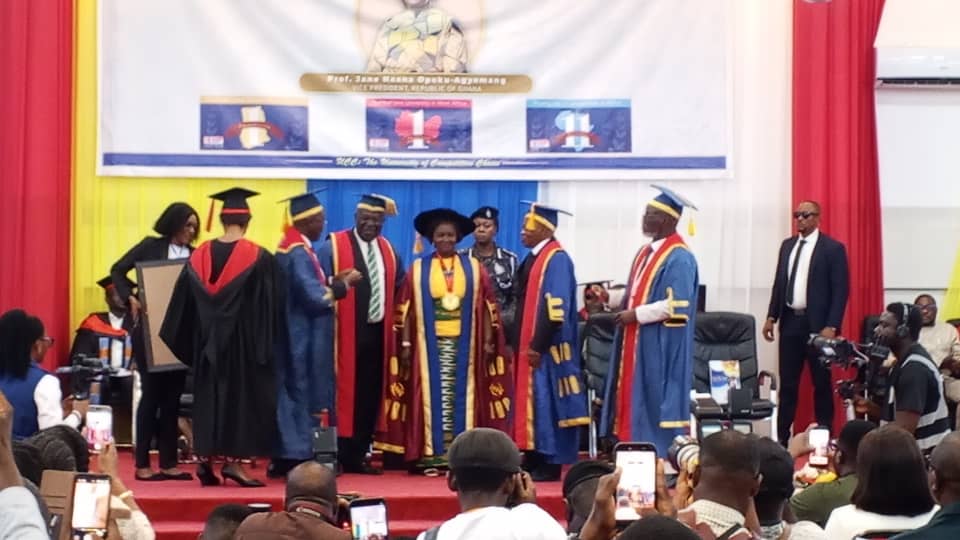
Speaking after receiving the Distinguished Fellow Award from the University of Cape Coast, the Vice President delivered a reflective address highlighting the role the institution played in her life and the broader responsibility that comes with education.
She noted that the recognition is particularly meaningful because it came from the very institution where her higher education and professional career began.
“There is something special about this recognition. This is where my higher education began, and where my professional life took shape,” she said.
Professor Opoku-Agyemang recounted her long association with the university, explaining that the campus had been the backdrop to many stages of her life.
“This campus was the backdrop of my life as a student, a national service person, a lecturer with different appointments and responsibilities, a professor, a vice-chancellor and, of course, as a mother too,” she told the audience.
She explained that the values instilled by the University of Cape Coast shaped the way she approached responsibilities outside academia after leaving the University.
“When I left the university, I did my best to carry its lessons into my non-academic roles,” she added.
The Vice President emphasised that education carries responsibilities beyond personal advancement, urging graduates and beneficiaries of higher education to use their knowledge in service to society.
“Knowledge is meant to bring illumination, not only for personal edification,” she said.

She stressed that societies must increasingly rely on research, evidence, and truth in addressing complex challenges.
Reflecting on Ghana’s educational heritage, she noted that the University’s establishment under the leadership of Kwame Nkrumah symbolised the country’s longstanding belief in the transformative power of education.
According to her, those who benefit from higher education must constantly ask whether the knowledge they acquire serves the society that made it possible.
“Higher education, even today, is a privilege. Therefore, we need to ask whether the knowledge we acquire serves the society that made it possible,” she said.
Professor Opoku-Agyemang also highlighted the close relationship between the University and surrounding communities, noting that the institution’s location among several towns serves as a constant reminder that academia must remain connected to society.
“Our education tells us to go beyond theoretical knowledge and make tangible improvements in our nation so that we can take genuine pride in our identity and capabilities,” she said.
She further encouraged individuals in all professions to play a role in mentoring others and passing on knowledge.
“We are invited, regardless of our professions or backgrounds, to be somebody else’s teacher to guide, advise and uplift others, and in so doing hold the future in trust for those who follow,” she stated.
The Vice President said the true value of knowledge and national progress should be measured by whether each generation leaves the country stronger and more capable than it inherited it.
“What it leaves for Ghana must be stronger, clearer and more valuable than what we received,” she said.
She concluded by expressing gratitude to the university community for the honour, describing the recognition as both humbling and deeply meaningful.
“I thank the University of Cape Coast once more for this exceptional recognition that leaves me truly humble and deeply grateful,” she said.
The Distinguished Fellow Award ceremony brought together government officials, academics, students, alumni, and other dignitaries to celebrate the Vice President’s contributions to education, leadership, and national development.
By Evelyn Tengmaa