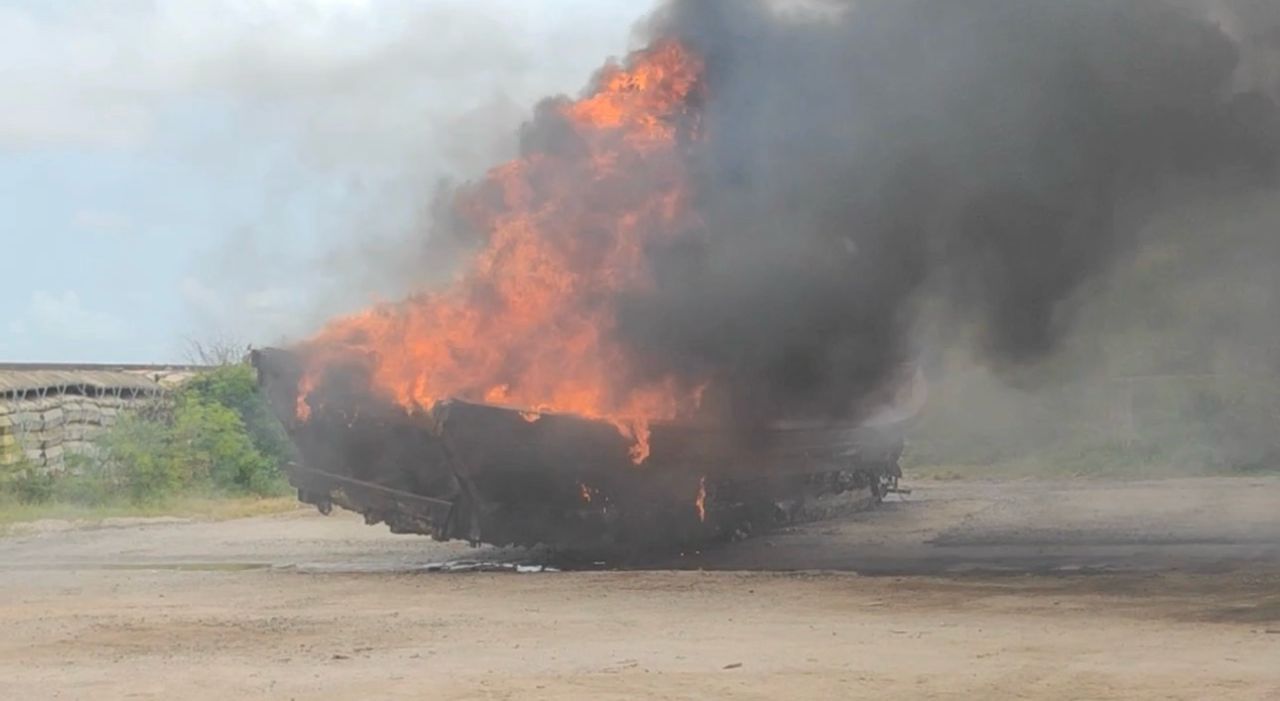

The National Petroleum Authority (NPA), together with security agencies, has launched a fierce crackdown on illegal fuel smuggling.
At the centre of the operation is a simple but dramatic tactic: burning the boats that move unmarked, untaxed, and potentially dangerous fuel onto the market.
In a no‑holds‑barred address, the Chief Executive Officer of the NPA, Godwin Kudzo Tameklo, laid out exactly why the authority is taking this fight to the water’s edge.
“First of all, the authority runs a scheme that allows us to mark every petroleum product that comes into the country,” Tameklo explained.
When a vessel arrives, the NPA tests the product to ensure it meets quality standards – even before it is allowed to be discharged. Once discharged, they mark the product.
Why? To stop adulteration.
“It’s a concentrate. Once the concentration falls, it means something has been added to increase the quantity for selling. That can have a negative impact on consumers.”
To protect what finally gets to Ghanaians, the NPA has ramped up its activities, collaborating closely with the Navy, the Marine Police, and the Ghana Police Service.
“They are greatly assisting us,” Tameklo said. “We want to be sure of the quality.”
There is another layer: taxes. Every liter carries a levy that goes toward national development. When fuel is smuggled unmarked, that revenue disappears.

Here is how the illegal operators work, according to the NPA boss.
A large vessel maybe carrying 10,000 metric tons of product which sits on the high seas. Smaller boats, the kind now being impounded and burned, ferry the fuel ashore. From there, tankers pick it up and deliver it directly to outlets.
The product is not marked. You cannot tell if it has been adulterated. You cannot collect the tax. And the consumer has no idea what they are putting into their vehicle.
That is why the NPA and security agencies launched this initiative.
“As you can see, we have impounded them. We are burning them to send a clear message.”
Tameklo points to the boats themselves: “At the heart of this illegal activity is the boat. Without it, this whole activity will be limited. You can’t be using gallons to convey or discharge this product. Once you get the boat down, the whole infrastructure begins to collapse.”
The NPA is not against petroleum business – only illegal petroleum business.
“If you want to do petroleum activity, come to the Authority. We will give you appropriate licenses. You can engage in that enterprise. But where you want to take the law into your hands, we will not encourage any form of impunity.”
He added: “People have built generational wealth out of such activities – but that is not our interest. Our interest is the consumer out there. What is getting into their vehicles?”
Ghana’s security services have a robust command centre that tracks every bulk road vehicle. But these boats?
“How do you track them? You don’t know which depot they came from. That is why this operation is intelligence‑led. They don’t operate in the day. They operate in a very clandestine manner. Thankfully, the security agencies have the skill set to lead these operations with intelligence.”
Tameklo broke down the numbers to show the scale of the problem.
One of these boats can carry enough fuel to fill two tanker trucks. Each tanker holds about 54,000 liters. So one boat can move roughly 108,000 liters in a single trip.
“We have about eight boats. Five boats alone can fill about 10 trucks. That is 540,000 liters of petroleum products. In one round.”
Now calculate the tax: assuming one cedi per liter levy, that single round cheats the state out of 540,000 Ghana cedis.
“Begin to do the calculation. That is huge sums of money.”
The NPA will continue the exercise, with the next operation planned at the Eastern Neighbour Command in Tema Newtown.
“We want to send a clear message: enough is enough.”
Tameklo acknowledged that the operators are rarely caught in the act: “By the time you get there, you don’t even see the people. But once you destroy the tool of their trade, you destroy the trade itself. Building one of these boats is not a joke.”
The CEO ended with an appeal: “We believe that together the Authority, the security agencies, and the media we can all fight this. The media, kindly help us propagate this message.”
By Ebenezer Atiemo