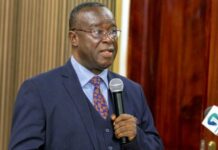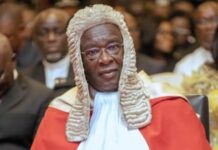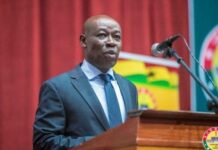

Chief Justice Paul Baffoe-Bonnie has expressed his strong disapproval of concerns raised by the Ghana Bar Association (GBA) that lawyers should not be made to procced with cases during legal vacations.
The Chief Justice defended the authority of judges to proceed with court cases during the legal vacation, insisting that lawyers cannot on their own decide not to appear in court simply because the trial has been scheduled within the legal vacation period.
Speaking at the 2nd Quadrennial Delegates Congress of the Senior Staff Association of the Judicial Service of Ghana in Sunyani, August 10, the Chief Justice explained that a lawyer who has made personal arrangements during the legal vacation cannot use those arrangements as grounds to prevent a judge who is sitting from hearing a case.
He emphasised that lawyers who wish to take leave may do so only if the client permits.
“To write to the Chief Justice to say that, the cases should not be adjourned to the vacation so I am not coming, I have already made arrangements outside so I am not coming.
“You are a lawyer, you have your clients. If your clients decide to give you leave, well, go on leave but you cannot say that there is a legal vacation and the Judge who is actually sitting cannot do your case, no that is not it,” he stated.
The Chief Justice also stressed that adjournments are judicial decisions and do not rest with the Chief Justice.
“No, adjournments are not at the instance of the Chief Justice, adjournment is a judicial act. This is something that is so basic,” he stated.
His comment follows a letter by the Ghana Bar Association (GBA) appealing to the Chief Justice over lawyers being required to appear in court during the legal vacation.
The GBA in letter dated August 10, 2026 argued that lawyers who had indicated their unavailability during the period should not be compelled to attend proceedings.
The GBA said it was responding to petitions from Zoe, Akyea & Co, Dame & Partners, and Sam Okudzeto & Associates, who raised concerns over notices served on them by virtue of warrants issued to specific judges to continue part-heard criminal cases during the vacation.
The Association explained that under the High Court (Civil Procedure) Rules, 2004, CI 47, specifically Order 79, Rule 4, the High Court observes three vacations annually, with the second and longest running from 1 August to 30 September. It said the rule exists to give lawyers, judges, and judicial staff a deserved period of rest after the second term, the longest in the legal calendar.
While acknowledging that Vacation Courts and Virtual Courts have, by convention, been designated to handle emergencies such as interlocutory matters, the GBA stressed that these courts do not conduct trials. It maintained that the overriding consideration for any matter before a Vacation Judge remains the willingness and availability of counsel to appear, adding that lawyers are under no compulsion to attend court during the vacation.
“Once Counsel in a matter indicates their unavailability to attend Court during the vacation, even though the Court may have listed their case, it cannot proceed with the case in any way,” the letter stated, noting that this applies whether one or both sides indicate their inability to proceed.
GBA further argued that innocent parties in civil or criminal trials should not be coerced by a judge into representing themselves, since the absence of a lawyer during a legal vacation is not considered wilful.
It said no step should be taken in such matters beyond adjourning to dates proposed by counsel.
The issue has triggered a broader debate over the scope of court proceedings during legal vacation.
The Deputy Attorney-General, Dr Justice Srem-Sai has maintained that the decision on whether proceedings should continue rests with the bench rather than lawyers.
Your claims are not supported by law – Srem-Sai responds to GBA on legal vacation brouhaha