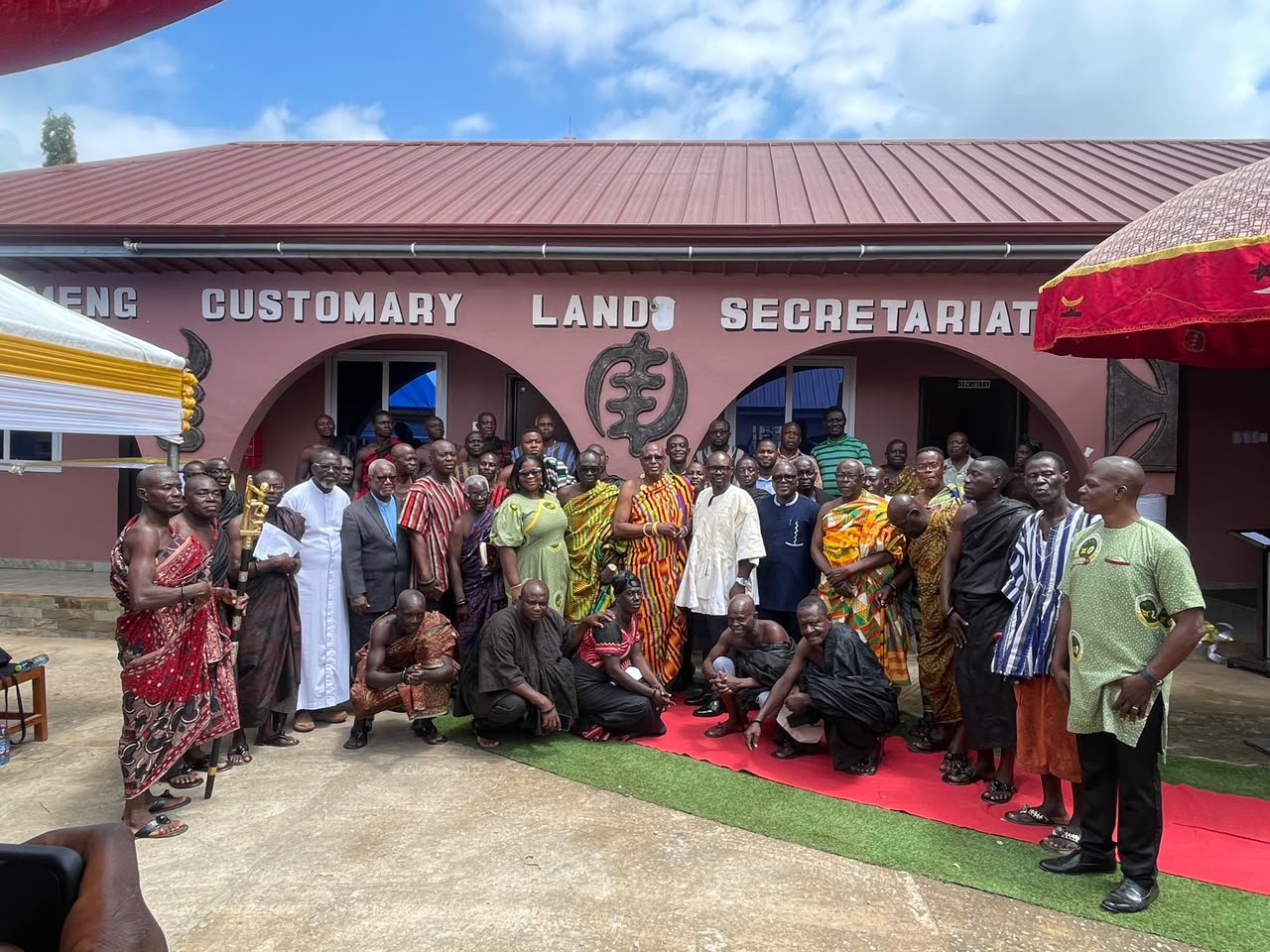

The Sunyani Traditional Area in the Bono Region and Kwahu Obomeng in the Eastern Region has inaugurated Customary Land Secretariats to promote efficient, transparent and accountable administration of customary lands.
The establishment of the two secretariats forms part of the government’s efforts, through the Office of the Administrator of Stool Lands (OASL), to strengthen customary land administration and improve land governance across the country.
Speaking at the inauguration ceremonies, the Administrator of Stool Lands, Mr. Gad Asorwoe Akwensivie, commended the traditional authorities of Sunyani and Kwahu Obomeng for taking steps to establish the secretariats.
He said the initiative demonstrated the commitment of the traditional authorities to responsible land administration and their willingness to integrate customary practices with modern systems.
«“It reflects a deep sense of responsibility towards your people. It also demonstrates your belief that customary land practices can co-exist with modern systems of land administration,” Mr. Akwensivie said.»
According to him, land remains a critical resource for national development, but poor management of the resource could undermine development and trigger conflicts.
“Land is a very powerful tool for national development if very well managed; but could retard national development and become a source of conflicts when mis-managed,” he stated.
Mr. Akwensivie noted that the fact that about 80 percent of land in Ghana is held under customary ownership placed a significant responsibility on traditional leaders to ensure that such lands were managed in the interest of both present and future generations.
Secretariats to improve land records
The Administrator said the Customary Land Secretariats would play an important role in improving land administration at the community level.
He explained that the secretariats would serve as reliable repositories for land records, document land rights, record land transactions and provide accurate and accessible information to the public, particularly investors.
According to him, the initiative would help reduce land disputes, enhance tenure security and promote orderly planning and use of land.
“The Customary Land Secretariats would serve as a reliable repository of land records, help to document land rights, record land transactions in the area, and provide accurate and accessible information to the public, particularly investors,” he said.
Mr. Akwensivie disclosed that there were currently about 100 Customary Land Secretariats in different parts of Ghana, helping to strengthen collaboration between traditional authorities and state institutions involved in land administration.
These institutions include the Office of the Administrator of Stool Lands, the Lands Commission, the Land Use and Spatial Planning Authority (LUSPA), the National Development Planning Authority and land-based non-governmental organisations.
Call for integrity and accountability
Mr. Akwensivie stressed that the effective management of the secretariats was critical to fostering cordial working relationships among stakeholders in land administration within the various communities.
He therefore urged staff of the secretariats and members of the Land Management Committees to uphold integrity, professionalism and accountability in the discharge of their duties.
“The trust of the people should be earned and maintained,” he emphasised.
He also encouraged residents of Sunyani and Kwahu Obomeng to support the operations of the new secretariats by making use of their services.
He said a well-functioning Customary Land Secretariat was a shared responsibility between traditional authorities and their subjects.
Government pledges continued support
Mr. Akwensivie said the government remained committed to supporting initiatives aimed at improving customary land administration.